Millions of Eye Drop Bottles Recalled Over Sterility Concerns at California Manufacturer
More than 3.1 million store-brand eye drop bottles made by Pomona's K.C. Pharmaceuticals were recalled after the FDA found the company couldn't guarantee sterility.

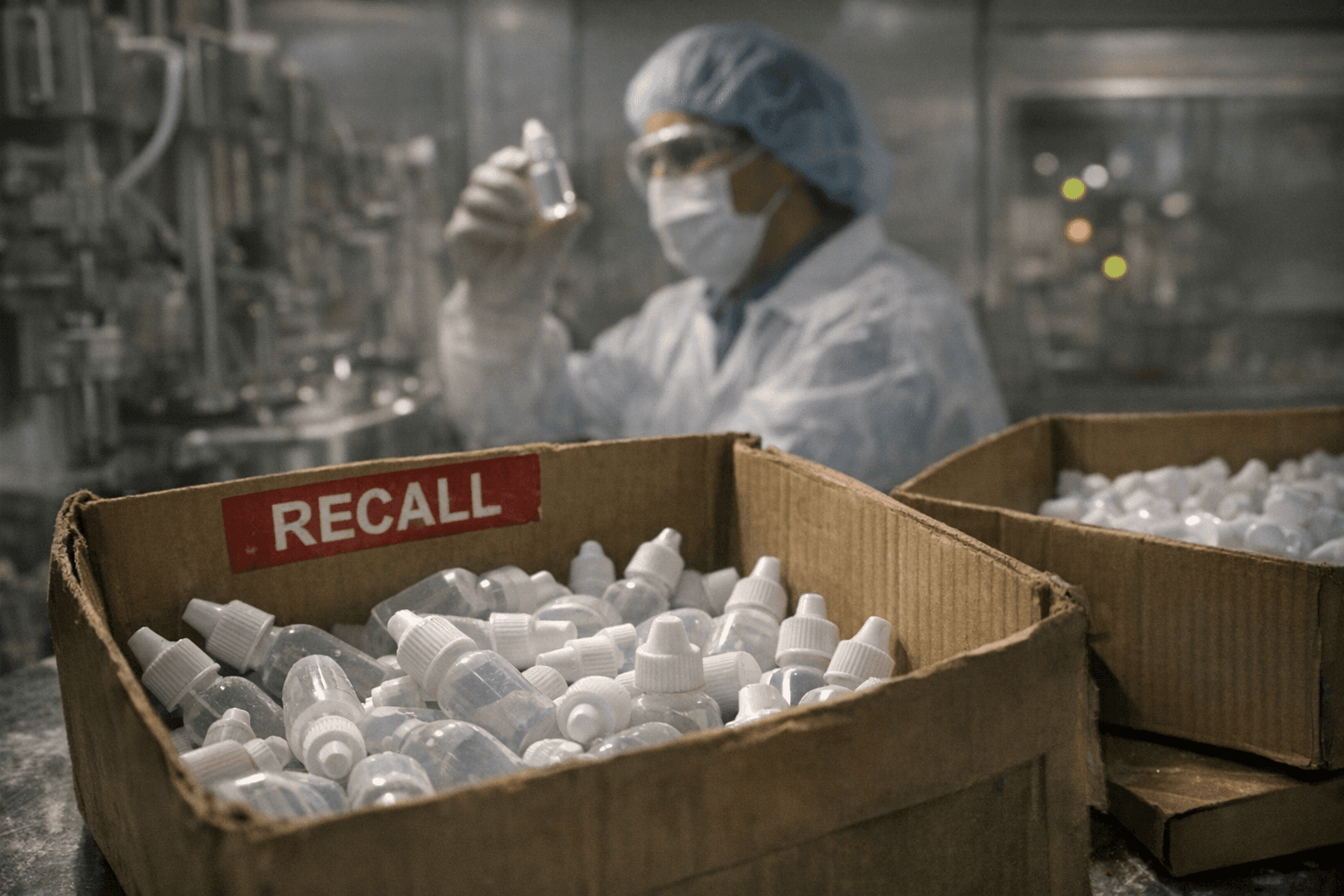
K.C. Pharmaceuticals, a Pomona, California manufacturer that supplies private-label eye drops to dozens of national retailers, recalled exactly 3,111,072 bottles of over-the-counter eye drop products after federal regulators determined the company could not guarantee its products were free of infection-causing microbes. The FDA disclosed the action on March 31, having classified it as a Class II recall, meaning use of the affected products "may cause temporary or medically reversible adverse health consequences, or where the probability of serious adverse health consequences is remote."
The recall spans 26 retail labels, reaching consumers through pharmacy chains CVS and Walgreens, grocery retailers Kroger and H-E-B, and wholesale distributors Cardinal Health and McKesson. Military exchanges and institutional buyers were notified separately through Defense Logistics Agency channels. The affected product types include Artificial Tears, Advanced Relief, and Redness Lubricant drops, as well as Sterile Eye Drops AC containing tetrahydrozoline HCl 0.05% and zinc sulfate 0.25%. Most implicated lots carry expiration dates extending into May or October 2026, meaning bottles still on medicine shelves or in bathroom cabinets across the country are likely affected. Store-brand labels from Best Choice, QC-Quality Choice, Good Sense, CareOne, Equaline, TopCare, Meijer, and Discount Drug Mart are among those included.
The stated reason is a "lack of assurance of sterility," a regulatory term meaning K.C. Pharmaceuticals could not demonstrate its aseptic manufacturing lines reliably prevented contamination. The FDA has not confirmed that any specific bottles were found to contain harmful microbes, only that the safety standards required to ensure sterility were not met. That distinction matters for risk assessment but not for consumer action: sterility failures in eye drops can introduce bacteria or fungi directly onto the ocular surface, where infections can cause serious, in some cases vision-threatening, damage.
The problems at K.C. Pharmaceuticals' facility were not new at the time of this recall. Following a January and February 2023 inspection of the Pomona plant, the FDA issued a warning letter in August 2023 that cited, by name, that the company's "aseptic processing operation is inadequately designed to prevent contamination of your ophthalmic drug products." The letter described failures to conduct smoke studies under dynamic conditions, uninvestigated media fill study failures dating to 2020 and 2021, inadequate monitoring of differential pressures in the aseptic facility, and incomplete cleaning and validation procedures. The recall, initiated on March 3, 2026, and classified by the FDA on March 31, came nearly three years after those findings were formally documented.
Check the lot code and expiration date on any eye drop bottle purchased at the stores listed above. The full lot-code list is published on the FDA's recall database at fda.gov. Affected product should be returned to the place of purchase for a refund or discarded. Do not continue use. Anyone who has already used the product and develops eye irritation, redness, pain, discharge, or blurred vision should contact a healthcare provider promptly. Adverse events can be reported to the FDA's MedWatch program at 1-800-FDA-1088 or through the MedWatch portal at fda.gov/safety/medwatch.
The scale of this recall reflects how concentrated private-label ophthalmic manufacturing has become: one Pomona facility's quality failures produced a supply disruption felt simultaneously at military bases, national grocery chains, and independently branded pharmacy products. The 2023 warning letter gave public notice that structural deficiencies existed at this plant. The recall of more than three million units in 2026 is the downstream consequence of those deficiencies going unresolved.
Sources:
Know something we missed? Have a correction or additional information?
Submit a Tip