MSD Veterinary Manual Updates Parrot Nutrition and Clinical Pet Bird Management
MSD Veterinary Manual, modified Sept 2024, links blunted choanal papilla to vitamin A deficiency and outlines IV and intraosseous catheter techniques, noting IO preference for longterm fluid therapy.
The MSD (Merck) Veterinary Manual’s professional pages on parrot care, reviewed Sept 2021 and modified Sept 2024 by Sharman M. Hoppes, DVM, DABVP (Avian) of Texas Avian & Exotic Hospital, foreground clinical signs that map directly to nutrition and husbandry problems. The entry, labeled v3304962 and organized under headings such as History, Physical Examination, Routine Grooming Procedures, Clinical Pathology, Routine Medical Procedures, and Nutrition, draws a straight line from what clinicians see in an exam to likely underlying causes.
The manual’s physical exam checklist is concrete and prescriptive: "The ears, eyes, nares, and oral cavity should all be examined and appear clean, with no exudate, masses, or swellings." It names the choana specifically and details papilla appearance: "The choana on the roof of the oral cavity should have intact sharp papilla. Blunted choanal papilla can be a sign of vitamin A deficiency." That single clinical sign gives owners and clinicians a measurable cue—papilla sharpness—to consider dietary vitamin A as part of a diagnostic workup.
Other exam findings tie into disease and behavior. The manual warns that "Exudate around the nares can indicate respiratory or sinus infection, and debris on the feathers of the head or face can indicate vomiting or regurgitation." It asks examiners to note feather and skin condition and the beak and nails in equal measure: "The condition of the feathers and skin should be noted, including the symmetry and integrity of the beak and nails. Overgrown beak and nails can indicate poor husbandry or nutrition, or liver disease." Foot health is addressed as well: "The integument of the feet should be intact, without excessive wear, callus, or ulceration." The supplied excerpt also records that "Excessive wear of the plantar surface of the feet can indicate inadequate perching or poor" in a passage that continues in the full professional entry.
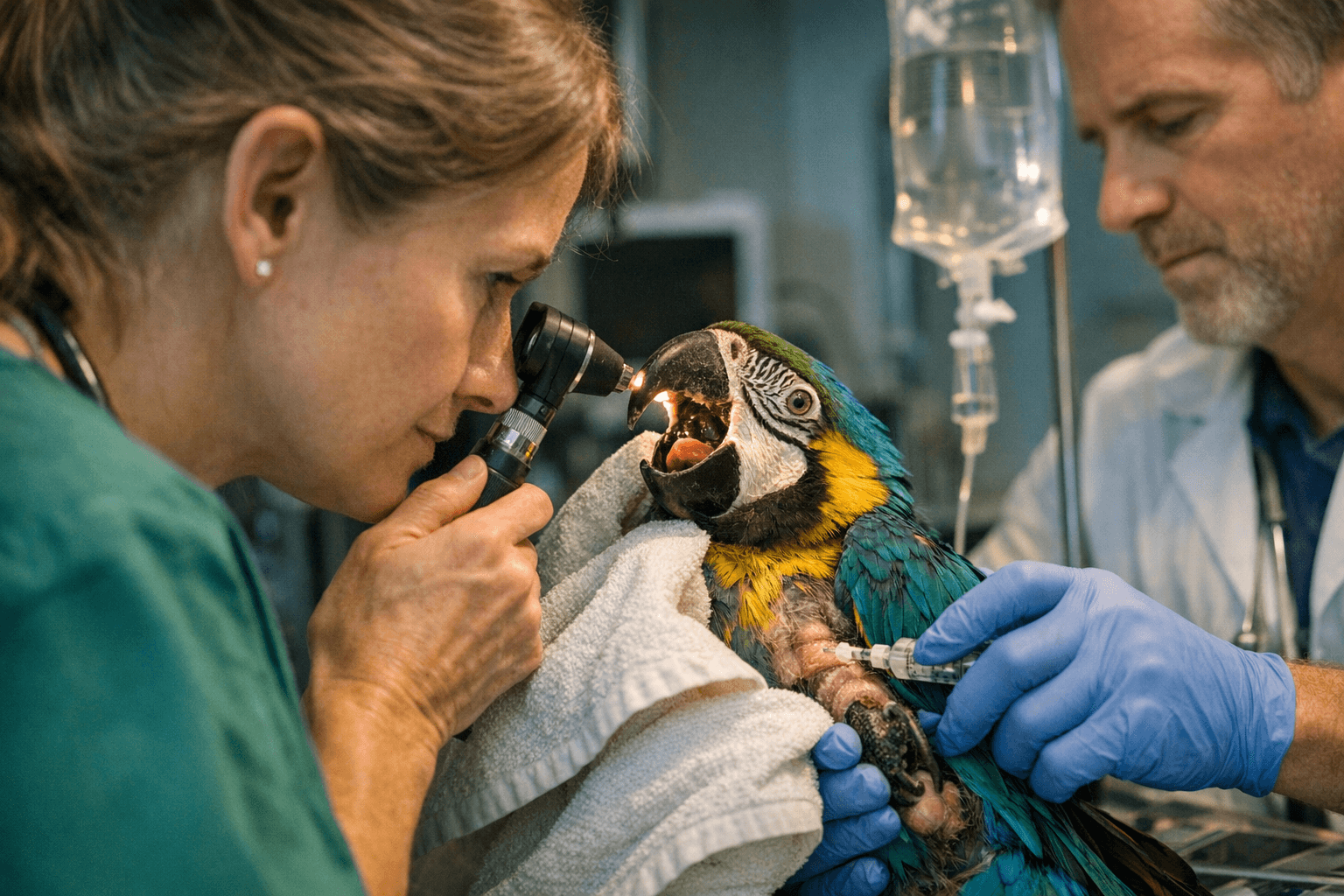
Practical vascular-access guidance is spelled out with sites, tools, and technique. "Indwelling catheters can be placed in the jugular, basilic, or medial metatarsal veins for constant-rate infusions or intermittent fluid administration. Intraosseous (IO) catheters can also be inserted, generally in the proximal tibiotarsal bone or distal ulna." The manual gives needle-size options and a warning about bone plugs: "A standard hypodermic needle may be used (usually 25-gauge for initial entry, followed by a second 22-gauge needle sutured in place), or a spinal needle with stylet may be used for large birds. Without a stylet or second needle, a bone plug may obstruct the needle." It also prescribes maintenance: "The IO or IV catheter is intermittently flushed with warm saline whenever fluids are not being infused." The entry concludes that "Maintaining an IV catheter in an avian patient can be challenging, and IO catheters are often preferable for longterm fluid therapy," with the supplied excerpt trailing into a continuation beginning "However, fluid therapy via IO."
The MSD Manual professional pages function as a veterinarian-focused reference linking bedside observations to nutrition and procedural choices. With author Sharman M. Hoppes’ credentials and the Sept 2021 review and Sept 2024 modification dates, the entry signals the sort of clinical detail clinicians and informed parrot owners rely on when assessing vitamin deficiencies, respiratory signs, beak and nail overgrowth, foot wear, and choices about IV versus IO fluid access. Expect clinicians at avian practices to lean on these specific exam findings and the manual’s catheter guidance when making diagnostic and emergency care decisions.
Know something we missed? Have a correction or additional information?
Submit a Tip