Museums Confront Human Remains Collected to Support Debunked Race Theories
Nineteen skulls of Black Americans held in a German university for 150 years were buried in New Orleans in 2025, forcing a global reckoning over museum collections built to justify debunked race theories.
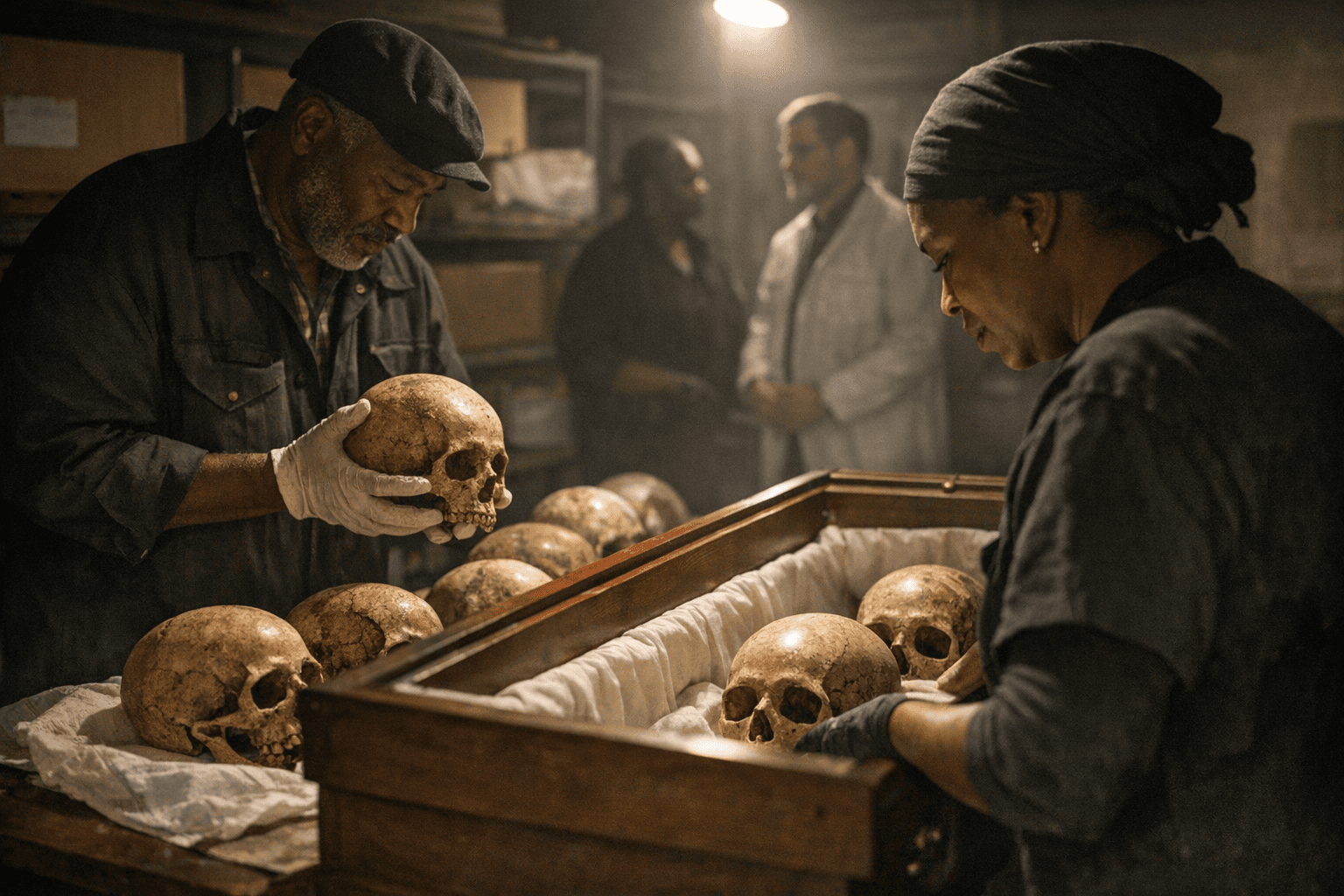
<cite index="2-2">In May 2025, many welcomed the news of 19 skulls of African Americans, taken in the 1870s from a New Orleans hospital for the purposes of "racial science," being returned by the University of Leipzig to Louisiana. On May 31, those remains were honored with a jazz funeral and interred, concluding a case that began when a New Orleans physician provided the skulls to a German researcher engaged in phrenological studies, the debunked belief that a person's skull could determine innate racial characteristics. The remains were returned after the University of Leipzig, in 2023, contacted the city archeologist in New Orleans, acknowledging the skulls had been acquired in a "colonial context and unethically."
The ceremony was celebrated. It also revealed the scale of what remains unresolved. Even today, tens of thousands of ancestral human remains are stored or displayed in German museum archives, universities, and private collections, denied their right to dignity while their descendants' right to mourn is disregarded. Most were gathered during the 19th and early 20th centuries to support theories of racial hierarchy that those same institutions now formally repudiate.
Germany's new 2025 guidelines promote dialogue with societies of origin and descendants, interdisciplinary provenance research, and proactive roles for museums, while acknowledging the cultural, spiritual, and epistemological singularities of each case. But the framework drew criticism for one embedded condition: it requires the consent of the state of origin and expands communication channels for restitution requests in ways that notably route authority through national governments. Critics argue that requirement sidelines descendant communities in favor of diplomatic channels. Germany still has no national laws on repatriation.
Pressure to close that gap has been building across Europe. France signed a law specifically governing human remains on December 26. A March 2025 report said museums and cultural institutions should stop displaying African ancestral remains and should remove conditions requiring claims to be made through national governments rather than communities. Within institutions, directors and trustees who don't understand repatriation are creating delays and pushback; these are usually the decision-makers, and they need to be better informed.
In the United States, the reckoning has concentrated on specific collections with documented ties to scientific racism. The University of Pennsylvania Museum of Archaeology and Anthropology announced the repatriation and reburial of the remains of Black Philadelphians within the Samuel G. Morton Cranial Collection, based on recommendations from the Morton Collection Committee. Morton, a 19th-century Philadelphia physician, used skull measurements to rank races hierarchically, and his collection became one of the canonical data sets of that pseudoscience. Following a public commemoration ceremony led by interfaith spiritual leaders, a permanent memorial plaque was unveiled in Harrison Garden on June 19, 2025, honoring those whose remains had been unethically collected.
Philadelphia's Mütter Museum holds approximately 6,500 human remains and announced an updated policy in August 2025. About 50 of its specimens are thought to be of Native American people, and since April 2024, nine remains have been repatriated to two tribes and one Native Hawaiian group. Senior director of collections and research Erin McLeary acknowledged that many holdings were "obtained in unacceptable circumstances including through force or duress" and may have been displayed in ways now recognized as examples of scientific racism. In the first months of 2025, the Mütter sent 101 consultation invitations to Native nations as part of a formal review process the museum called Postmortem: Mütter Museum.
What distinguished the Leipzig repatriation was its mechanism: the university did not wait for legislation or formal diplomatic process. It contacted the community, acknowledged the origin of the collection, and returned the remains. For institutions still holding thousands of skulls gathered in the name of race science, that model, treating accountability as non-negotiable rather than aspirational, is now the standard against which every delayed, bureaucratically stalled, or quietly shelved repatriation case will be judged.
This article was produced by Prism’s automated news system from verified source data, official records, and press releases, then run through automated quality and moderation checks before publishing. The system is built and supervised by the people who set the standards it runs under. Read our full AI policy.
Did this article answer your question?


