Myanmar Junta Chief Min Aung Hlaing Nominates Himself as President
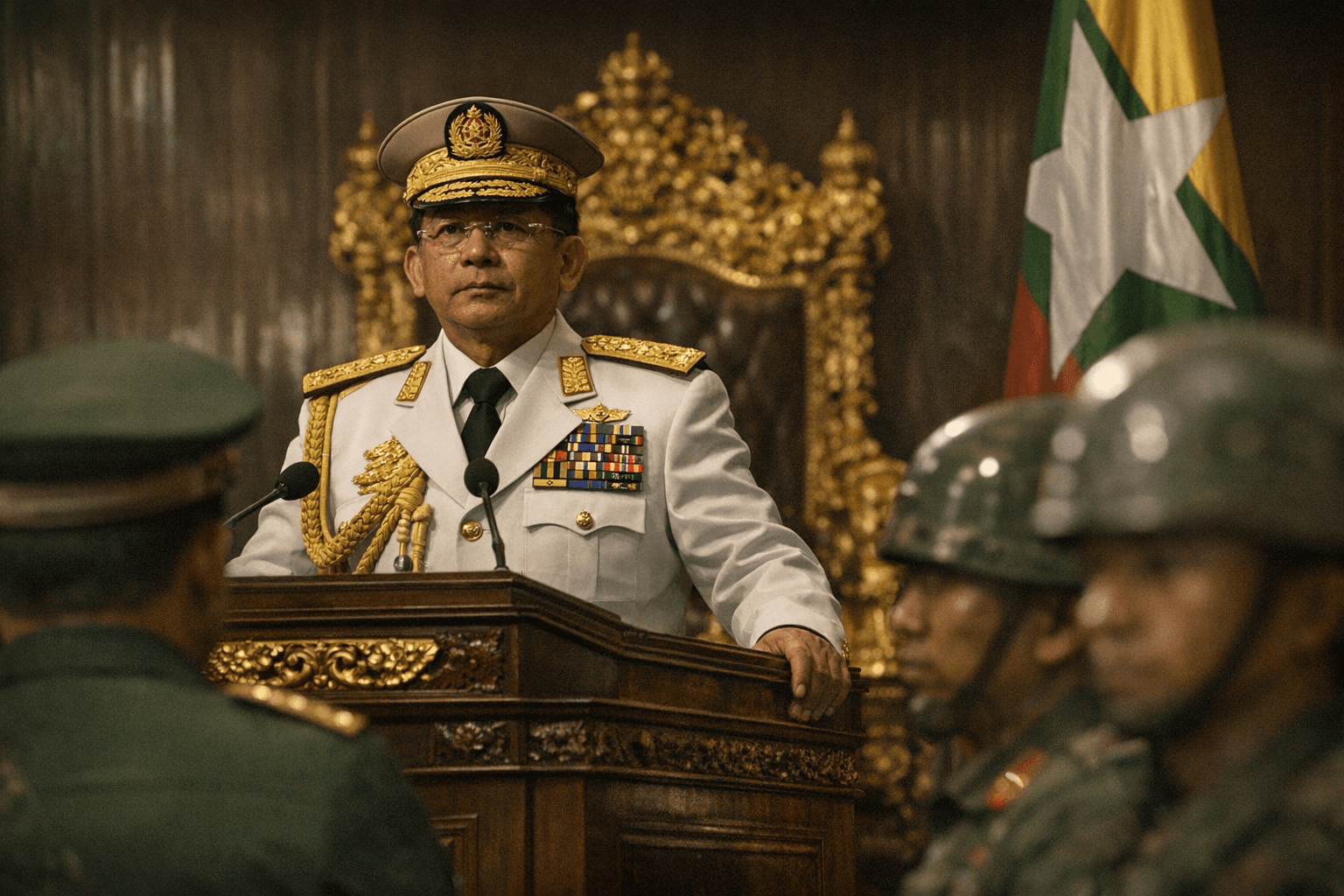
Myanmar's junta chief nominated himself president while a civil war he started has killed over 90,000 people and displaced 3.7 million.
He told Myanmar he would hand over power. Then he nominated himself to receive it.
On New Year's Day, Senior General Min Aung Hlaing stood before cameras and described a "second chapter" for the country. "We will hand over power to the government that emerges after the election and continue to work hard to ensure that the second chapter is successful," he said. By late March, state-run MRTV had broadcast an announcement transferring responsibility for national defense and security from acting President Myint Swe to Min Aung Hlaing himself, following state media reports that Myint Swe was undergoing medical treatment. Lawmakers were scheduled to begin selecting a new president as early as last week.
Min Aung Hlaing is chairman of the State Administration Council, the formal name of the military junta that seized power in 2021, arresting democratically elected de facto leader Aung San Suu Kyi and President Win Myint on charges rights groups described as politically motivated. Myint Swe, who held the post of first vice president before the coup, advanced to the presidency after those arrests. His illness now clears the path for the man who engineered those arrests to claim the office they vacated.
The constitutional mechanics are pointed. Myanmar's constitution bars a president from serving concurrently as commander-in-chief, meaning Min Aung Hlaing would formally relinquish his military post, which he has held since 2011. Foreign Minister Than Swe has already informed his Thai counterpart, Sihasak Phuangketkeow, that a new commander-in-chief will replace him. Deputy Commander Soe Win, whose comments at an official dinner on March 27 signaled that leadership changes in the armed forces were expected after the Armed Forces Day parade, is emerging as a central figure in the junta's relationship with Beijing. Chief of the General Staff General Kyaw Swar Lin, long considered Min Aung Hlaing's heir apparent, is also expected to gain a prominent command role.
What does not change is control. The same week final election results confirmed the military-backed Union Solidarity and Development Party had won more than 44 percent of the nationwide vote, Min Aung Hlaing signed a law authorizing a new Union Consultative Council with broad powers, a body analysts say could allow him to retain effective authority over the regime even after formally stepping down from military command. The constitution already guarantees 25 percent of parliamentary seats to the military, and major opposition parties were excluded from the election entirely. Observers described the vote as orchestrated to block opposition candidates.
Min Aung Hlaing told Russian Security Council Secretary Sergey Shoigu, during a January meeting in Naypyitaw, that parliament would convene in the third week of March to elect a new president; the new government is expected to take office in April. He also claimed that agreement had been reached on 43 points during peace talks aimed at amending the 2008 constitution, though he did not specify which parties were involved in those discussions.
The Union Solidarity and Development Party captured 68 seats in the 83 townships for which first-phase election results were announced. State-run Myanma Alinn reported that more than 13 million voters, about 54 percent of the 24 million eligible, cast ballots. The first phase began on December 28, 2025, across 102 townships; the junta urged citizens to participate in remaining voting rounds while simultaneously admitting it was unable to conduct the election across the entire country.
The civilian transition frames a war that shows no sign of ending. ACLED estimates more than 90,000 people have been killed on all sides since 2021. The United Nations counts more than 3.7 million displaced. About half the country lives in poverty, and last year recorded the highest number of military air and drone strikes since the coup. In some regions, opposition forces have junta troops encircled; armed groups have announced their intention to intensify operations. Those living under junta control face rising prices, electricity shortages, and widespread unemployment, conditions Min Aung Hlaing's New Year's address papered over when he claimed foreign investment had increased in 2025.
Aung San Suu Kyi, whose government Min Aung Hlaing overthrew four years ago, remains in military detention. Her son has reported her health is worsening.
The state of emergency that has provided the junta's legal scaffolding expires on July 31. The 11-member National Defense and Security Council must decide whether to renew it for another six months, and under Myanmar's law, the acting president must approve any renewal. That role now belongs to Min Aung Hlaing.
This article was produced by Prism’s automated news system from verified source data, official records, and press releases, then run through automated quality and moderation checks before publishing. The system is built and supervised by the people who set the standards it runs under. Read our full AI policy.
Did this article answer your question?


