NASA Artemis II Launches, Sending Crew Beyond Earth Orbit for First Time in 50 Years
Artemis II launched Wednesday carrying four astronauts beyond Earth orbit for the first time in 53 years, with the most diverse crew ever bound for the Moon.
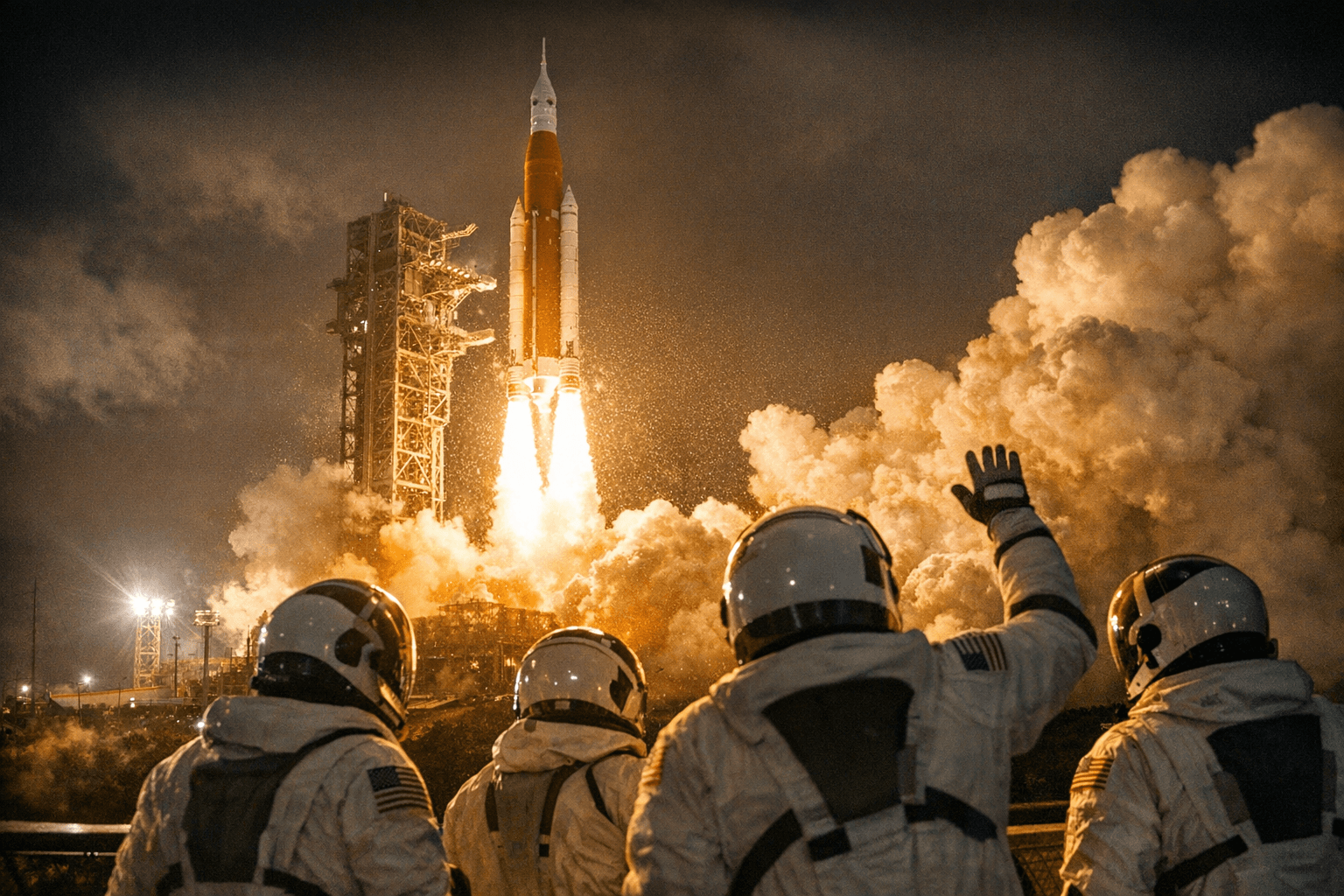
The 322-foot Space Launch System rocket lifted off from Launch Complex 39B at Kennedy Space Center at 6:35 p.m. EDT Wednesday, carrying four astronauts beyond low Earth orbit for the first time since Apollo 17 in December 1972. An estimated 400,000 spectators packed Florida's Space Coast to watch the orange-and-white rocket climb into the evening sky, and heard just before ignition the exchange that brought many of them close to tears: Mission Control's "Godspeed, Artemis II," answered by Commander Reid Wiseman's "We go for all humanity."
Minutes after liftoff, Wiseman radioed Mission Control: "We have a beautiful moonrise. We're headed right at it."
NASA Administrator Jared Isaacman confirmed the crew were "safe, secure, and in great spirits." They represent the most diverse group ever assembled for a mission beyond Earth orbit: Wiseman, a former NASA chief astronaut and U.S. Navy test pilot with 165 logged days in space; Victor Glover, the first Black astronaut ever assigned to a lunar mission, a former U.S. Navy captain who flew F/A-18 Hornet combat missions; Christina Koch, the first woman to travel beyond low Earth orbit; and Jeremy Hansen, 50, of London, Ontario, the first non-American and first Canadian to travel toward the Moon. Before launch, Glover described the mission's significance plainly: "It's the story of humanity, not Black history, not women's history, but that it becomes human history."
The 10-day mission is a lunar flyby, not a landing, and that distinction carries enormous weight for what comes next. After launch, the crew orbited Earth twice to verify Orion's life support and onboard systems. The Interim Cryogenic Propulsion Stage fired approximately 50 minutes after liftoff, setting Orion on a four-day transit to the Moon. At closest approach, the crew will pass roughly 8,000 kilometers from the lunar surface on a free-return trajectory, meaning lunar gravity will arc the spacecraft back toward Earth without requiring a major propulsion burn, before splashing down in the Pacific Ocean.
In the process, the four astronauts are expected to shatter the record for the farthest distance any human has traveled from Earth, surpassing 400,000 kilometers, or approximately 252,000 miles. The previous mark, 248,655 miles, has stood since Apollo 13 in April 1970.
Every system aboard Orion now faces its first sustained test with crew aboard. Life support, thermal management, and propulsion all carry pass-fail consequences for Artemis III, the planned first crewed Moon landing since December 1972. The Orion capsule's service module was built by the European Space Agency under a partnership signed in January 2013, and its performance over the next 10 days is as consequential for ESA's role in future flights as it is for NASA's. No Artemis III timeline is confirmed until Artemis II's data is fully analyzed.
The night before launch, Jeremy Hansen's son Devon addressed a Canadian Space Agency reception with words that seemed to speak for a wider audience: "To Earth, he's a pioneer and an explorer."
With Artemis II underway, the question of whether humans will walk on the Moon again is no longer a matter of program aspiration. It now depends on what four astronauts prove over the next 10 days.
Sources:
Know something we missed? Have a correction or additional information?
Submit a Tip