NASA awards Blue Origin and rivals moon base contracts worth millions
NASA is paying Blue Origin, Astrolab, Lunar Outpost and Firefly to build the freight and mobility layer of a moon base, starting with landers, rovers and drone carriers.

NASA announced new contracts worth hundreds of millions of dollars to Blue Origin and rivals as it began the first phase of Moon Base, a long-term lunar plan built around sustained activity at the lunar South Pole. The agency rolled out the awards at NASA Headquarters in Washington, D.C., and framed them as the opening pieces of an infrastructure push rather than a single flagship landing.
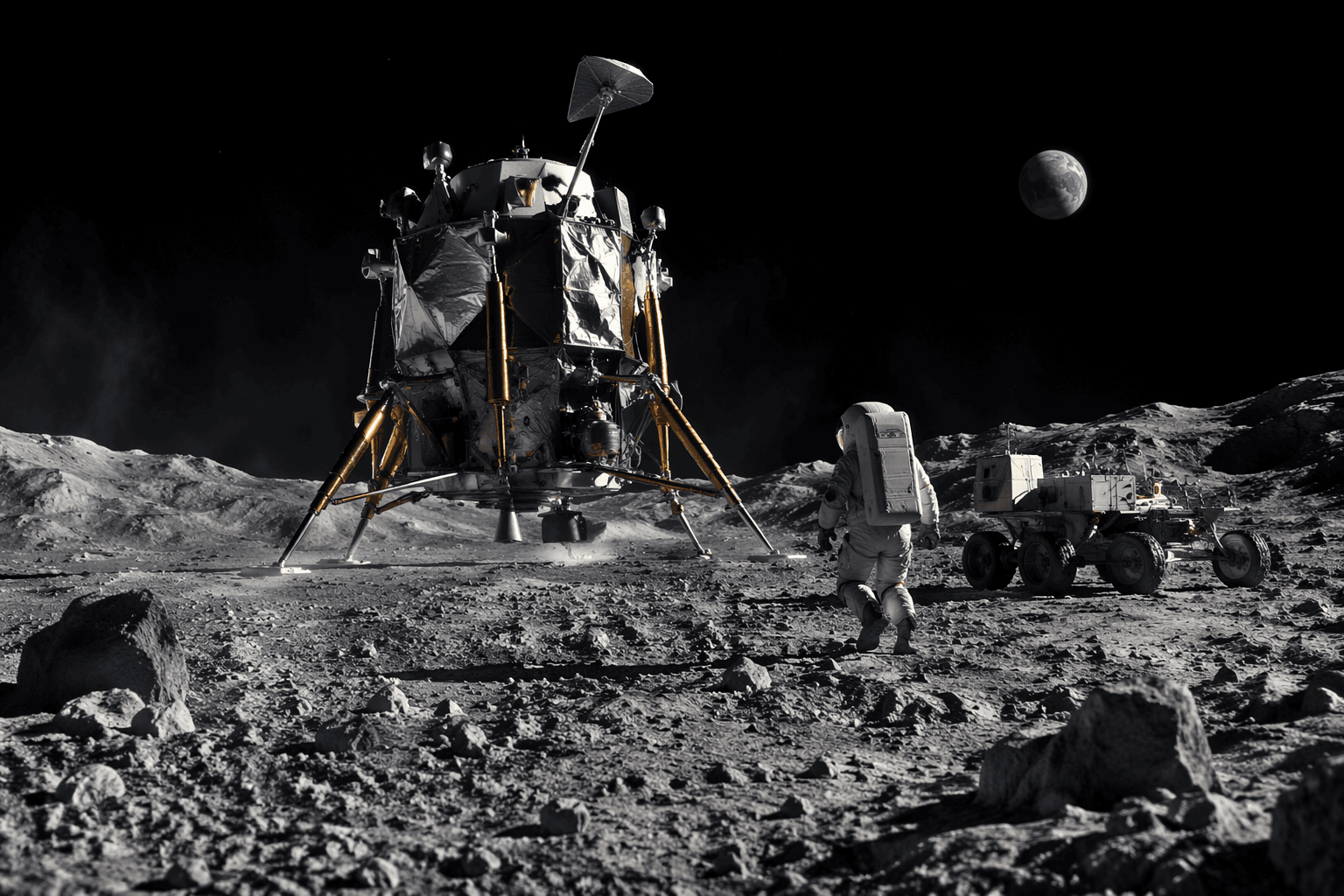
Jared Isaacman, NASA's administrator, called Moon Base "America's and humanity's first outpost on another celestial world," but the hardware tells the larger story. NASA said the initiative is designed to enable sustained human presence and expanded scientific and commercial activity at the South Pole, with the first phase centered on cargo landers, two lunar terrain vehicles and a carrier spacecraft for robotic drones. In practical terms, the landers move freight to the surface, the rovers extend mobility across difficult terrain, and the drone carrier broadens reach into places wheels and boots cannot easily go.
The first three missions are meant to start that build-out. Moon Base I is targeted for launch no earlier than fall 2026 on Blue Origin's Blue Moon Mark 1 Endurance lander, carrying NASA's Stereo Cameras for Lunar Plume-Surface Studies and Laser Retroreflective Array to the Shackleton Connecting Ridge. NASA said that work is intended to reduce risk for future crewed Artemis landings in 2028. Moon Base II is planned for later in 2026 and will deliver more than 1,100 pounds of cargo on Astrobotic's Griffin lander, including Astrolab's FLIP rover, to mature mobility systems for future lunar terrain vehicle operations. Moon Base III is also targeted for 2026 and will fly the first payload selected through NASA's Payloads and Research Investigations on the Surface of the Moon program.
The awards sit on top of a broader procurement strategy that is steadily turning lunar exploration into a supply chain. NASA said the Moon Base architecture could involve up to 25 missions by 2029, including 21 lunar landings, and deliver about four metric tons of cargo while adding the first transportation systems for astronauts and scalable power, logistics, communications and navigation. That follows the April 2024 lunar terrain vehicle selection of Intuitive Machines, Lunar Outpost and Venturi Astrolab, a contract with a combined maximum potential value of $4.6 billion, and Blue Origin's $3.4 billion human landing system award from May 2023.
It also extends Commercial Lunar Payload Services, which NASA says has a cumulative maximum contract value of $2.6 billion through 2028. Firefly Aerospace's Blue Ghost Mission 1 landed on the Moon in March 2025, and Blue Ghost Mission 2 is set to carry payloads to the far side of the Moon and a communications and data relay satellite into lunar orbit. NASA's message was clear: the next lunar era is not just about reaching the Moon, but about building the industrial backbone to stay.
This article was produced by Prism’s automated news system from verified source data, official records, and press releases, then run through automated quality and moderation checks before publishing. The system is built and supervised by the people who set the standards it runs under. Read our full AI policy.
Did this article answer your question?