NASA delays Swift rescue launch after weather forces scrub
Weather scrubbed NASA’s Swift rescue launch, pushing the next try to Wednesday at 5:43 a.m. EDT as engineers race to catch a telescope sliding lower.
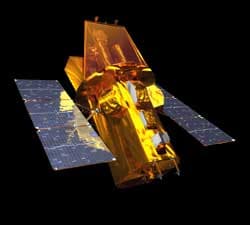
Weather scrubbed NASA’s planned June 30 launch of a rare orbital rescue for the Neil Gehrels Swift Observatory, pushing the next attempt to no earlier than Wednesday, July 1, 2026, at 5:43 a.m. EDT from Kwajalein Atoll in the Republic of the Marshall Islands. The mission is meant to reach a telescope that is still producing science but is losing altitude as Earth’s atmosphere tugs harder on the spacecraft. NASA is trying to rendezvous with Swift, grapple it and raise it back to a safer orbit over several months.
Swift, launched on Nov. 20, 2004, was renamed in 2018 for Neil Gehrels, its first principal investigator. The spacecraft studies gamma-ray bursts and other cosmic transients in visible, ultraviolet, X-ray and gamma-ray light, and it can relay burst positions to the ground within seconds.
Recent increased solar activity accelerated Swift’s orbital decay, and by early February the observatory’s average altitude had fallen below about 250 miles. On Feb. 11, 2026, NASA suspended most science operations to reduce atmospheric drag and slow the decline, then later shut down the Burst Alert Telescope and reoriented the spacecraft to preserve power and buy time for the reboost plan. NASA set a target of keeping Swift above about 185 miles, or 300 kilometers.

NASA awarded Katalyst Space Technologies of Flagstaff, Arizona, a contract in September 2025, giving the company less than a year to design, build, test and launch a spacecraft able to meet Swift, an observatory never built for docking or repair. Northrop Grumman’s Pegasus XL rocket, carried aloft by the Stargazer aircraft and dropped from about 40,000 feet, will deploy Katalyst’s LINK robotic servicing satellite.
This article was produced by Prism’s automated news system from verified source data, official records, and press releases, then run through automated quality and moderation checks before publishing. The system is built and supervised by the people who set the standards it runs under. Read our full AI policy.
Did this article answer your question?