NASA officials give update as Artemis II crew heads back to Earth
Orion cleared the lunar sphere of influence Tuesday on a free-return path to Earth, with splashdown off San Diego set for Friday after a record-shattering 252,756-mile journey.

Orion cleared the Moon's gravitational sphere of influence at 17:23 UTC Tuesday, crossing the 41,072-mile boundary on a free-return arc that NASA expects will deliver the four-member Artemis II crew to the Pacific Ocean off San Diego by 8:07 p.m. EDT on Friday, April 10.
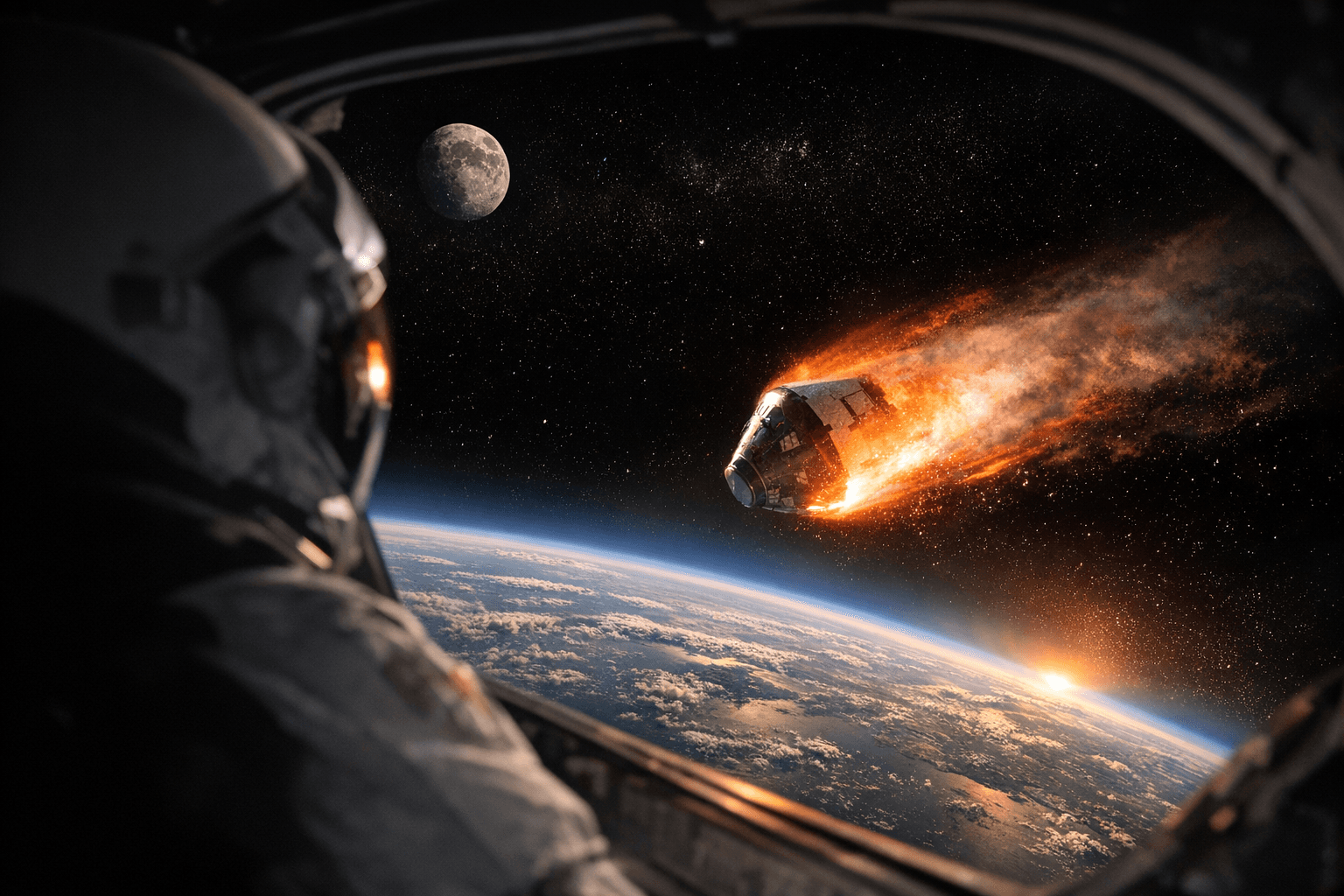
The crossing came one day after the mission's most demanding and spectacular passage: a seven-hour lunar flyby that included roughly 40 to 45 minutes of complete communications blackout as Orion passed behind the far side of the Moon, among the longest communication gaps in human spaceflight history. With that blackout behind them, NASA's attention has turned fully to re-entry, when Orion must thread a precise atmospheric corridor and validate the heat shield that is central to the spacecraft's certification for future crewed deep-space missions.
Commander Reid Wiseman, Pilot Victor Glover, and Mission Specialists Christina Koch and Jeremy Hansen began Tuesday still more than 236,000 miles from Earth, their gravitational fall home gathering pace after Monday's flyby that stretched human spaceflight records to 252,756 miles from Earth, which is 4,111 miles beyond the mark set by Apollo 13 in 1970. At closest approach, Orion came within 4,067 miles of the Moon's surface and looped an additional 4,700 miles beyond the lunar disk, both new records.
Glover described the blackout period during a call Monday night with President Donald Trump: "I said a little prayer, but then I had to keep rolling." Trump told the crew they had "made history and made all of America really proud. Incredibly proud," calling them "modern-day pioneers." NASA Administrator Jared Isaacman, coordinating the call from Houston mission control, called the launch "a defining moment for our nation and for all who believe in exploration," adding: "America is back in the business of sending astronauts to the Moon."
When Orion emerged from behind the Moon, the crew witnessed Earthrise and a solar eclipse, watching the Sun disappear behind the darkened lunar disk. Using eclipse-viewing glasses similar to those worn during the 2024 total solar eclipse that crossed the continental United States, the crew studied the solar corona and scanned the lunar surface for meteoroid flashes — scientific observations embedded directly into the flyby's geometry.
The mission carries a freight of firsts. Koch became the first woman to travel to the Moon; Hansen, representing the Canadian Space Agency, became the first Canadian; and Glover became the first Black astronaut to reach lunar distance. Wiseman, a retired U.S. Navy captain and Baltimore native who flew to the International Space Station in 2014, commands a crew whose records will not be broken until the Artemis III landing attempt, which NASA continues to target for early 2028.
For that crew, Artemis II is already paying a direct dividend. Glover noted the crew has compiled a body of operational lessons covering everything from packing protocols to hygiene management in the deep-space environment. "We've almost got a book to hand them," he said. As a test flight, Artemis II's core purpose is validating Orion's systems before NASA puts a crew on the lunar surface for the first time since Apollo 17 in December 1972, and with splashdown still three days out, the spacecraft's heat shield performance and guidance precision at re-entry will provide the final chapter of that evaluation.
Recovery helicopters will extract the crew after splashdown and transfer them to the USS John P. Murtha for initial medical evaluation before the team is flown to Johnson Space Center in Houston.
This article was produced by Prism’s automated news system from verified source data, official records, and press releases, then run through automated quality and moderation checks before publishing. The system is built and supervised by the people who set the standards it runs under. Read our full AI policy.
Did this article answer your question?