NASA orders annual moon landings, adds mission in 2027
NASA will add a 2027 Artemis mission, standardize SLS production and pursue yearly lunar surface landings, shifting contractor roles toward federal workers and tightening launch cadence.
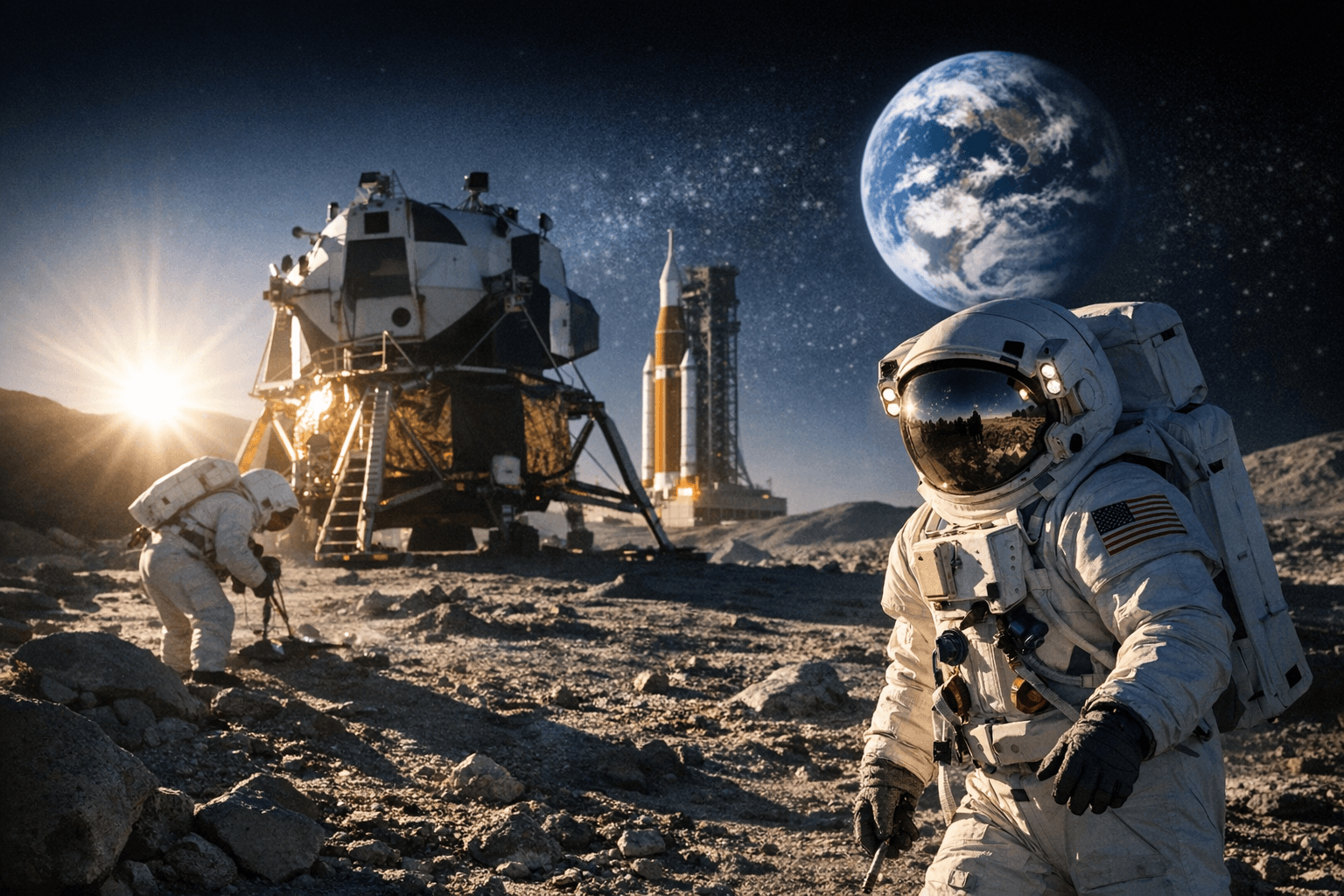
NASA Administrator Jared Isaacman announced a sweeping overhaul of the Artemis program that adds an extra mission in 2027 and charts a path toward “at least one surface landing every year thereafter,” changing both the technical and workforce approach to returning Americans to the Moon.
The agency said it will standardize the Space Launch System configuration, limit upper stage changes beginning in 2028 and press for a much faster launch cadence. Isaacman has set an internal tempo goal of launches roughly every 10 months, a dramatic acceleration from the multiyear gaps that had become the program’s norm. “No one here at NASA forgot their history books,” Isaacman said. “We shouldn’t be comfortable with the current cadence. We should be getting back to basics and doing what we know works.”
The changes come as engineers work to repair the rocket and Orion capsule after fueling tests uncovered problems. Technicians detected a leaking hydrogen line during a key fueling test and later found a blockage in helium flow to part of the booster’s upper stage, forcing the vehicle and capsule to be rolled back to the Vehicle Assembly Building for further work. NASA has not published a final launch date; engineers said repairs could allow an attempt in early April if they proceed as planned.
Program sequencing is being altered to reduce near-term risk. Under the revised plan, Artemis III, previously slated for a lunar surface attempt, will instead perform rendezvous and docking practice in low Earth orbit in 2027. That in-orbit demonstration will be followed by surface landings on later missions, with Artemis IV and V identified as candidates to carry crews to the lunar surface in 2028 and beyond using commercial landers developed by SpaceX and Blue Origin. The Aerospace Safety Advisory Panel had urged revising Artemis III “given the demanding mission goals,” and NASA officials framed the change as a safety-driven course correction.
NASA is coupling the technical shift with a major personnel and industrial strategy. An agency workforce directive will “rebuild core competencies in the civil servant workforce including more in-house and side-by-side development work with our Artemis partners,” the agency said, and St. Louis program notes indicate an explicit intent to transition some contractor roles into federal employment. Lori Glaze, acting associate administrator for Exploration Systems Development Mission Directorate, praised the move. “I’m grateful to Administrator Isaacman for taking this bold step and moving quickly to assure we have the support and resources needed to launch Artemis astronauts to the Moon every year,” she said. “Our team is up to the challenge of a successful Artemis II mission, and soon thereafter,enabling a more frequent cadence of Moon missions.”
That workforce turn has implications for communities around NASA centers. Moving work into federal jobs could change local employment patterns, wages and benefits and alter access to stable health coverage for technical staff now employed by contractors, a shift that will matter to regions that depend on space program contracts.
The schedule is still a patchwork of competing dates and contingencies. Past program notes record multiple target windows for Artemis II ranging from February to April 2026 after earlier delays tied to heat shield damage on Orion and the new fueling setbacks. NASA also reiterated its appeals to commercial partners to accelerate lander development while preserving international contributions such as ESA’s ESPRIT and Canada’s Canadarm3 on later missions.
Officials describe the plan as an attempt to marry speed with safer, more predictable operations. “This is not about slowing down momentum. This is about increasing it, about making sure that we are focused on the right things in terms of how we execute the program,” said NASA associate administrator Amit Kshatriya. The changes will test whether Congress and industry can sustain the funding, workforce and supply chain adjustments needed to translate an ambitious cadence into safe, equitable benefits for the communities and workers that build the program.
Know something we missed? Have a correction or additional information?
Submit a Tip

