NASA Veterans Share Insights on Artemis II Crew's Road to Launch
Three NASA veterans decode what the Artemis II crew is truly experiencing as humanity prepares to fly beyond Earth's orbit for the first time in over 50 years.
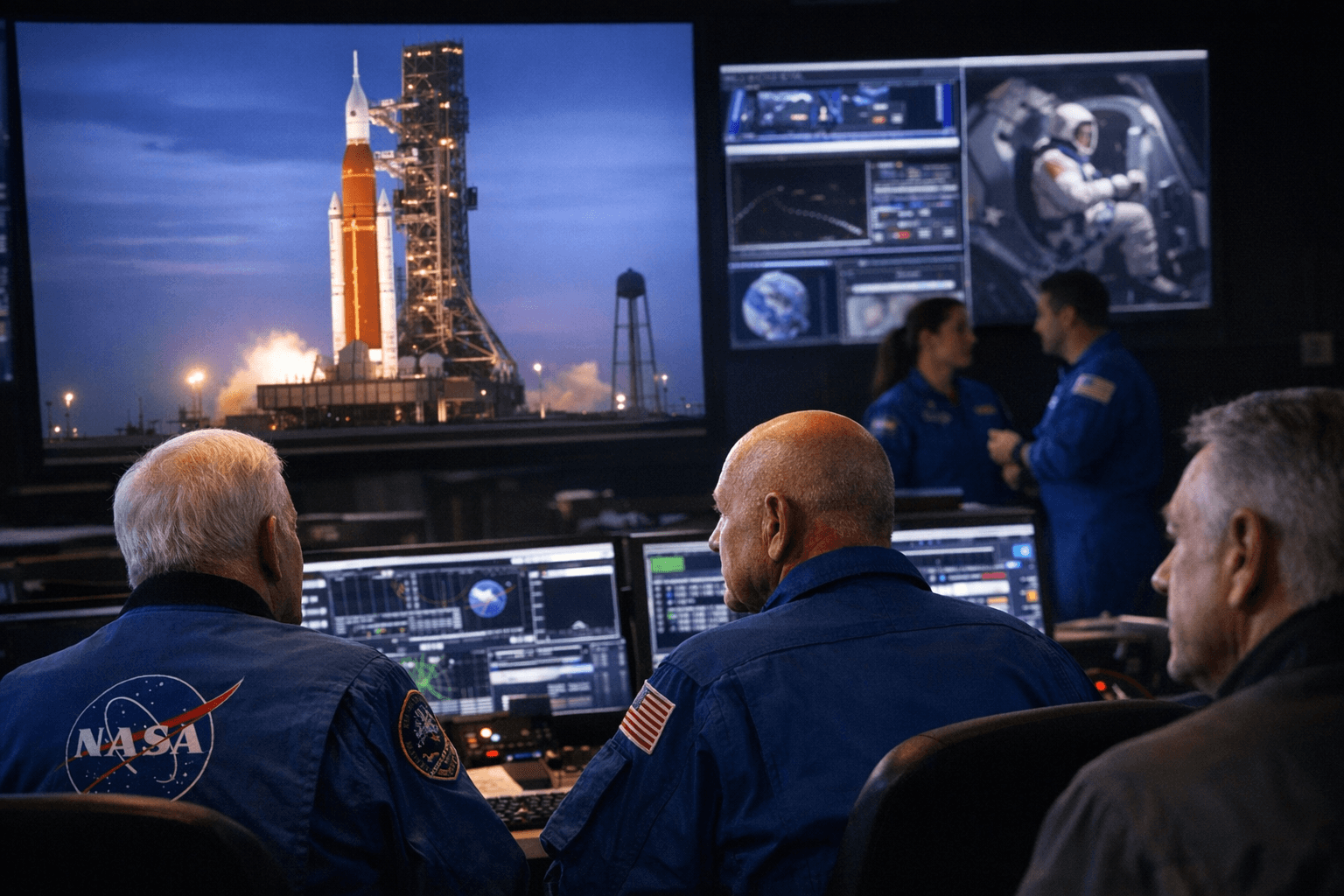
Four astronauts are strapped into an Orion spacecraft atop the most powerful rocket NASA has ever built, preparing to travel farther from Earth than any human since the final Apollo mission in 1972. To understand what that truly means, three retired NASA veterans — Mike Hopkins, Peggy Whitson, and Nick Hague — sat down with Major Garrett to share candid perspectives on the Artemis II mission and what commander Reid Wiseman, pilot Victor Glover, mission specialist Christina Koch, and Canadian Space Agency astronaut Jeremy Hansen are experiencing in the critical final stretch before liftoff.
A Historic Mission, Years in the Making
Artemis II, scheduled to lift off from Launch Complex 39B at Kennedy Space Center in Florida, is a 10-day lunar flyby that marks the first crewed mission beyond low-Earth orbit since Apollo 17 landed on the moon in December 1972. The four-person crew was formally announced in April 2023, and since that moment they have spent nearly three years training together — running through simulators, traveling internationally to build team cohesion, and learning the Orion spacecraft's systems in exhaustive detail. As the Smithsonian's National Air and Space Museum noted, they have been preparing "for the confines of the Orion spacecraft" in a pressurized volume comparable to a large SUV, for ten straight days in deep space.
The mission carries layered historic weight. Victor Glover will become the first Black person to travel to deep space. Christina Koch will be the first woman to venture to the moon, surpassing even the record-breaking career of Whitson herself, who held the title for most consecutive days in space by a woman before Koch shattered it during her 328-day ISS stay. Jeremy Hansen, the lone non-NASA crew member, will be the first Canadian and first non-U.S. astronaut to reach the lunar vicinity. "Among the crew are the first woman, first person of color, and first Canadian on a lunar mission," said Vanessa Wyche, director of NASA's Johnson Space Center.
What the Veterans Bring to the Conversation
Whitson, Hopkins, and Hague each carry hard-won knowledge about the psychological and physical demands of extended spaceflight. Whitson's NASA career stands as one of the most accomplished in the agency's history: she accumulated 695 days in space across multiple missions, served twice as International Space Station commander, and completed 10 spacewalks totaling more than 60 hours — records for a female astronaut at the time of her retirement from NASA in 2018. She later commanded two Axiom Space missions to the ISS, in 2023 and 2025, keeping her perspective on crew dynamics and mission pressure sharply current.
Hopkins flew two ISS expeditions and knows firsthand how the final days before launch sharpen both focus and nerves within a crew. Hague, who survived a harrowing Soyuz rocket abort in October 2018 before successfully flying to the ISS in 2019, brings a perspective on resilience under pressure that few astronauts can match. Together, the three veterans offer something the official NASA briefings cannot: an unvarnished account of what the countdown period actually feels like from inside.
The Crew's Final Days Before Launch
The Artemis II crew arrived at Kennedy Space Center days ahead of the April 1 liftoff window, set for no earlier than 6:24 p.m. EDT. On March 30, Wiseman, Glover, Koch, and Hansen visited Launch Complex 39B for a final walkdown of the Space Launch System rocket and Orion spacecraft — a ritual that functions as both technical verification and psychological preparation. The closeout crew later completed suit-up, hatch closure, and critical spacecraft checks before departing the White Room, leaving Orion sealed and ready for flight.
Speaking to reporters just days before launch, Wiseman projected collective confidence: "The four of us, we are ready to go. The team is ready to go. The vehicle is ready to go." Glover, reflecting on the years of sacrifice that preceded this moment, acknowledged the toll on loved ones. "Our families have been along for this entire journey, the third quarantine of this series, and all the years of training and the travel, and they're here now," he said. Hansen, making his spaceflight debut and set to become the first Canadian on a lunar mission, described the bond that formed through three years of shared training: the crew had become "like a family at this point."
What the Mission Will Actually Do
Artemis II is not a lunar landing — that comes with Artemis III, currently targeted for 2028. Instead, the crew will fly a free-return trajectory around the moon and back to Earth, covering approximately 685,000 miles. In the first two days, they will check out Orion's systems and conduct a targeting demonstration test in Earth's vicinity before beginning the three-day transit toward the moon. The crew will spend one full day observing the lunar far side — parts of which have never been seen by human eyes due to lighting conditions. Wiseman himself put the significance plainly: "We've seen it in satellite photos, but humans have never, ever seen that before. That's cool."
The mission also carries a scientific payload called AVATAR (A Virtual Astronaut Tissue Analog Response), which mimics individual astronaut organs to study the effects of deep-space radiation exposure on human biology. The journey will expose the crew to radiation levels far beyond anything encountered on the ISS, and Artemis II represents the first time AVATAR has been tested outside the International Space Station and the Van Allen Belt.
Building Toward a Permanent Lunar Presence
The broader Artemis program envisions a permanent outpost near the moon's south pole. Artemis II's primary purpose is to validate the SLS rocket and the crewed Orion spacecraft in the actual environment of deep space, confirming that all systems perform as designed with people aboard. Every anomaly identified, every data point gathered, feeds directly into the architecture for Artemis III and beyond.
Veterans like Whitson, Hopkins, and Hague understand that missions of this scale are never just about the four people in the capsule. They are about the thousands of engineers, flight controllers, and mission planners whose work converges on a single launch window, and about the generations of astronauts who will follow the trail Wiseman's crew blazes tonight. For the Artemis II crew, years of preparation collapse into a 10-day test of human endurance and engineering precision. For the veterans watching from the ground, it is the mission they trained for — carried out by the next generation.
This article was produced by Prism’s automated news system from verified source data, official records, and press releases, then run through automated quality and moderation checks before publishing. The system is built and supervised by the people who set the standards it runs under. Read our full AI policy.
Did this article answer your question?


