NASA's Artemis Moon Program Represents a $100 Billion Bet on the Agency's Future
At roughly $100 billion, NASA's Artemis program is the agency's largest wager since Apollo, with a crewed lunar flyby days away and China closing the gap.

The $100 Billion Architecture
The price tag attached to America's return to the Moon is not a single line item in a federal budget. It is an accumulation: direct NASA appropriations, contractor commitments from Boeing to SpaceX to Blue Origin, allied program spending, and decades of long-lead infrastructure development. When Bloomberg aggregated those figures across the full Artemis architecture, the total approached $100 billion, a sum that frames every decision NASA makes about human spaceflight not merely as exploration policy, but as industrial policy with consequences stretching well into the 2030s.
That architecture includes crewed lunar landings, lunar gateway modules, surface habitats, and the heavy-lift logistics required to sustain human operations beyond low-Earth orbit. The specific hardware components pulling on that budget are substantial: development of Space Launch System successors, next-generation Orion spacecraft, commercial human landing systems, and the ground and in-space infrastructure to support crews living and working on and around the Moon. The Moon, in this framing, is not the destination. It is the proving ground for Mars.
Artemis II: The Program's First Real Test
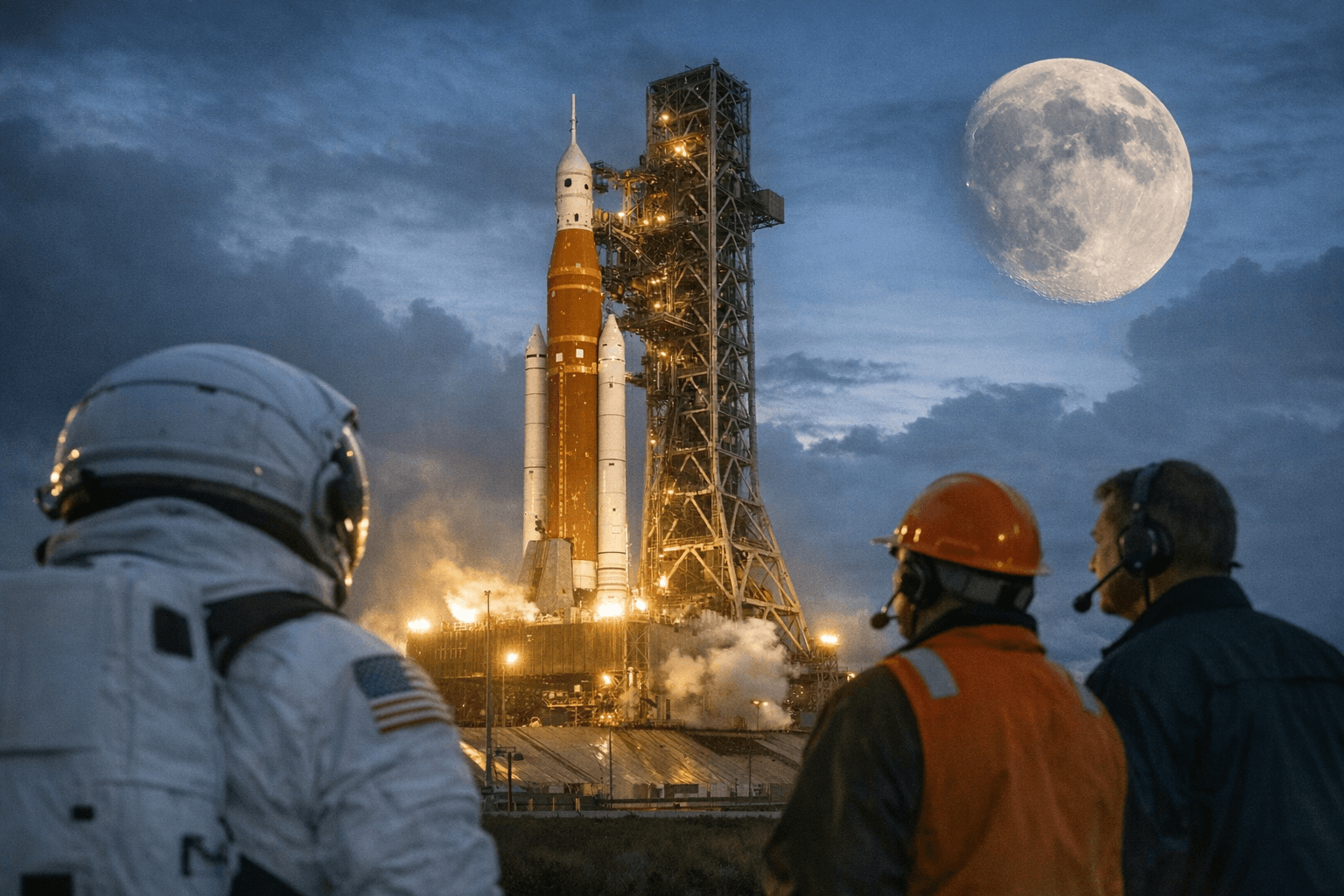
The abstract becomes concrete on April 1, 2026, when the SLS rocket is scheduled to lift off from Kennedy Space Center carrying four astronauts on the first crewed Orion flight in history. NASA astronauts Reid Wiseman, Victor Glover, and Christina Koch, joined by Canadian Space Agency astronaut Jeremy Hansen, will spend ten days on a lunar flyby, the first humans to travel beyond low-Earth orbit since Apollo 17 in 1972.
Artemis II does not land. It does not deploy hardware on the surface. But it is the mission NASA's critics and supporters alike have been watching since Artemis I's uncrewed flight in 2022. A successful crewed flyby would generate the political momentum and public legitimacy that a program of this cost and ambition urgently needs, especially as the Trump administration has pushed to retire SLS after Artemis III in favor of less expensive commercial alternatives. Congress, for its part, allocated $4.1 billion specifically for SLS rockets supporting Artemis IV and V in its most recent legislative package, signaling that the debate over the program's hardware future is far from settled.
The Commercial Bet Inside the Big Bet
A defining feature of Artemis, compared to Apollo, is the explicit transfer of major capabilities to the private sector. SpaceX was contracted to develop the initial Human Landing System for Artemis III, evolving its Starship-derived lander design to meet NASA's requirements for sustainable exploration. Blue Origin was selected as the second lander provider, contracted to demonstrate its Blue Moon lander on Artemis V, bringing increased crew capacity and longer surface mission duration.
The logic behind this approach is straightforward: public-private partnerships reduce up-front taxpayer risk and create a domestic industrial base capable of exporting capabilities internationally. If SpaceX and Blue Origin can prove out lunar lander designs on NASA contracts, those designs become the foundation for a commercial lunar economy that extends well beyond government missions.
The risk, however, is concentration. Bloomberg's analysis flagged a scenario where a small number of contractors capture critical capabilities in the absence of robust competition and regulatory oversight. Congressional oversight and contracting reforms, the analysis noted, will determine whether the $100 billion investment produces a competitive marketplace or a small group of entrenched providers with limited incentive to drive costs down. The difference between those two outcomes has enormous implications for every mission that follows Artemis.
Geopolitics at 238,000 Miles
No honest accounting of Artemis ignores China. The United States is not returning to the Moon because the science demands it alone. Agency insiders and industry executives described the program to Bloomberg as a geopolitical instrument as much as a scientific endeavor, central to maintaining American leadership in space technologies at a moment when state actors and private companies outside U.S. jurisdiction are accelerating their own programs. China has announced intentions for a crewed lunar landing before the decade ends, and its space program operates without the transparency or coalition-building that characterizes the Artemis Accords framework, which has drawn dozens of partner nations into alignment with American norms for space exploration.
The contrast matters strategically. Leadership in space, historically, has translated into leadership in satellite technology, communications infrastructure, navigation systems, and increasingly, the commercial exploitation of orbital and cislunar resources. Artemis is simultaneously a statement about where the next generation of those capabilities will be developed and governed.
The Risk Register
The Bloomberg analysis did not minimize the program's vulnerabilities. Cost overruns have been a recurring feature of Artemis since SLS's early development phases, when projected development costs ran well above initial estimates. Schedule slips have become an expectation rather than an exception: Artemis II itself was delayed multiple times before arriving at its current April 2026 launch window. The Gateway lunar station, once central to NASA's sustained presence architecture, was cancelled in 2026, a signal that even flagship program elements remain subject to political and budgetary revision.
Political cycles represent perhaps the most structural risk. Multi-decade space programs depend on bipartisan continuity across administrations with very different priorities. NASA leadership must deliver visible milestones, crewed flights, lunar surface touchdowns, and deployable infrastructure, to sustain the congressional support that keeps the funding flowing. A program that spends heavily but produces delayed or scaled-back results invites exactly the scrutiny that leads to cancellations. Apollo itself was wound down before its full scientific potential was realized.
What Hangs in the Balance
The stakes extend beyond exploration. Success for Artemis would validate a model of human spaceflight built on public-private partnership, international coalition-building, and long-range strategic investment. It would cement NASA's position as the anchor institution of the next era of human presence beyond Earth and create the industrial and technological base for missions to Mars and beyond. Failure, or a prolonged cycle of overruns and retreats, would invite retrenchment: reduced budgets, narrowed ambitions, and a transfer of initiative to other actors, state or commercial, less committed to open access and shared norms.
At $100 billion and counting, the Artemis program is the most consequential financial commitment in NASA's history since the Moon race of the 1960s. The agency has days to begin making the case that the bet was worth placing.
Know something we missed? Have a correction or additional information?
Submit a Tip

