NCAA Panel Reviews 5-for-5 Model to Simplify College Athlete Eligibility Rules
An NCAA panel reviewed the "5-for-5" eligibility model Tuesday, offering athletes a fifth playing season while stripping injury waivers, driven by a White House deadline.
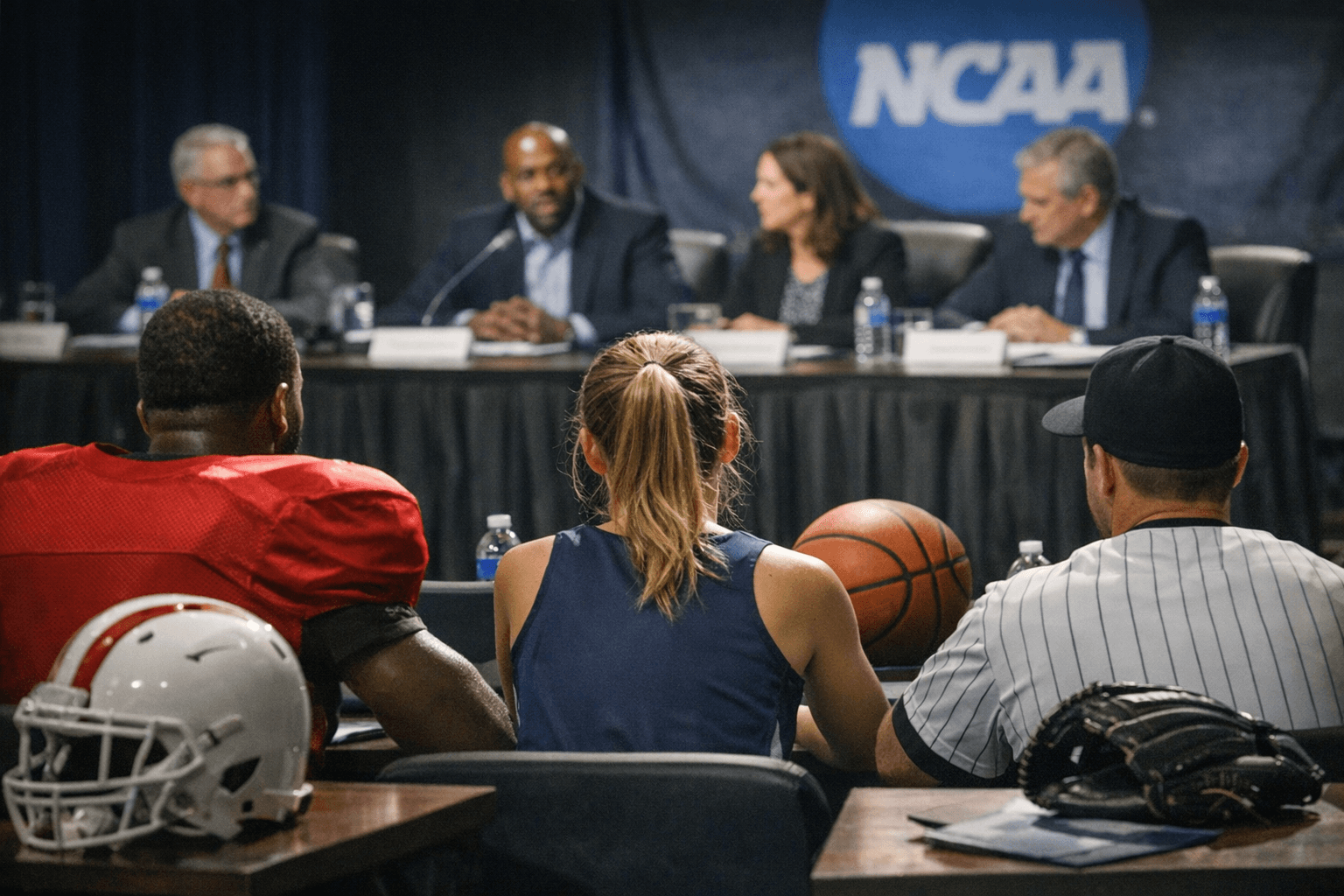
The NCAA's Division I Cabinet took up a proposal Tuesday that would grant college athletes five full playing seasons for the first time while eliminating injury extensions from the eligibility rulebook entirely, a combination that stands to benefit some athletes and significantly disadvantage others.
The framework, dubbed the "5-for-5" model, would set a five-year eligibility clock triggered by whichever comes first: a player's 19th birthday or high-school graduation. Under current NCAA rules, athletes receive four playing seasons spread across a five-year calendar window. The proposed model expands actual playing time by one full season but removes the flexibility that has historically allowed injured players, medical redshirts, and graduate transfers to extend their careers.
The proposal's narrow exceptions tell much of the story. Maternity leave, military service, and religious missions would qualify for clock extensions. Injuries would not. That exclusion falls hardest on athletes in collision sports like football, where medical redshirts have long served as both a developmental and protective tool, and on older or nontraditional students whose academic or athletic timelines don't map neatly to an age-linked trigger.
The urgency behind Tuesday's review traces directly to an executive order President Trump signed April 3, just five days before the proposal surfaced publicly. Titled "Urgent National Action to Save College Sports," the order demands the NCAA establish transfer restrictions, eligibility caps, and NIL guardrails by August 1, 2026, backed by the threat of stripping universities of federal grants and contracts. Trump's order calls specifically for "clear, consistent and fair eligibility limits, including a five-year participation window," language that maps directly to the NCAA's draft. The August deadline gives the Division I Cabinet little runway.
NCAA President Charlie Baker, speaking at the Final Four, said the administration and the association "want to get something on the books that works and represents what most people are looking for at this point, which is a much simpler eligibility process." Simplicity, though, cuts both ways. The NCAA processed 1,450 eligibility waiver requests in the last academic year alone, granting roughly two-thirds of them, a volume that has strained staff and produced unpredictable legal exposure across sports and conferences.
Those inconsistencies have landed repeatedly in federal court. Vanderbilt quarterback Diego Pavia sued the NCAA in November 2024, arguing that his junior-college years should not count against his eligibility clock. He won a preliminary injunction and played the 2024 season; the case prompted the NCAA to issue a temporary blanket waiver that has since expired. Ole Miss quarterback Trinidad Chambliss and Tennessee's Joey Aguilar have since filed similar injunction requests, creating what Baker described as an unworkable cascade: "The court system is set up to judge one case on its merits, but the decisions create precedent that the NCAA then must honor."
The 5-for-5 proposal also arrives as the transfer portal and NIL landscape have fundamentally shifted power dynamics in college athletics. Critics view the age-linked clock and tightened exceptions as an attempt to reassert institutional control over athlete movement, particularly given that Trump's order simultaneously limits players to one transfer with immediate eligibility, with a second allowed only after earning a four-year degree.
Congressional relief remains elusive. The Student Compensation and Opportunity through Rights and Endorsements Act, introduced in 2025 with support from both Trump and the NCAA, has stalled despite Sen. Ted Cruz of Texas calling college sports "in crisis." The Department of Justice has separately flagged a general consensus against new antitrust exemptions, undermining the NCAA's legislative strategy. Baker and SEC Commissioner Greg Sankey attended a White House roundtable in March 2026 to press for federal action, with Baker telling ESPN that lawmakers have begun to grasp why the association needs outside help to establish a national framework.
The Division I Cabinet did not vote on the proposal Tuesday; further deliberations are expected before any formal adoption. If approved, implementation could begin as early as fall 2026 under a phased rollout designed to shield current athletes from retroactive harm. The August 1 White House deadline now functions as the external forcing mechanism the NCAA has so far been unable to generate on its own.
This article was produced by Prism’s automated news system from verified source data, official records, and press releases, then run through automated quality and moderation checks before publishing. The system is built and supervised by the people who set the standards it runs under. Read our full AI policy.
Did this article answer your question?