Nearly one in four U.S. mid-career workers face stalled wages
Nearly 1 in 4 mid-career professionals are stuck for years with flat pay, and a stalled software developer can lose more than $43,000 over 15 years.

A five-year stall in the middle of a career can become a lasting pay cut. New research finds that 24.2% of mid-career professionals in the United States are effectively stuck, steadily employed but going years without a promotion, a meaningful raise or a clear path upward.
The analysis, which tracked 1.3 million career histories over 25 years, describes a hidden labor-market problem that does not show up in unemployment data. Mid-career was defined as roughly 10 to 15 years after a worker starts a professional career, a point when wages, retirement contributions and future opportunities are supposed to accelerate, not freeze.
The long-term cost is real. For the average stalled software developer, the financial penalty exceeds $43,000 over 15 years. That kind of wage loss does not just shrink take-home pay. It also reduces the base for future raises, trims 401(k) contributions tied to salary and weakens employer matching over time, turning a period of flat wages into a drag on lifetime wealth.
The report, Sidetracked: The Hidden Crisis in Mid-Career Mobility, was produced by the Burning Glass Institute and New York University School of Professional Studies with support from the Gates Foundation. Its authors say stall risk is driven by occupational structure, credential quality and alignment, and early-career trajectory. Warning signs can appear as early as the ten-year career mark, suggesting that many workers are already on a slow track before they recognize it.
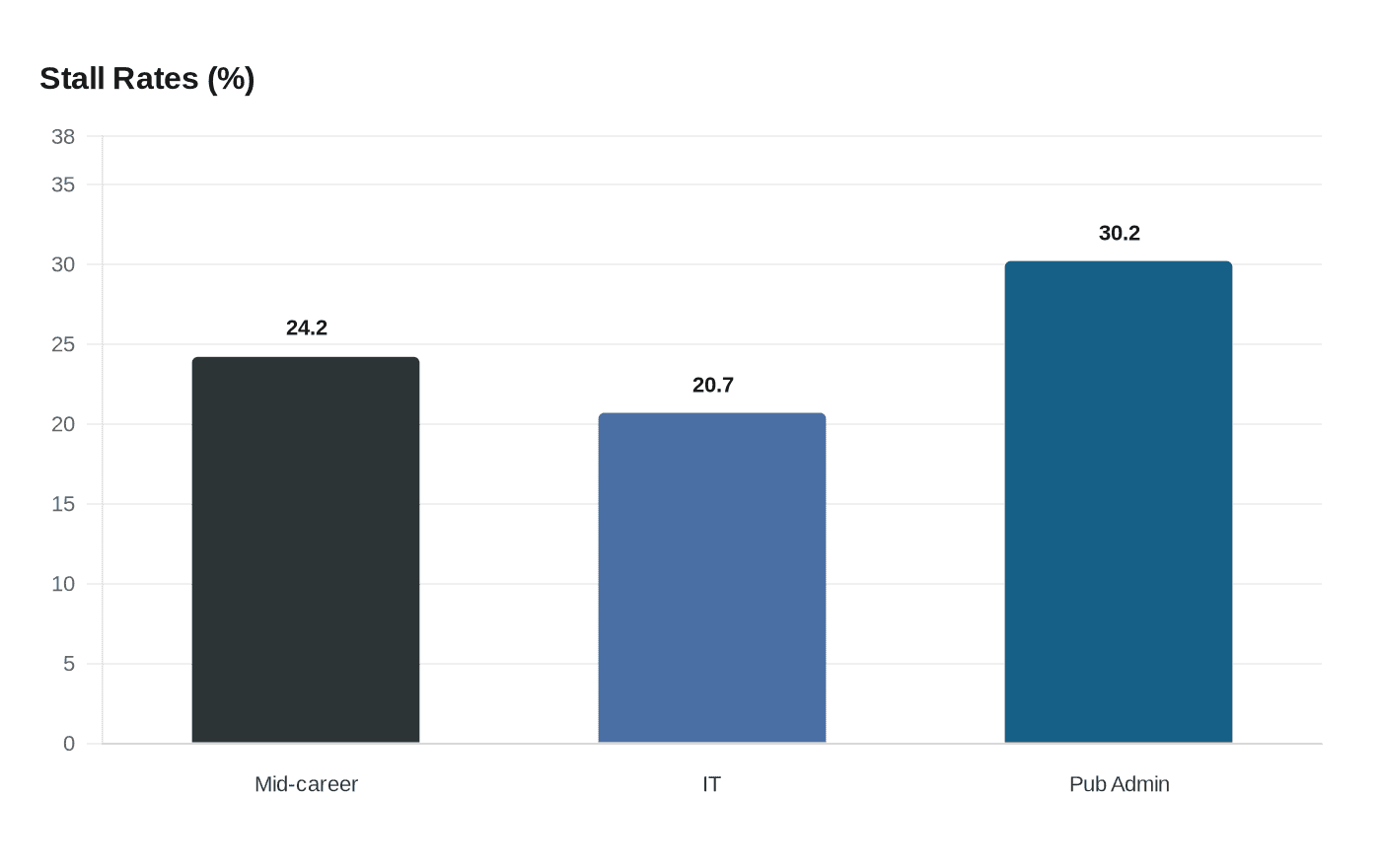
The problem varies sharply by industry. Stall rates range from 20.7% in information technology to 30.2% in public administration, a spread that points to different promotion ladders, job structures and internal mobility norms. Carlo Salerno, a lead author at Burning Glass Institute, said workers in stall often feel trapped, with flatter organizations and fewer chances to move up by switching companies or relocating reinforcing the bottleneck.
The findings line up with broader labor-market data. Gallup reported in October 2025 that one in four American employees say they lack opportunities for career advancement, and workers at larger organizations were more likely than those at very small ones to report those opportunities. The new research adds a sharper warning: stalled talent is not idle talent. It is underused talent, and employers that fail to build advancement paths are quietly paying for it in lower retention, weaker productivity and a growing mid-career exodus. Strategic reskilling into adjacent roles can cut stall risk by as much as 86%, but the report makes clear that the burden falls as much on employers as on workers.
This article was produced by Prism’s automated news system from verified source data, official records, and press releases, then run through automated quality and moderation checks before publishing. The system is built and supervised by the people who set the standards it runs under. Read our full AI policy.
Did this article answer your question?