Netanyahu Claims Victory Over Iran, but Few Israelis Believe Him
Netanyahu claimed a second Iranian victory as the Islamabad ceasefire took effect, but his coalition holds just 50 Knesset seats and his personal approval rating sits at 5.6 out of 10.
The two-week ceasefire agreement known as the Islamabad Accords took effect April 8, halting active strikes between the United States, Israel, and Iran. Benjamin Netanyahu immediately claimed it as vindication. The problem, for a growing number of Israelis, is that they have heard this before.
In June 2025, following the 12-day Operation Rising Lion, Netanyahu declared "a historic victory, which will stand for generations." It lasted less than a year. By March 2026, a former Israeli security official told CNN: "He refused to discuss any Gaza day-after plan, never consolidated the Lebanon November 2024 ceasefire, and described the 12-day war in June as a massive success. Eight months later we are back in the same loop. It's clear that it was only a bandage."
Netanyahu's critics do not see the Iran war as an isolated event but as the latest episode in a familiar pattern, with similar victory declarations following military campaigns in Gaza, Lebanon, and Iran, all framed as turning points restoring Israel's deterrence and regional balance. Visiting the site of the Dimona strike in late March, Netanyahu made the same victory promise: "The war will continue until we win."
The gap between rhetoric and reality is sharpest in the numbers. A Channel 12 poll showed Israeli Army Chief of Staff Eyal Zamir rated 7.3 out of 10, Mossad chief David Barnea at 7.1, while Netanyahu's personal approval plummeted to 5.6 out of 10. A separate Channel 12 survey found that 66 percent of Israelis were satisfied with the war's achievements, including 55 percent of voters who oppose Netanyahu, suggesting Israelis credit the military and not the prime minister.
That satisfaction has not translated into political capital. A poll found Netanyahu's coalition received only 50 Knesset seats, while the opposition bloc strengthened to 60 seats, with Arab parties Hadash-Ta'al and Ra'am together holding 10. Likud remained at 27 seats, while former prime minister Naftali Bennett's Bennett 2026 party continued to poll as Netanyahu's most credible challenger. With neither bloc able to form a majority without Arab party support, the coalition math leaves Netanyahu exposed regardless of battlefield outcomes.
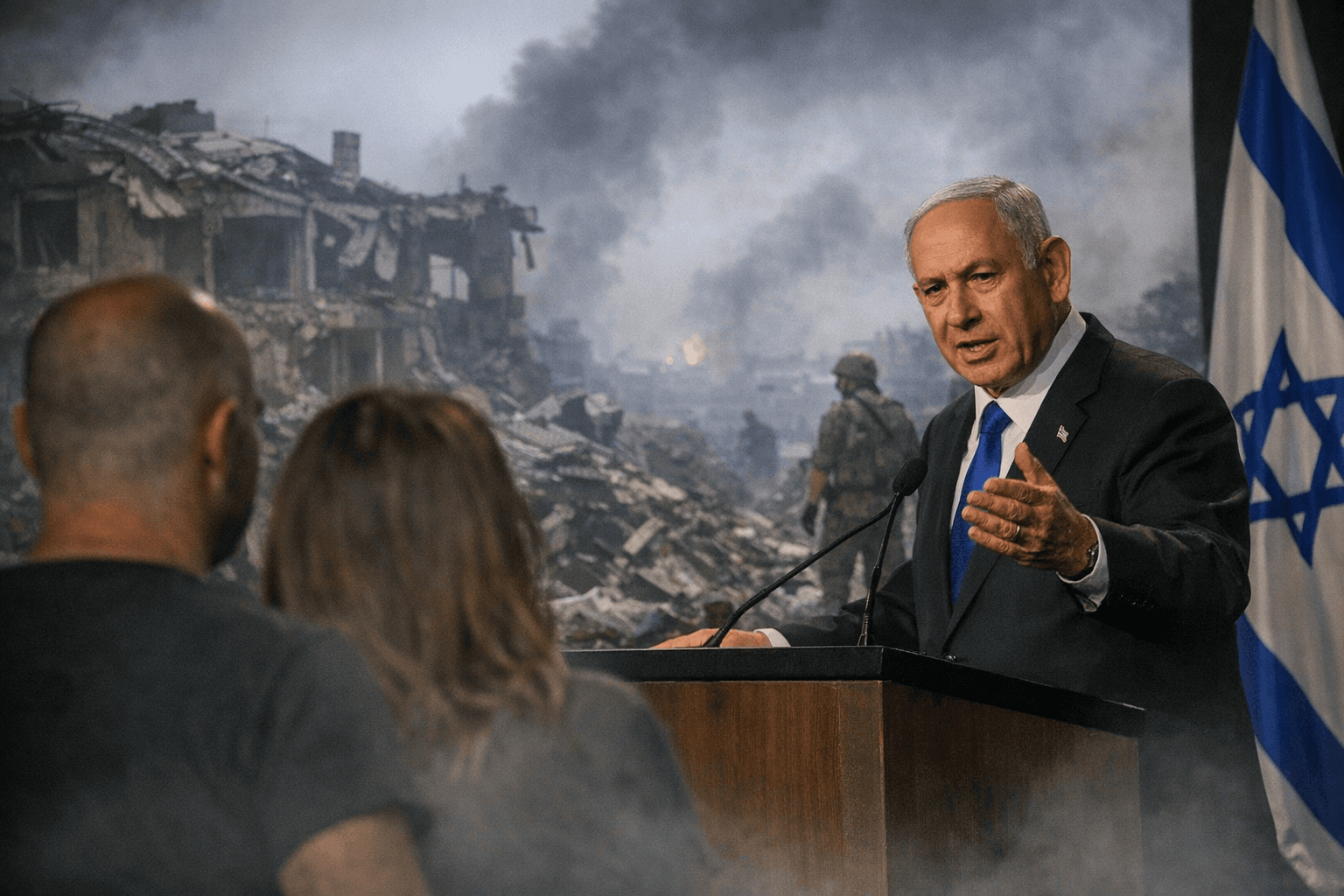
The war's stated objectives compound the credibility problem. Netanyahu had been consistent in stating his Iran war aim as regime change, but analysts cautioned that anything less than regime change might be seen as failure by the Israeli public. The Islamabad Accords, as announced April 8, constitute a two-week ceasefire under which Iran agreed to reopen the Strait of Hormuz. Regime change remains unrealized. Netanyahu acknowledged as much, stating on April 8 that Israel backed Trump's efforts to ensure "Iran no longer poses a nuclear, missile and terror threat," a narrower formulation than the removal of the Islamic Republic he had championed for months. Separately, Netanyahu confirmed the ceasefire does not include Lebanon, where Israeli military operations continue.
An analysis from the RAND Corporation noted that 2026 is an election year in Israel, that Netanyahu has staked his political fortunes on guaranteeing security from Iran, and that he must appease his hard-right coalition partners to govern. Polling suggests 64 percent of Israelis believe an election should happen as soon as the war is over, and more than 75 percent believe Netanyahu should step down.
A former security official captured the central tension: "This is a prime minister who refuses to pair military action with strategic planning." A two-week pause in strikes does not resolve that charge. What the Islamabad Accords actually hold, and whether Netanyahu can convert a ceasefire into a political lifeline before October elections, remains the unanswered question hovering over both the war's end and his government's survival.
This article was produced by Prism’s automated news system from verified source data, official records, and press releases, then run through automated quality and moderation checks before publishing. The system is built and supervised by the people who set the standards it runs under. Read our full AI policy.
Did this article answer your question?

