New York Voters Divided on Zohran Mamdani Across City Neighborhoods
Nearly 90 days into his term, Mamdani's record-low crime stats and housing fast-track signal progress, but a widening affordability gap and no Black deputy mayors are straining his coalition.
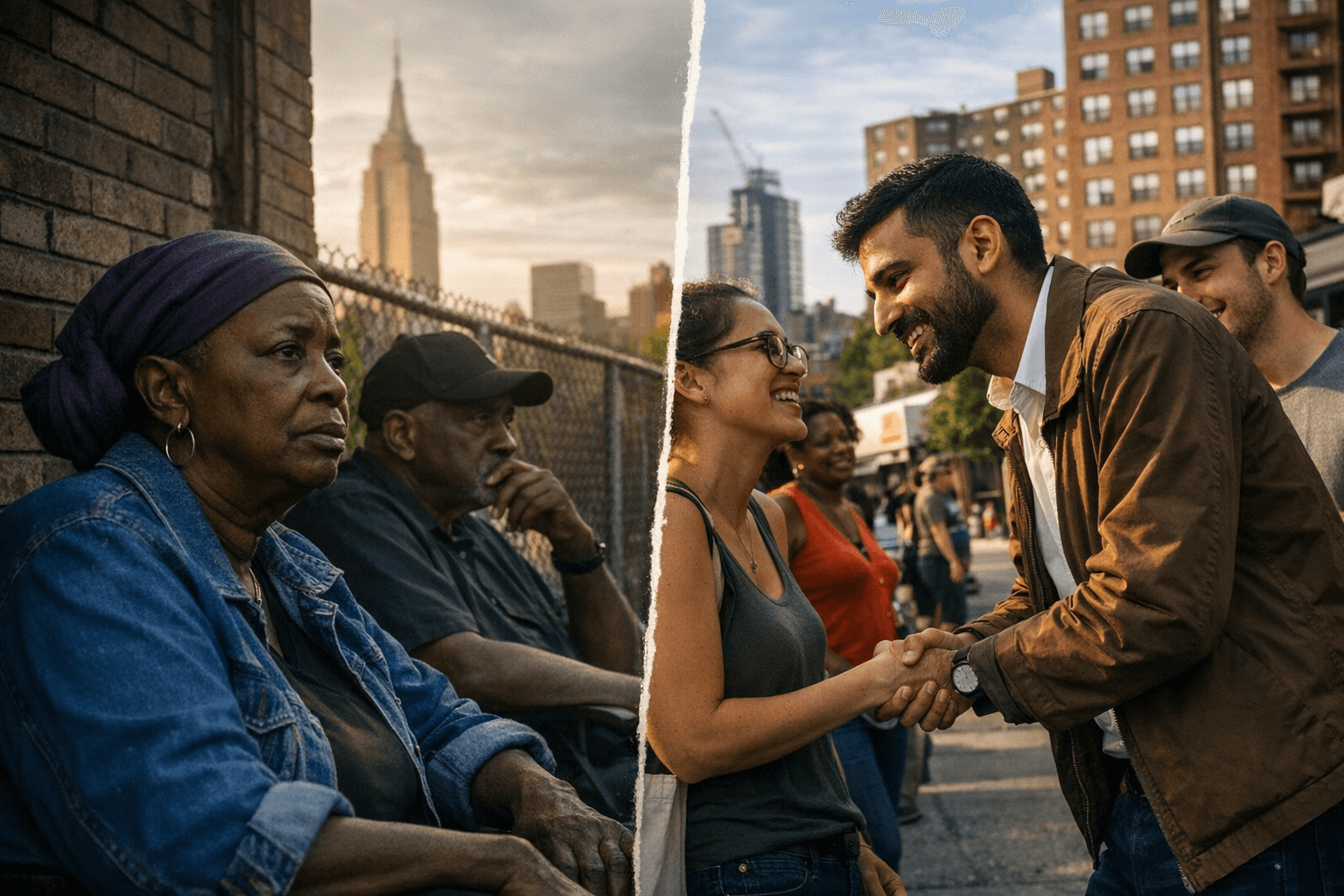
The geography of Zohran Mamdani's November 2025 mayoral victory told a vivid story: Jamaica Hills gave him a 54-point margin, Ridgewood a 48-point cushion, and Kensington, Brooklyn's "Little Bangladesh," delivered a 41-point rout over Andrew Cuomo. Staten Island, by contrast, was the only borough Cuomo carried. But the electoral map has since given way to a governing reality, and across the same neighborhoods that fueled his historic win, voters are now measuring results against expectations on four fault lines: public safety, affordability, housing development, and racial equity.
On crime, Mamdani enters his first-100-days finish line with data that would be difficult to dispute. The city recorded 54 murders in the first quarter of 2026, the lowest figure for that period on record and down from the previous benchmark of 60 killings set in 2018. Major crime fell more than 5 percent across all five boroughs, with the Bronx leading the decline at 9.4 percent. Shooting incidents, at 139, tied last year's record low. Police Commissioner Jessica Tisch attributed the numbers to "a precision policing strategy, going after the guns, taking down the violent gangs." What complicated the otherwise favorable briefing was a separate controversy: Tisch distanced the mayor from a change in how the NYPD categorizes and reports hate crimes, an issue that landed at the intersection of public safety and the political sensitivities of communities Mamdani carried by wide margins.
Affordability is where the gap between expectations and early results is diverging fastest. On April 6, with 96 days in office, Mamdani stood at Medgar Evers College in Brooklyn and announced that 62 percent of New York City residents lack the resources to meet the city's true cost of living. The figure framed the urgency behind his agenda, but also the scale of the problem he inherited. His own budget office identified a chronic underinvestment in rental assistance: roughly $1 billion allocated across fiscal years 2026 and 2027 against $4.1 billion in known expenses.
On housing development, the scorecard is split. Mamdani launched the Neighborhood Builders Fast Track on March 25 from a vacant lot in Bedford-Stuyvesant, promising to accelerate affordable housing construction on city-owned land across the 12 community districts that produced the least affordable housing in recent years. The city also initiated its first-ever Expedited Land Use Review, clearing a path for 84 affordable homes at 351 Powers Ave. in under 90 days rather than the standard seven months. However, former Mayor Eric Adams converted a long-planned affordable senior housing site in lower Manhattan to state parkland the day before the November election, leaving the project legally frozen and politically thorny.
The coalition fault line drawing the sharpest criticism is internal. Mamdani built his winning margin on a broad alliance of South Asian immigrants, well-to-do liberals in brownstone Brooklyn, working-class voters in Queens and the Bronx, and Black New Yorkers who ultimately set aside primary-season doubts about his candidacy. Black voters backed Cuomo heavily in the June 2025 Democratic primary before shifting to Mamdani in the general. Ninety days into that trust, Mamdani has appointed no Black deputy mayors, a conspicuous absence that critics argue signals how the administration is already prioritizing within its coalition.
Mamdani won more than 1,036,000 votes in an election that drew over two million New Yorkers to the polls, the highest turnout the city had seen since 1969. Sustaining a coalition that broad through the friction of governing is a different challenge than assembling it.
This article was produced by Prism’s automated news system from verified source data, official records, and press releases, then run through automated quality and moderation checks before publishing. The system is built and supervised by the people who set the standards it runs under. Read our full AI policy.
Did this article answer your question?

