Nevada judge halts Kalshi's sports and election prediction markets over unlicensed gambling
A Nevada judge blocked Kalshi from offering sports and election contracts, ruling the $22 billion startup operated without a gaming license.
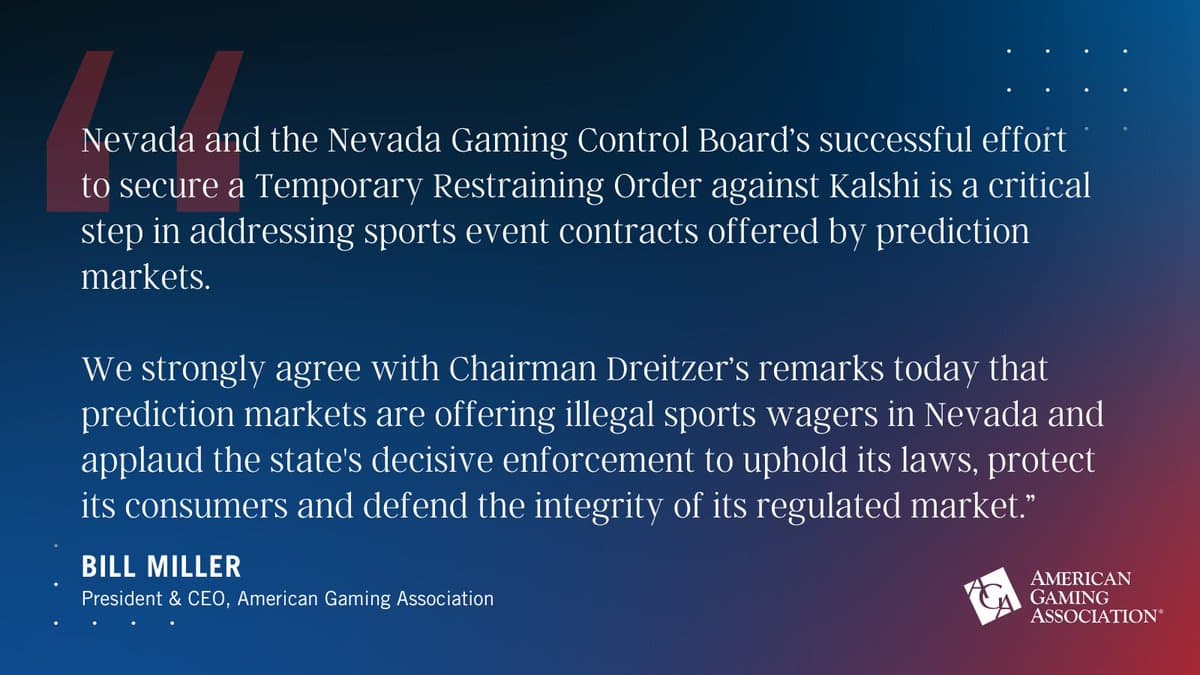
A Nevada district court judge issued a temporary restraining order Friday barring prediction-market startup Kalshi from offering sports, election and entertainment event contracts to users in the state, ruling that the company had been operating without a required gaming license.
District Court Judge Jason Woodbury, sitting in Carson City's First Judicial District Court, found that "an unlicensed participant beyond the Board's control, such as Kalshi, obstructs the Board's ability to fulfill its statutory functions." The order lasts up to 14 days, with a hearing on a longer preliminary injunction set for April 3.
The Nevada Gaming Control Board, which brought the civil enforcement action in February, had been pursuing Kalshi since 2025, when it first ordered the company to cease offering sports-related event contracts. NGCB Chairman Mike Dreitzer did not hold back in his assessment of the company's conduct.
"Kalshi has repeatedly stated that its operations are legal in 50 states, which is clearly not true," Dreitzer said in a statement. "Prediction markets, to the extent they facilitate unlicensed gambling, are illegal in Nevada, and we have a statutory duty to protect the public. We want people in the state to wager safely at a licensed book."
The order does not affect all of Kalshi's business. Contracts tied to crypto and gold prices remain available to Nevada users; only the sports, entertainment and election markets are blocked.
The ruling came one day after a federal appeals panel rejected Kalshi's bid to keep the dispute in federal court, where the company had argued it faced "imminent harm" from state regulators. That procedural loss cleared the way for Woodbury to act Friday.
Kalshi declined to comment on the Nevada development.
The company's legal exposure extends beyond Nevada. On March 17, Arizona's attorney general charged Kalshi with running an unlicensed gambling business and offering illegal election wagering, adding a criminal dimension to the company's mounting state-level battles. Nevada regulators have also secured temporary restraining orders against Polymarket, Robinhood, Crypto.com and Coinbase in connection with similar unlicensed-gambling allegations.
The enforcement wave is unfolding against a backdrop of a larger jurisdictional fight over who actually regulates prediction markets. CFTC Chair Brian Selig has insisted his agency holds authority over these products under federal derivatives law, not state gambling regulators. Selig filed a court brief making that argument and has pledged publicly to contest state enforcement actions. The CFTC's position has yet to override state-level actions, and Nevada's aggressive posture signals regulators there have no intention of waiting.
For Kalshi, the stakes are substantial. The company recently raised more than $1 billion in new funding, giving it a valuation of $22 billion, according to people familiar with the matter. That capital was secured even as the company fought regulators on multiple fronts, a sign of investor confidence in the long-term legitimacy of prediction markets as a financial product.
If Judge Woodbury grants the preliminary injunction on April 3, Kalshi would be locked out of Nevada's sports, election and entertainment markets for the duration of the lawsuit, a significant blow in a state where the gaming industry's political and legal infrastructure runs deep.
This article was produced by Prism’s automated news system from verified source data, official records, and press releases, then run through automated quality and moderation checks before publishing. The system is built and supervised by the people who set the standards it runs under. Read our full AI policy.
Did this article answer your question?