New book explores Wilmington’s white supremacist coup and its legacy
Lauren Collins’s new book traces how Wilmington’s 1898 white supremacist coup shattered Black power and still echoes in fights over democracy and memory.
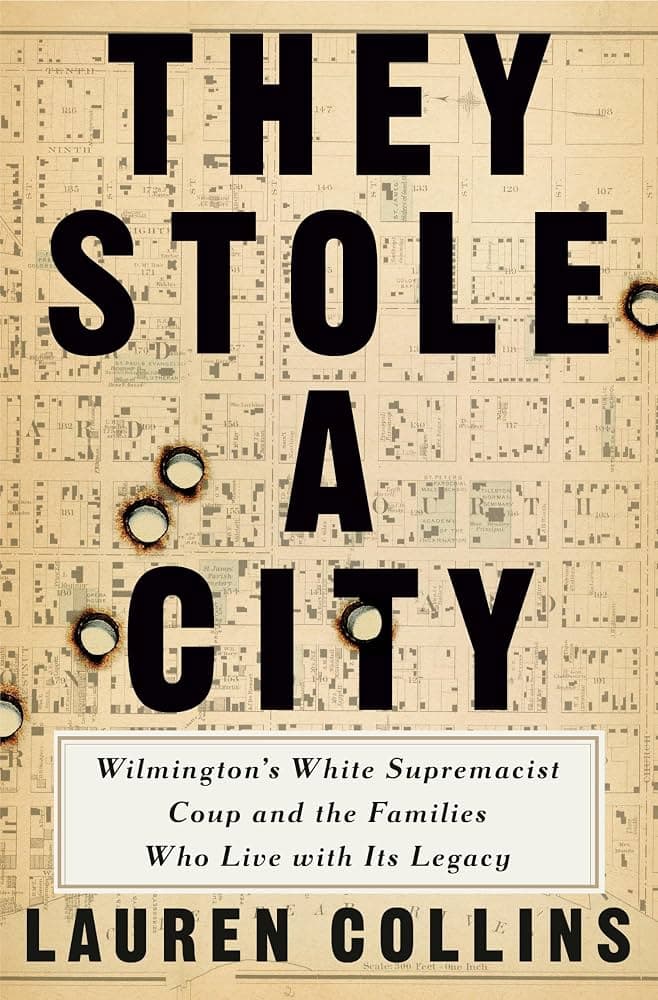
A white-supremacist campaign turned Wilmington, North Carolina, into a case study in how democracy can be dismantled from within. Lauren Collins’s new book follows the 1898 coup, the families who lived through its aftermath, and the long shadow it cast over Black political power, public memory, and the rules of American life.
A city seized, then rewritten
*They Stole a City: Wilmington’s White Supremacist Coup and the Families Who Live With Its Legacy* is scheduled for publication by Penguin Press on July 14, 2026. Collins, a New Yorker staff writer who was born in Wilmington in 1980, structures the book around four Wilmington families and follows their histories across 125 years, linking one day of political terror to generations of loss, survival, and memory.
The coup itself unfolded on November 10, 1898, after a white-supremacy campaign that began the year before and was aimed at driving Populist and Republican politicians from office in the 1898 election. The result was not just political turnover but an armed assault on a Black-led civic order that had outlasted Reconstruction in Wilmington longer than almost anywhere else in the South.
How the coup was built
The violence did not begin with the gunfire in Wilmington. It grew out of a coordinated campaign that used false claims, intimidation, and organized white militias to break the Fusionist interracial coalition and restore white Democratic control. The Equal Justice Initiative has described that effort as one that targeted the Black newspaper, summoned Red Shirts, and terrorized Black voters.
That machinery came to a head when white supremacists destroyed the offices of the Black-owned Daily Record, the city’s Black newspaper. Elected officials were forced to resign at gunpoint, and Silas P. Wright stepped down under pressure before former Confederate colonel Alfred Moore Waddell took office as mayor. The seizure of power was violent, public, and deliberate, with armed force used to settle an election and erase a multiracial government.
The coup also carried a wider social purpose. It was part of a broader effort to reverse Black political gains and to reassert white political dominance in a city where Black residents had built unusual influence in business, civic life, and voting power. In that sense, Wilmington was not an isolated riot but a blueprint for how elites, propagandists, and armed supporters can coordinate to overturn democratic outcomes.
Why historians treat Wilmington as a warning
Public-history institutions and museum materials often describe the event as the only successful coup d’état in U.S. history, a phrase that underscores how thoroughly the local order was replaced. That interpretation matters because it forces the 1898 violence out of the category of local disturbance and into the larger history of democratic collapse, election subversion, and state-sanctioned racial hierarchy.
The consequences reached far beyond the day itself. Scholars have shown that the coup helped usher in the Jim Crow era in North Carolina, with effects that lasted for decades. Black political and economic power was diminished, white Democratic control hardened, and the city’s multiracial experiment was replaced by a system designed to exclude Black citizens from power.
That is why Collins’s book is framed not only as family history but as a political warning. The Wilmington story shows how misinformation, elite complicity, and physical terror can work together to turn an election result into a regime change.
What remains disputed, and why the record still matters
Even now, some details of the 1898 violence remain contested. North Carolina’s 2006 commission report said casualty estimates ranged from the coroner’s 14 confirmed dead to unconfirmed reports of scores or hundreds. Britannica has described the overthrown city government and said as many as 60 Black Americans were killed, while other historical accounts and museum materials say thousands of Black residents were banished from Wilmington.
Those disagreements have not prevented the state from building an official record. The 1898 Wilmington Race Riot Commission released a draft report in December 2005 and a final report in May 2006. In its final findings, the commission called for more education about the event and recommended financial restitution, signaling that memory work alone was not enough to address the damage done.
That policy dimension still shapes how Wilmington is remembered. Recent remembrance projects have focused on identifying verified victims and descendants, a painstaking effort that turns abstraction into named loss and family history into public record. The work also challenges any version of American democracy that treats racial terror as a footnote rather than a governing force.
Why Collins’s book lands now
Collins is writing from inside the place she describes, but the book’s reach is national. By weaving together four Wilmington families over more than a century, she treats the coup as a living inheritance, one that still affects how the city understands race, citizenship, and political power. Her account places the 1898 overthrow beside present-day battles over election subversion, propaganda, and who gets to define democratic legitimacy.
The book also arrives in the middle of a broader fight over historical memory. North Carolina’s state process, including the 2010 authorization of a commission to study the event and its impact, shows how long it can take a government to confront political violence carried out in its name. The continuing work of institutions such as the Wilmington 1898 Museum and the Cape Fear Museum of History and Science keeps the record in view, but the larger struggle is over what gets taught, what gets minimized, and which democracy Americans are asked to remember.
Wilmington’s coup was not just the seizure of a city hall. It was an organized assault on Black political participation, a warning about the fragility of elections under racial terror, and a precedent that still sharpens the debate over how American democracy can be broken, buried, and taught back into public memory.
This article was produced by Prism’s automated news system from verified source data, official records, and press releases, then run through automated quality and moderation checks before publishing. The system is built and supervised by the people who set the standards it runs under. Read our full AI policy.
Did this article answer your question?