New Pit Viper, Flying Snake Among Dozens of Species Found in Cambodia Caves
A turquoise pit viper with no name yet is among 11 new species pulled from 64 caves in Cambodia's Battambang Province, where a single hill hid 14 caves no scientist had ever entered.
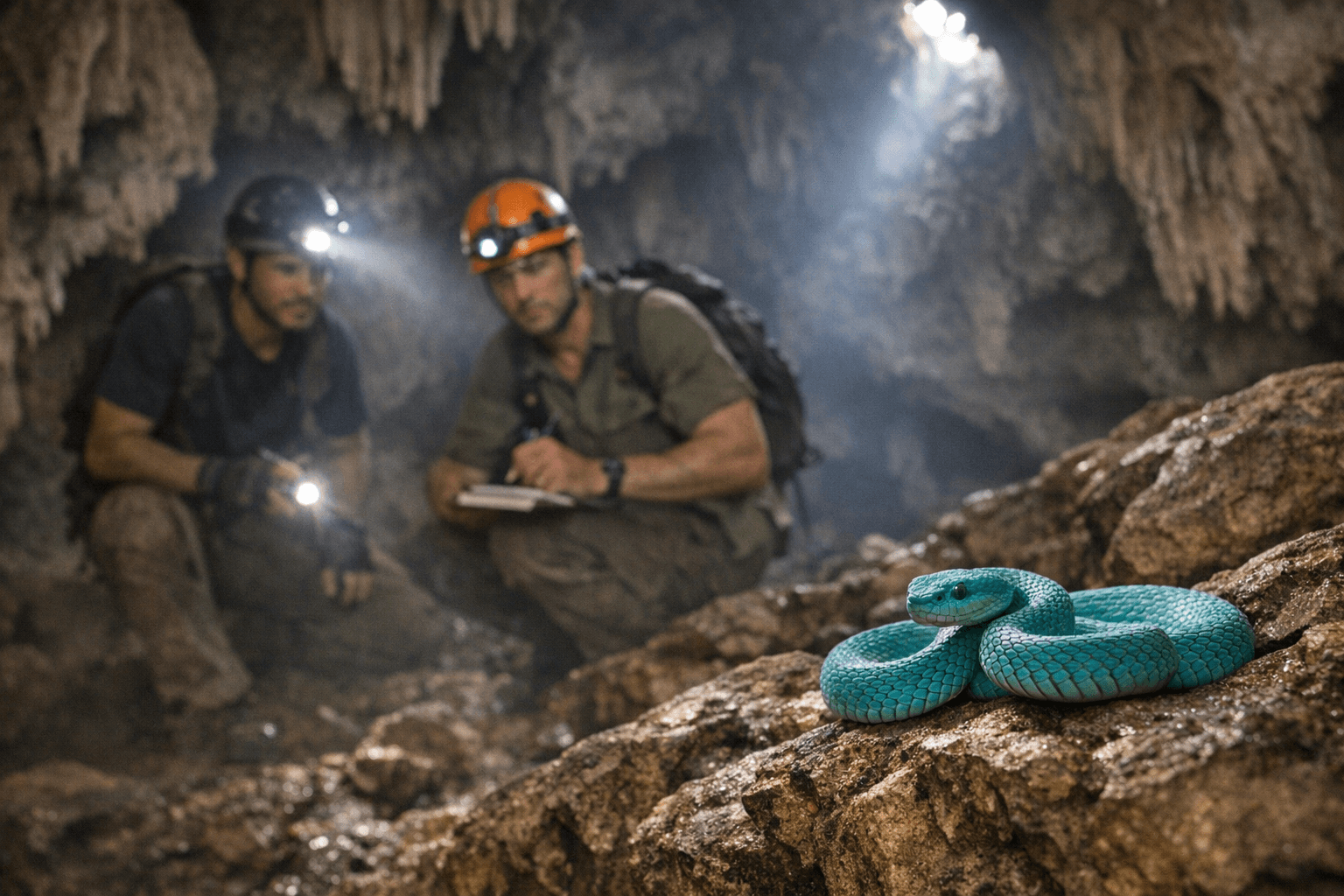
A spectacular turquoise pit viper from the *Trimeresurus* genus, collected during a survey of Phnom Prampi in Battambang, is currently being described by scientists — and it has no formal name yet. The snake was among 11 new species discovered in Cambodia's karsts, ancient limestone cliffs with hidden cave systems; while its official name has not been decided, the "pit" refers to the heat-sensitive organ on its head, which it uses to detect and track down warm-blooded prey.
The viper and three of the newly discovered gecko species are still being formally named and characterized. The other finds were officially recognized over the course of the biodiversity survey, which explored 64 caves across 10 hills between November 2023 and July 2025, and was published in a report Monday. The survey was led by UK-based conservation charity Fauna & Flora, along with Cambodia's Ministry of Environment and field experts.
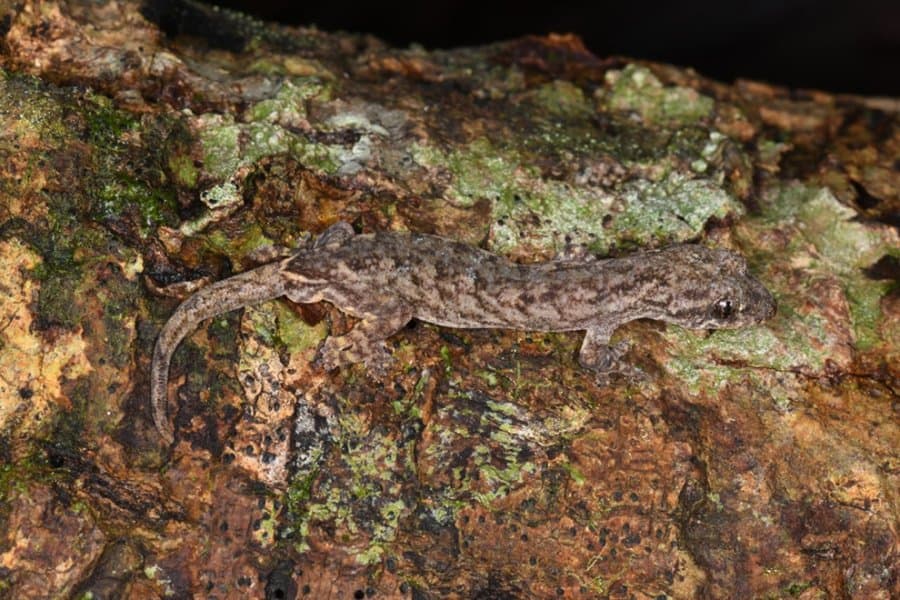
The survey uncovered a range of species new to science, including a turquoise pit viper, a flying snake, several geckos, two micro-snails and two millipedes. The ornate flying snake glides from tree to tree by flattening its rib cage and twisting through the air like a shimmering ribbon; it is increasingly threatened by illegal trade, as its vivid colors make it popular among reptile collectors. Among the formally named gecko discoveries, *Dixonius noctivagus* is covered in tiny leopard-like spots and named for its nocturnal habits, with "noctivagus" meaning "night wanderer" in Latin.
Named after the Hindu god of destruction, Gekko shiva was another unique reptile found in the surveys. It was discovered in early 2025 in a Thai cave temple dedicated to the deity. Researchers warn that its striking appearance makes it a target for the exotic pet trade, and giving it a formal name is the first step toward legal protection. The survey team also found it in Battambang, marking the first record for Cambodia.
Conservation biologist Pablo Sinovas led the Fauna & Flora team in Cambodia, working with local researchers to assess the terrain by day and search for creatures at night. The team would head out after sunset and spend hours traversing "sharp, rocky terrain" with torches, "looking around every crevice, looking around caves in the landscape, rocks, branches, vegetation, really everywhere. It was kind of a nice search party," said Sinovas, who is now a senior program manager at the charity. Some caves in the region hold up to one million bats, although the research team did not enter caves with large bat colonies due to health concerns.
Fourteen caves that had not previously been surveyed were registered on one karst hill in the Banan district of Battambang Province alone. Karst landscapes make up about 9% of Cambodia's land area, at 20,000 square kilometers, and a large portion of this remains unknown to science. Each hill and cave in Cambodia's rocky karst landscape is isolated from the others, performing as its own individual "island laboratory" of evolution, holding numerous distinct life forms that have adapted to their niche habitat.
In addition to surveying the caves inside and out, the team set camera traps at strategic points in the wider karst landscape. These cameras confirmed the presence of many threatened species including the Sunda pangolin, Indochinese silvered langur, long-tailed macaque and green peafowl.
Sothearen Thi, Karst Biodiversity Coordinator for Fauna & Flora's Cambodia Programme, said Cambodia's karst areas are a treasure trove of scientific secrets waiting to be uncovered. "From undiscovered reptiles and snails, to hidden caves — there is still so much we do not know about these unique ecosystems," she said. "But, without sustainable management, we may never find out what these areas truly hold. Karst landscapes are facing many human-driven challenges, and biologically significant species could go extinct before they have even been discovered."
Despite their extraordinary biodiversity, Cambodia's karst landscapes are largely unprotected, often quarried and blasted for their limestone to produce cement. Fauna & Flora warns that because some species exist only in one hill, destroying a single formation can drive species to extinction, including some we know nothing about yet. Sinovas put it directly: "There is growing demand for cement and karst limestone is useful for the making of cement and, so, karst provides a very important raw material."
He added that they have only "scratched the surface" in terms of the biodiversity waiting to be discovered in the ecosystems of the wider Cambodian landscape.
This article was produced by Prism’s automated news system from verified source data, official records, and press releases, then run through automated quality and moderation checks before publishing. The system is built and supervised by the people who set the standards it runs under. Read our full AI policy.
Did this article answer your question?


