New theory says spacetime may remember its own history
A speculative model says spacetime stores quantum imprints of its past, aiming at dark matter, dark energy and black holes, but it remains under peer review.
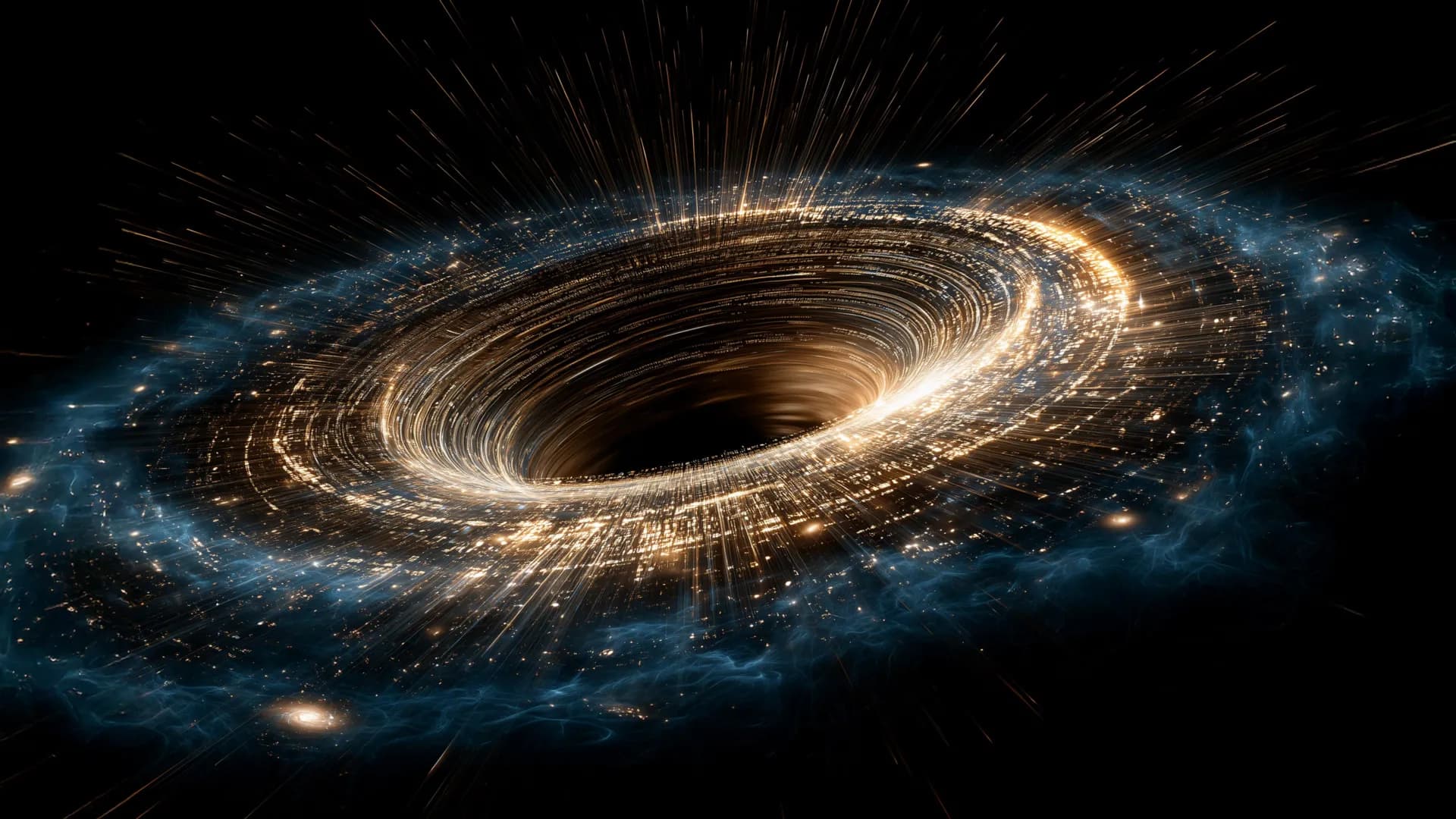
A new theory is drawing attention for a simple reason: it tries to solve several of physics’ hardest problems with one idea. In the Quantum Memory Matrix, or QMM, spacetime is not just a stage for events but a recording surface that can retain traces of what has happened, and those traces could shape gravity, cosmic expansion and the growth of matter.
The framework was set out in a paper submitted March 30, 2025 by Florian Neukart, Reuben Brasher and Eike Marx. Their argument is that information, not matter, energy or even spacetime itself, is the most fundamental ingredient of reality. To make that case, QMM treats spacetime as made of discrete Planck-scale cells that can store quantum imprints from interactions, a setup the authors present as a response to the black hole information paradox, the long-running problem of how information survives when a black hole radiates away through Hawking radiation.

The appeal of the idea is that it tries to connect the gaps rather than isolate them. A follow-on preprint submitted April 4, 2025 extended the same Planck-scale framework to the strong and weak interactions, suggesting the model could be broadened to cover the full range of Standard Model gauge forces. Another preprint, submitted June 14, 2025, explored whether QMM-related imprint entropy could help seed primordial black holes in a cyclic universe, a path that matters because primordial black holes remain one of the more closely watched candidates for dark matter.
That is why the theory is being discussed alongside dark matter, dark energy and black holes in the same breath. The idea does not claim to settle those mysteries outright. It offers a unifying language in which dark matter might emerge from hidden structure in spacetime, dark energy from the way that structure evolves, and black holes from the same information bookkeeping that governs the rest of the cosmos.
The decisive question is not whether the mathematics is inventive. It is whether QMM can produce signatures that can be checked against observation and that standard cosmology cannot already explain. That bar is higher now that the Dark Energy Spectroscopic Instrument collaboration reported in 2025 that dark energy may not be perfectly constant over cosmic time. For QMM, that makes the challenge sharper: the model will have to show measurable consequences in galaxy formation, expansion history or black hole behavior before cosmic memory can move from provocative hypothesis to working physics.
This article was produced by Prism’s automated news system from verified source data, official records, and press releases, then run through automated quality and moderation checks before publishing. The system is built and supervised by the people who set the standards it runs under. Read our full AI policy.
Did this article answer your question?


