Nigeria charges six over alleged coup plot against Tinubu government
Nigeria has charged six people, including retired officers and a serving police inspector, over an alleged coup plot. Timipre Sylva is named as a seventh suspect and remains at large.
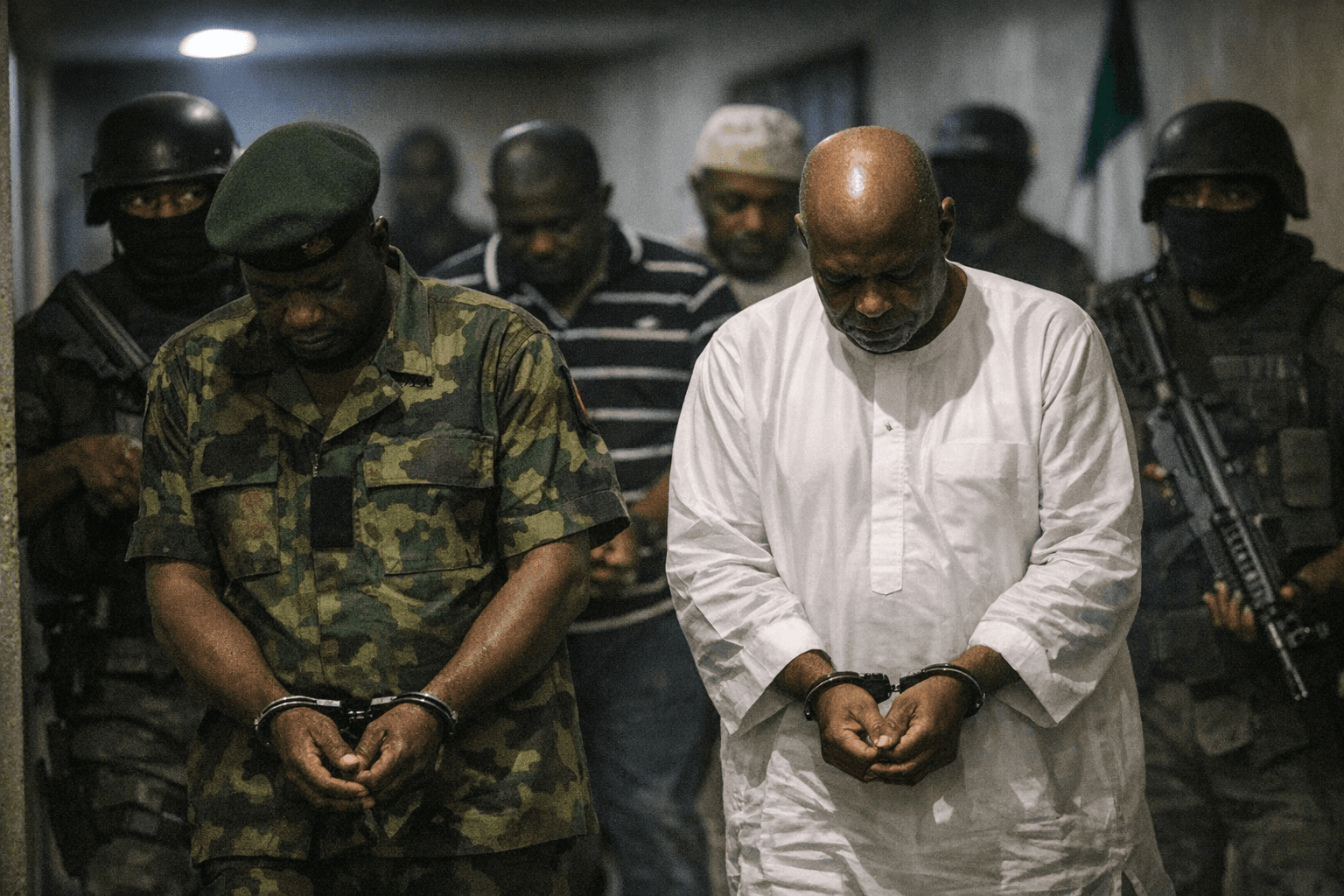
Nigeria has charged six people, including a retired army major-general, a retired naval captain and a serving police inspector, with 13 criminal counts over an alleged plot to overthrow President Bola Tinubu’s government and levy war against the state. Former Bayelsa State governor and former oil minister Timipre Sylva was also named as a suspect and remains at large.
Prosecutors filed the case at the Federal High Court in Abuja on Monday, April 20, 2026, and the defendants are due to be arraigned on Wednesday, April 22, before Justice Joyce Abdulmalik. The charges include treason, terrorism, terrorism financing, suppression of intelligence and money laundering. Among those named in the case are Mohammed Ibrahim Gana, Erasmus Ochegobia Victor, Ahmed Ibrahim, Zekeri Umoru, Bukar Kashim Goni and Abdulkadir Sani.
The case is the most serious treason prosecution since Tinubu took office in 2023, and it reaches well beyond a routine criminal filing. It follows months of tension that began in October 2025, when concerns about a possible coup attempt first surfaced after the government abruptly cancelled the planned October 1 parade for Nigeria’s 65th Independence Anniversary. The military denied at the time that the cancellation was linked to a coup plot.
Those suspicions did not fade. Reports in October 2025 said about 16 military officers had been detained in the investigation, and Tinubu reshuffled Nigeria’s military leadership on October 24, 2025, in a move the presidency said was intended to strengthen national security. The sequence of events suggested that the alleged plot had already begun to strain confidence inside the country’s security establishment, even before charges were filed.
The political stakes are unusually high in a country with a long history of coups and attempted coups. Military rule dominated much of Nigeria’s life from 1966 to 1999, and the last successful coup is generally dated to 1993. That history still shapes how Nigerians read any allegation of treason, especially when the accused include serving and retired security personnel.
The charges land at a moment of economic strain, an Islamist insurgency in the north and broader political friction. Whether the case proves to be an isolated conspiracy or the surface expression of deeper institutional fracture will depend on what prosecutors can prove in court. For now, the filing itself has sharpened scrutiny of the relationship between Nigeria’s elected government and the armed institutions meant to protect it.
This article was produced by Prism’s automated news system from verified source data, official records, and press releases, then run through automated quality and moderation checks before publishing. The system is built and supervised by the people who set the standards it runs under. Read our full AI policy.
Did this article answer your question?

