Nike Shares Sink as Sales Slump and Turnaround Plan Falters
Nike shares sank 9% after the company projected a 20% China sales drop and warned Middle East unrest could further derail its already-stumbling turnaround.

Nike's stock plunged more than 9% in after-hours trading Tuesday after the company delivered guidance that blindsided Wall Street: fiscal fourth-quarter sales would fall between 2% and 4%, against analyst expectations of a 1.9% increase. The miss sent the shares of the world's largest sportswear company toward their lowest levels in nearly a decade, erasing gains that CEO Elliott Hill had been counting on to validate his 18-month-old turnaround blueprint.
The sharpest alarm came from Greater China, where revenue already fell 17% in the fiscal third quarter ended February 28 to $1.62 billion, marking seven consecutive quarterly declines. Hill and Chief Financial Officer Matt Friend told investors on the earnings call to brace for conditions to worsen: the company expects China sales to drop roughly 20% in the current quarter as Nike tries to reset a market it allowed to become deeply discount-driven. "What we've done is a start, but it's not happening at the level or the pace we need to drive wider change," Hill said of the China recovery.
Friend did not stop at China. He flagged geopolitical turbulence in the Middle East as a fresh variable capable of disrupting both supply-chain costs and consumer behavior in a region where Nike had been counting on growth to offset weakness elsewhere. "We also recognize that the environment around us has become increasingly dynamic, and we could experience unplanned volatility due to the disruption in the Middle East, rising oil prices and other factors that could impact either input costs or consumer behavior," Friend said, adding: "We are focused on what we can control." The acknowledgment matters to American investors because Nike's exposure to global demand shocks runs directly through retirement portfolios; the stock is a fixture in major index funds and ETFs that anchor 401(k) accounts across the country.

The Q3 results themselves technically beat expectations: earnings per share came in at $0.35 against an anticipated $0.28, and revenue of $11.28 billion edged past the $11.24 billion consensus. But gross margin slid 130 basis points to 40.2%, pressured by tariff costs that the company projects will total $1.5 billion, and net income dropped 35% to $520 million. Diluted EPS fell to $0.35 from $0.78 a year earlier, a deterioration that no earnings-beat headline could obscure.
North America remained the one region Hill could point to as proof of concept. Revenue there rose 9% in the quarter to $5.6 billion, fueled by a 24% surge in wholesale that reflected the company's deliberate pivot away from its predecessor's direct-to-consumer obsession. Wholesale overall grew 8% companywide. "The geography that is leading the way for Nike right now is North America," Hill told investors. That wholesale revival carries direct implications for domestic jobs: Nike's U.S. retail and distribution partners, from Foot Locker to regional sporting-goods chains, are hiring or stabilizing staffing in part on the expectation that Nike's wholesale shipments keep climbing.
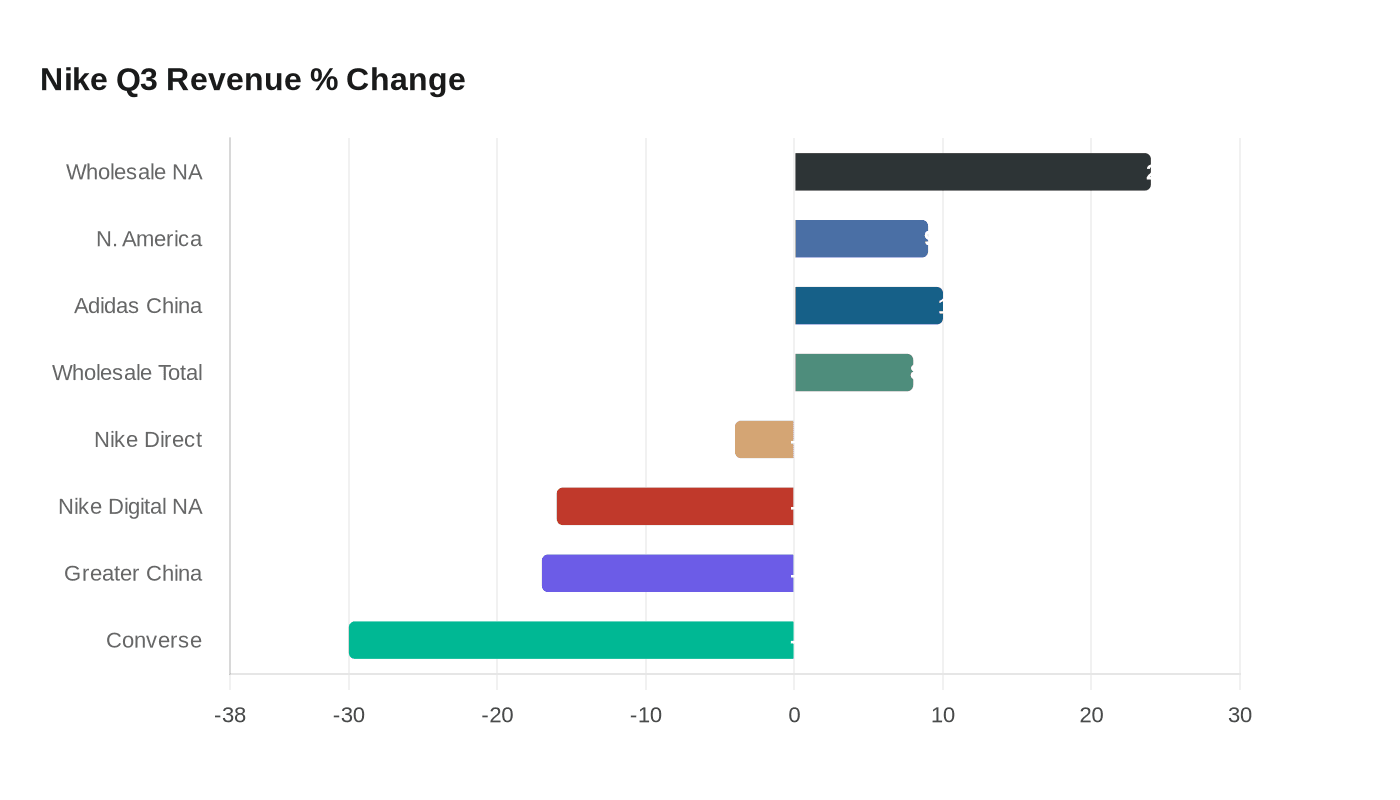
Elsewhere the picture was less encouraging. Nike Direct fell 4% globally, Nike Digital slid 16% in North America, and Converse revenue collapsed 30%. Meanwhile competitors filled the vacuum: Adidas posted 10% China revenue growth in its most recent quarter, while On Running and Hoka's parent Deckers continued to take share in running footwear. China's domestic brands Anta and Li Ning added further pressure in a market where discount culture has entrenched itself after years of economic slowdown.
To accelerate the China recovery, Hill replaced Angela Dong, who had run Greater China since 2015, with Cathy Sparks, a 25-year Nike veteran who previously led the Asia Pacific and Latin America division. The company is concentrating its "Win Now" actions on Beijing and Shanghai, editing product assortments and stepping up storytelling around new innovations. With Nike shares now down roughly 23% year to date and trading near nine-year lows, Hill's middle-innings metaphor carries real weight: the game is far from over, but the innings ahead may be the hardest ones to play.
This article was produced by Prism’s automated news system from verified source data, official records, and press releases, then run through automated quality and moderation checks before publishing. The system is built and supervised by the people who set the standards it runs under. Read our full AI policy.
Did this article answer your question?