Nike warns turnaround will stay difficult, China sales keep falling
Nike beat revenue estimates, but it still warned of a low- to mid-single-digit sales drop in fiscal 2027 as China weakness deepened.

Nike closed fiscal 2026 with revenue of $46.4 billion, flat on a reported basis and down 2% in currency-neutral terms, while fourth-quarter revenue came in at $11.0 billion, down 1% reported. Nike said fiscal 2027 revenue is expected to fall in the low- to mid-single digits as China stays weak.
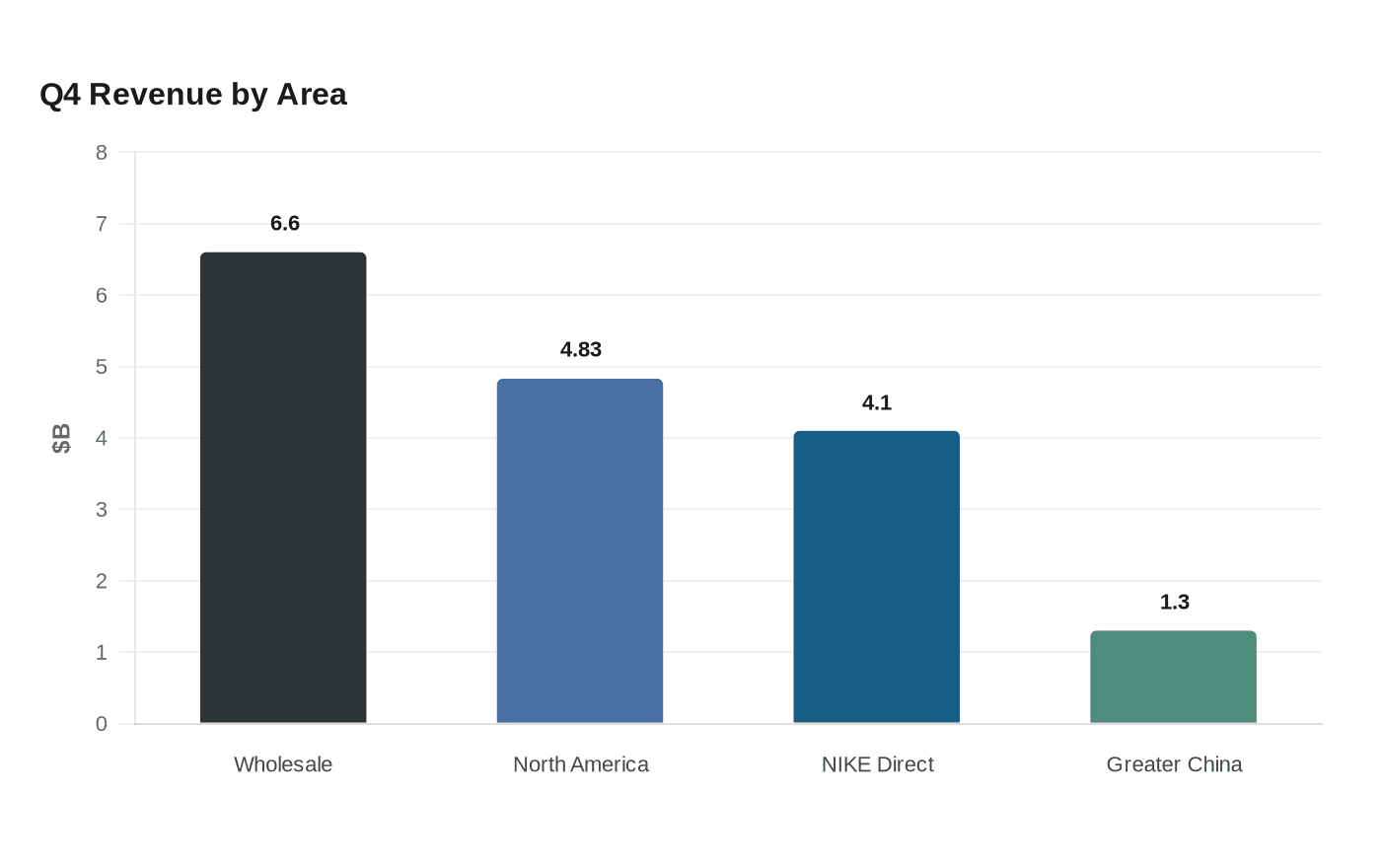
Fourth-quarter sales in Greater China fell 12% to $1.30 billion on a reported basis and 17% on a constant-currency basis, reflecting weaker product assortments and market-share losses to Anta and Li Ning. North America revenue rose 3% to $4.83 billion.

Elliott Hill, who took over in 2024, has been steering Nike back toward sports-focused categories, rebuilding wholesale relationships and bringing more products to market. Wholesale revenue in the fourth quarter rose 4% to $6.6 billion, while NIKE Direct revenue fell 7% to $4.1 billion. Hill said, “We know we’re not living up to our full potential,” and added that the results were not yet where he wanted them to be. He also said Nike would launch more than a dozen footwear styles, but progress in sports-focused product lines remained uneven.
Gross margin rose 890 basis points to 49.2% in the quarter, with nearly 900 basis points tied to an expected recovery of IEEPA tariffs. Nike had collected more than $300 million in cash related to tariff refund claims by quarter-end, and that recovery contributed 52 cents to earnings per share.
Matthew Friend said the consumer remains under pressure globally and that the environment is not expected to improve over the next six months. Nike’s shares have fallen 35% so far this year and slipped about 4% in after-hours trading after the results before recovering some of the loss. David Swartz said, “expectations were low, but the results were still not good.”
This article was produced by Prism’s automated news system from verified source data, official records, and press releases, then run through automated quality and moderation checks before publishing. The system is built and supervised by the people who set the standards it runs under. Read our full AI policy.
Did this article answer your question?