Nine March 2026 Exhibitions Reframe Memory, Material Culture for Contemporary Jewelry
ArtReview’s Feb 27 preview names nine March exhibitions that recast objects as carriers of memory and material history, linking contemporary jewelry narratives: “memory, material culture and the afterlives of objects—topics that intersect with contemporary jewelry narratives (how obj”
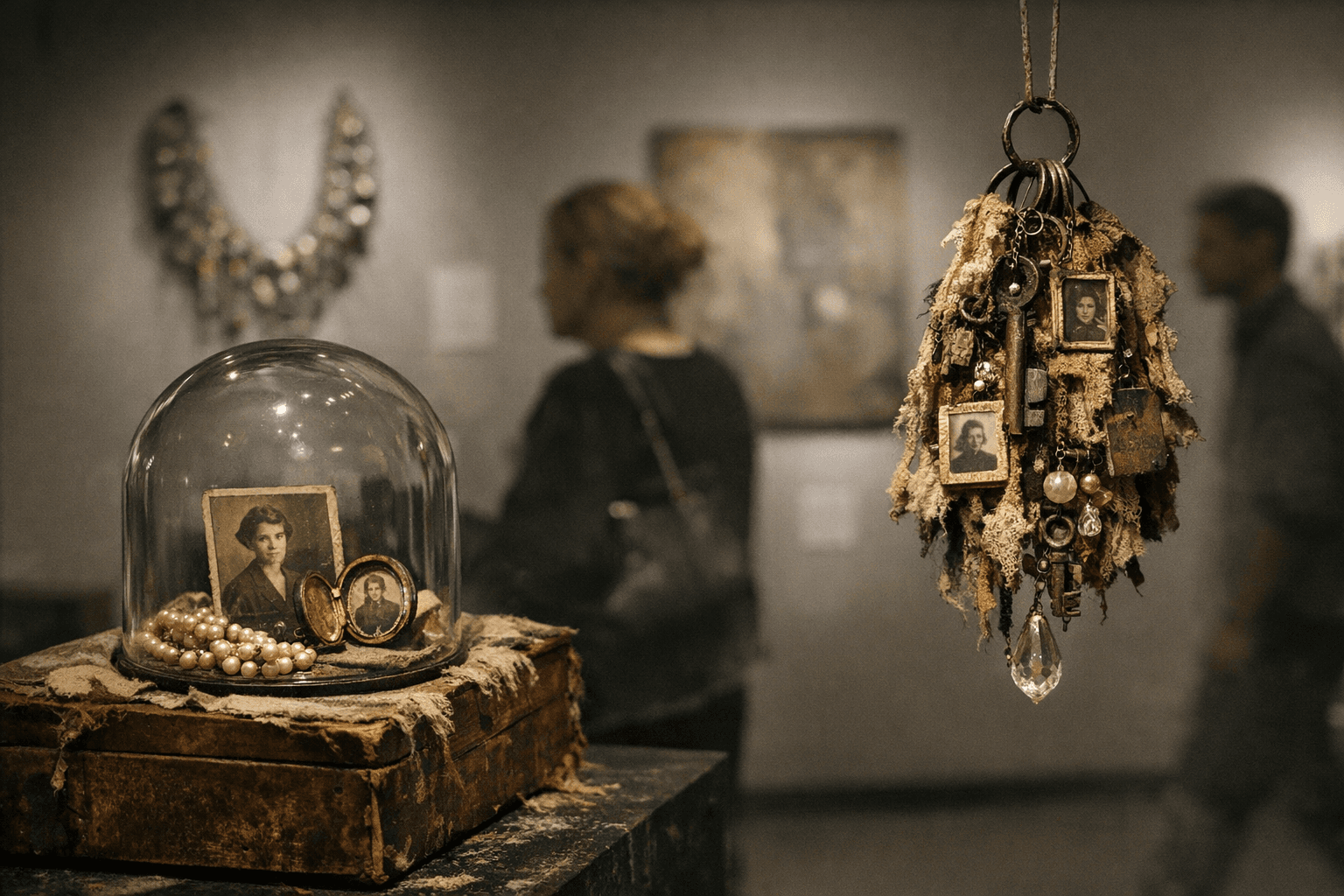
ArtReview’s Feb 27 preview gathers nine exhibitions that, taken together, insist that objects are never neutral: they carry memory, labor and material histories that jewelry makers and collectors already contend with. The piece foregrounds “memory, material culture and the afterlives of objects—topics that intersect with contemporary jewelry narratives (how obj” and the selections here show how museums stage those stories, whether through site-specific commissions, found materials or stone-embedded ritual objects.
CCA Tashkent: Hikmah Hikmah, opening at the Centre for Contemporary Arts Tashkent from 21 March to 30 June, stakes a bold institutional claim: CCA Tashkent is Uzbekistan’s first permanent centre for contemporary art. The exhibition, titled with the Uzbek word for wisdom, is described as one about sharing knowledge and “exploring discussions around forms of intelligence and revelation.” Its formal program answers the building as much as it answers the artists: site-specific works will respond to the 1912 industrial building that houses the CCA, and new commissions include Muhannad Shono, Nari Ward, Shokhrukh Rakhimov and Tarik Kiswanson alongside Ali Cherri and Kimsooja. For jewelers and collectors, Hikmah’s focus on local histories and commission-based work raises questions about provenance, labor and how new-made objects inherit older industrial narratives.
MAAT Lisbon ArtReview lists MAAT Lisbon with dates 25 March to 31 August, though the preview fragment does not include an exhibition title or artist roster. MAAT’s long season suggests an ambitious program slot that will likely engage architecture, materiality or technology—the museum’s recent curatorial language often foregrounds design and objects in urban contexts. The lack of a title in the fragment is itself a prompt for designers and jewelers to watch for the show’s materials list and conservation notes, details that determine whether an exhibition treats objects as raw resources or as storied artifacts with traceable origins.
25th Biennale of Sydney: Rememory Rememory, the 25th Biennale of Sydney running March 14 to August 23, deploys a curatorial vocabulary that already resonates with jewelry’s interest in commemoration and lineage. Biennales are laboratories for artists working across sculpture, textiles and wearable practices; a title like Rememory signals work that reanimates histories or repackages vernacular objects as carriers of collective recollection. For makers, the Biennale’s run offers a chance to see how international institutions display, document and label material fragments—practices that directly affect how a piece’s provenance is read and valued.
Kim Yun Shin: Two Be One, Hoam Museum of Art Kim Yun Shin’s survey Two Be One at the Hoam Museum of Art in Yongin opens March 17 and runs to June 28, showing work by an artist now in her 90s who continues to use heavy machinery to sculpt elegant abstractions. Three years after a Seoul Museum of Art retrospective became a surprise hit, this Korean survey will examine how she “wields weighty materials with grace, making them appear light.” The artist’s own description captures her process: “When inspiration strikes, I immerse myself completely, picking up the chainsaw and finishing the piece in a single day.” That visceral, tool-driven approach matters to jewelers who prize technique and risk: seeing how scale, force and surface transform raw wood or industrial detritus reframes conversations about tactility and finish in small-scale, wearable work.
David Hockney: A Year in Normandie and Some Other Thoughts About Painting, Serpentine North Serpentine North presents David Hockney’s exhibition from March 27 to August 30, a focused investigation of place and medium. Hockney’s Late works have been read as meditations on color, memory and the act of looking—concerns that also animate contemporary jewelry when makers translate landscape, atmosphere or family lore into metal and stone. For collectors, Hockney’s show will be a reminder that provenance encompasses not only material sources but also the artist’s sustained engagement with subject and place, which often drives market and scholarly interest.
Cecily Brown: Picture Making, Serpentine South Cecily Brown’s Picture Making at Serpentine South arrives with painterly force: the fragmentary image description supplied with the listing reads like a jeweler’s sketchbook, “A painting of a river with a branch running across it. The land on either side of the river is filled with paint strokes in all directions.” Brown’s work interrogates representation and surface, and that emphasis on gesture and residue is relevant for makers who use patina, abrasion or intentional imperfection as narrative tools. Although no dates appear in the fragment, the Serpentine pairing—Hockney north and Brown south—frames a conversation about how mark-making carries memory across mediums.
Tavares Strachan: The Day Tomorrow Began, LACMA Tavares Strachan’s The Day Tomorrow Began at LACMA runs through March 29, 2026, and LACMA has installed works from Strachan’s archive in large-scale configurations. The Unframed notes include Strachan’s Six Thousand Years, 2018, and The Encyclopedia of Invisibility, 2018, examples of his research-driven practice that blends archival work, sculpture and narrative. For jewelry practitioners, Strachan’s emphasis on historical layering and encyclopedic collection points to a practice of assembling meaning across time rather than presenting objects as discrete, ahistorical adornments. The installation credits supplied emphasize museum provenance and photographic documentation, two elements collectors should look for when assessing a work’s exhibition history.
Raphael: Sublime Poetry, The Metropolitan Museum of Art Raphael: Sublime Poetry at The Metropolitan Museum of Art, March 29 to June 28, promises an expansive loan show billed as the first comprehensive U.S. exhibition dedicated to the Italian master. The exhibition deliberately foregrounds story, intellect and emotion on canvas, recalling jewelry’s storytelling function across centuries. Image credits for key loans are already in place, including Raphael’s Portrait of a Lady with a Unicorn, 1505-6, credited to Galleria Borghese with photography by Mauro Coen, and Portrait of Baldassarre Castiglione, 1514–1516, credited to RMN-Grand Palais / Art Resource, NY. Those loan lines matter: a major painter’s provenance and loan history set standards for condition reporting and transport—practices that should be mirrored in the jewelry market when historic or high-value pieces circulate.
Marina Abramović: Transforming Energy Transforming Energy, dated Mar. 29 to June 28, coincides with the Venice Biennale and the artist’s 80th birthday and will place new and old works alongside classic paintings from the museum’s permanent collection. Expect restagings of iconic performances as well as displays of her interactive “Transitory Objects”, stone beds and crystal-embedded structures intended to evoke and transmit energy. A particular highlight called out in the fragment is a pairing of Abramović’s Pietà (with Ulay) (1983) alongside Titian’s Pietà, ca. 1575–76, and the note that “Abramović was also the first woman to win the Golden Lion for Best Artist in 1997” underlines her institutional stature. For jewelers, her use of crystals and ritualized, participatory objects opens a dialogue about the line between decorative ornament and charged ceremonial device, and about how museums contextualize spiritual or metaphysical claims made for materials.
Conclusion These nine shows, assembled in a single month, map several overlapping lessons for makers and collectors: how institutions articulate provenance through loans and installation credits; how artists reuse, reframe or remake materials to carry memory; and how the display context transforms an object from adornment into archive. If jewelry is the body’s memory made portable, these exhibitions show the reverse: museums are turning portable memories back into objects that demand ethical care, clear provenance and rigorous documentation.
Know something we missed? Have a correction or additional information?
Submit a Tip