Nokia beats profit forecasts, lifts AI growth targets on data-center demand
Nokia’s AI and cloud sales jumped 49% as it booked 1 billion euros in orders, pushing shares to their highest level since 2010 and lifting its growth targets.

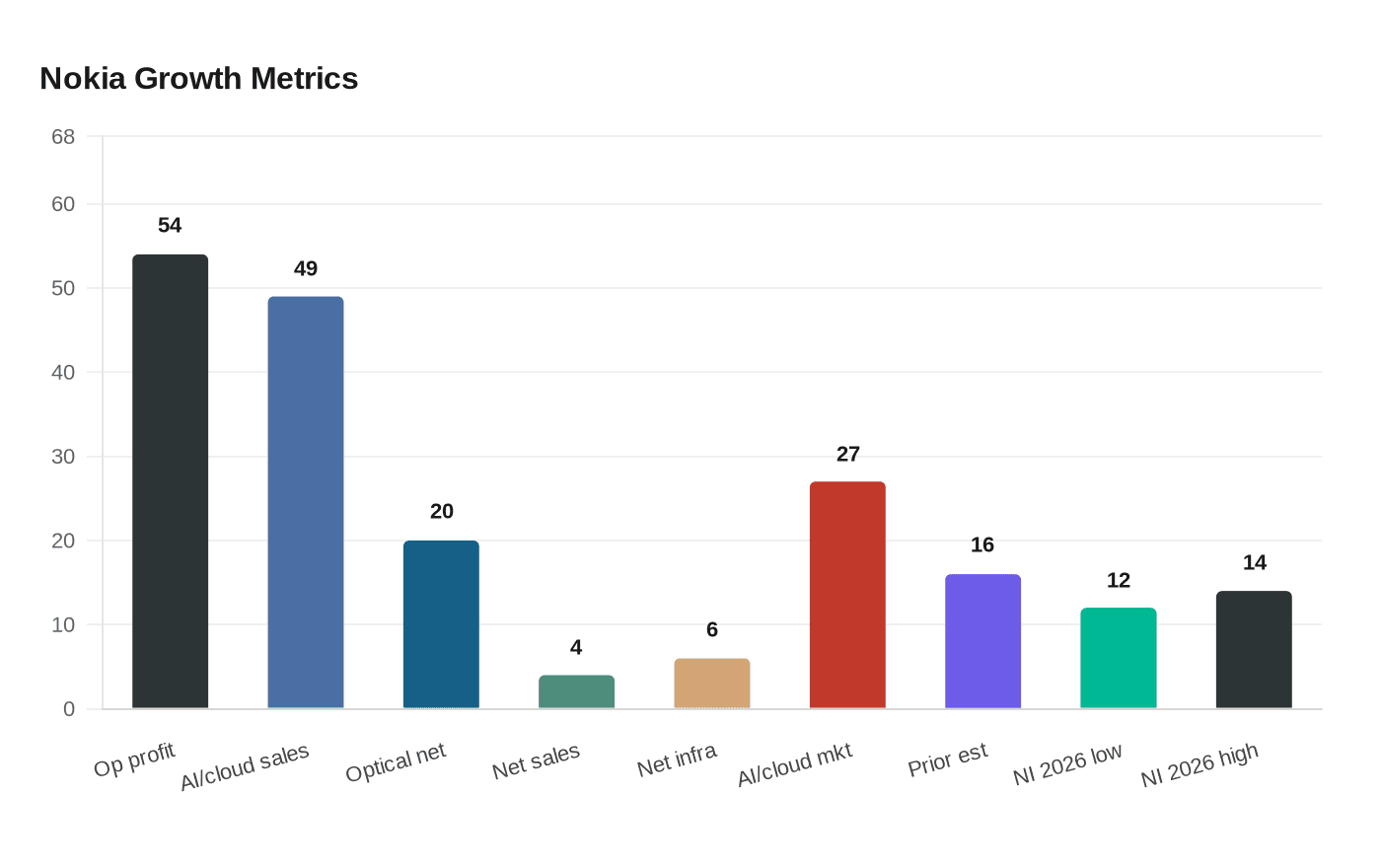
Nokia’s latest quarter offered something investors have been waiting for from the AI boom: evidence that the spending wave is showing up in real orders, not just in market slogans. The Finnish network equipment maker said comparable operating profit rose 54% to 281 million euros, easily topping the 250 million-euro consensus, while the stock climbed nearly 7% in early Helsinki trading to its highest level since April 2010.
The numbers point to a business mix that is shifting toward the infrastructure behind artificial intelligence. Nokia said net sales from AI and cloud customers rose 49% in the first quarter and that it booked 1 billion euros in new orders from those customers. AI and cloud buyers now account for 8% of group sales, a sign that hyperscalers and other data-center operators are becoming a meaningful revenue engine for a company long associated with mobile networks and consumer handsets.
The broader quarter was solid, if less dramatic, with comparable net sales up 4% year over year on a constant-currency and portfolio basis. Network Infrastructure sales rose 6%, Optical Networks grew 20%, and free cash flow reached 0.6 billion euros. Nokia ended the period with a net cash balance of 3.8 billion euros, giving management more room to invest while the company still keeps its full-year comparable operating profit outlook at 2.0 billion to 2.5 billion euros.

Nokia also sharpened its view of the market it is chasing. It now expects the addressable AI and cloud market to grow 27% a year from 2025 through 2028, up from a 16% estimate it gave in November 2025. At the same time, it raised its 2026 Network Infrastructure growth forecast to 12% to 14%, from 6% to 8%, a stronger signal that demand is no longer confined to a few early projects.
That shift has been reinforced by Nokia’s acquisition of Infinera, which closed on February 28, 2025. Nokia said the San Jose-based optical networking company would improve scale and profitability in optical networks, expand its presence with webscale customers and strengthen its position in North America. The deal helped turn Nokia further into a data-center supplier, with Optical Networks sales up 20% in the quarter and new AI and cloud design wins spread across pluggables and line systems.
For a company that spent years fighting investor skepticism, the latest quarter suggests the AI buildout is starting to create tangible winners in old-line telecom infrastructure. The key question now is not whether the market exists, but how quickly Nokia can convert those orders into durable growth.
This article was produced by Prism’s automated news system from verified source data, official records, and press releases, then run through automated quality and moderation checks before publishing. The system is built and supervised by the people who set the standards it runs under. Read our full AI policy.
Did this article answer your question?