North Korea Claims New Missile Can Strike U.S. Mainland, Experts Skeptical
North Korea's Hwasong-14 flew high enough to threaten Los Angeles, but Kim Jong Un's claim of mainland reach still hinges on an unproven warhead.
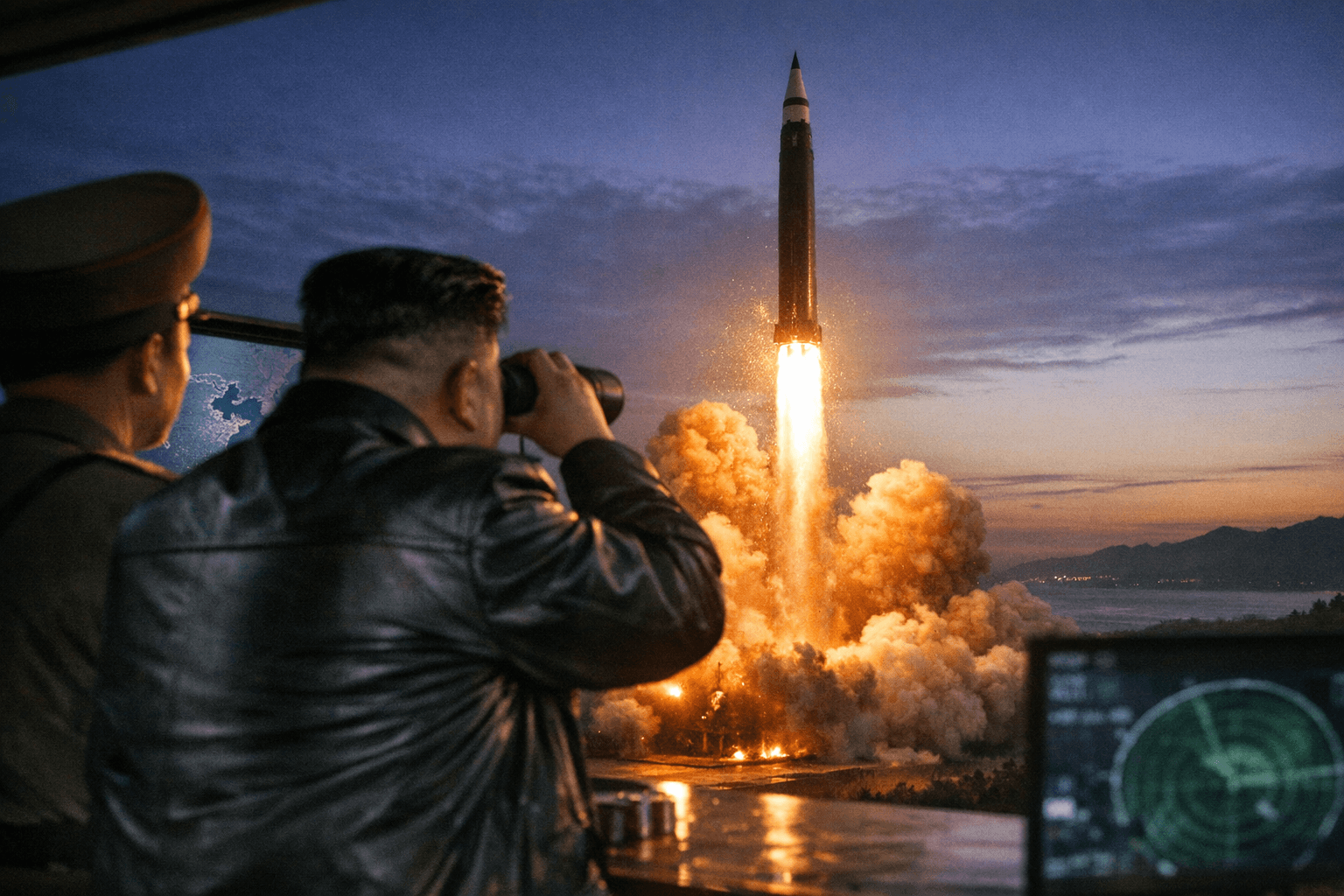
When Kim Jong Un turned to celebrate with his troops at Mupyong-ni, near North Korea's border with China, he had apparent reason for satisfaction: the Hwasong-14 had just climbed 3,700 kilometers into the sky, traveled 1,000 kilometers across the sea, and Kim declared that "the whole US mainland" was now within his country's reach. What the missile had not done was prove it could bring a warhead back down.
The Pentagon confirmed the launch as an intercontinental ballistic missile by initial assessment. Pentagon spokesman Capt. Jeff Davis said the missile flew approximately 1,000 kilometers and landed in the Sea of Japan within Japan's exclusive economic zone. "Our commitment to the defense of our allies, including the Republic of Korea and Japan, in the face of these threats, remains ironclad," Davis said. "We remain prepared to defend ourselves and our allies from any attack or provocation."
A combined analysis by U.S., South Korean and Japanese authorities showed the missile flew for about 45 minutes, reaching a peak altitude of 3,700 kilometers (2,300 miles). David Wright of the Union of Concerned Scientists said that if the same Hwasong-14 were fired on a flatter, standard trajectory, it would put Los Angeles, Denver and Chicago well within its range, with a possible reach extending to New York and Boston. Wright cautioned that early analysis could not determine how heavy a payload the missile was carrying; the heavier the warhead, the shorter the range. The Union of Concerned Scientists estimated, based on trajectory data, that the missile could "easily reach the U.S. West Coast and a number of major U.S. cities."
The question of payload is only one unresolved issue. Some foreign experts said North Korea still faced significant technological hurdles ensuring warheads could survive the violent conditions of atmospheric reentry at hypersonic speeds. Without a demonstrated reentry vehicle, Kim's targeting claim is, in technical terms, a trajectory calculation rather than a confirmed strike capability. Other analysts disputed that the hurdles remained, pointing to the years Pyongyang had spent on its nuclear and missile programs.
The shift toward solid-fuel propulsion added urgency to the deterrence calculus for U.S. and allied planners. Solid-fuel missiles can be stored ready to fire and deployed with far less warning than North Korea's older liquid-fuel missiles, which require on-site fueling and are visible to satellites during launch preparation. State media reported that Kim also observed a ground test of a newly upgraded engine using composite carbon fiber material, with thrust reported by the Korean Central News Agency as 2,500 kilotons, up from roughly 1,971 kilotons in a comparable engine test in September. Observers said the power increase was likely associated with efforts to place multiple warheads on a single missile to defeat U.S. missile defenses.
South Korea's joint chiefs of staff assessed that Friday's test was more advanced than a missile launched earlier this month, based on the distance it traveled. That earlier test had already led analysts to conclude North Korea had the capability to reach Alaska.
Kim described Pyongyang's weapons program as "a precious asset" that cannot be reversed or replaced. North Korean state media framed the test as part of a five-year military escalation program aimed at upgrading what it called "strategic strike means," understood in analytical circles as nuclear-capable ICBMs targeting the continental United States. The test drew condemnation from the United States, China, Japan and South Korea.
The 45-minute flight and 3,700-kilometer altitude are data points. A city on the receiving end of a functioning nuclear warhead would need the reentry vehicle to work, too.
This article was produced by Prism’s automated news system from verified source data, official records, and press releases, then run through automated quality and moderation checks before publishing. The system is built and supervised by the people who set the standards it runs under. Read our full AI policy.
Did this article answer your question?