North Korea fires short-range missiles after IAEA warns of nuclear advances
North Korea fired multiple short-range missiles hours after the IAEA warned of “very serious” nuclear advances, sharpening pressure on U.S. allies in the region.

North Korea escalated again before dawn, firing multiple short-range ballistic missiles from the Sinpo area on its eastern coast at about 6:10 a.m. local time and sending them roughly 140 kilometers toward the East Sea, also known as the Sea of Japan. South Korea said the launch involved several missiles and that South Korean and U.S. intelligence authorities were still analyzing the exact specifications.
The timing raised the stakes well beyond a routine weapons test. Just days earlier, International Atomic Energy Agency Director-General Rafael Grossi warned in Seoul that North Korea had made “very serious” advances in its ability to produce nuclear weapons. Grossi cited the probable addition of a new uranium enrichment facility and stepped-up activity at the Yongbyon complex after meeting South Korea’s foreign minister. The missile launch tied that warning directly to an active demonstration of force.
The barrage was North Korea’s seventh ballistic missile launch of 2026 and its fourth in April, underscoring how quickly Pyongyang has accelerated its testing cadence. It followed a recent run of weapons activity that included ballistic missiles, anti-warship cruise missiles and cluster munitions. The pattern has fueled broader concern that North Korea is pushing ahead with both missile and nuclear programs despite U.N. sanctions.
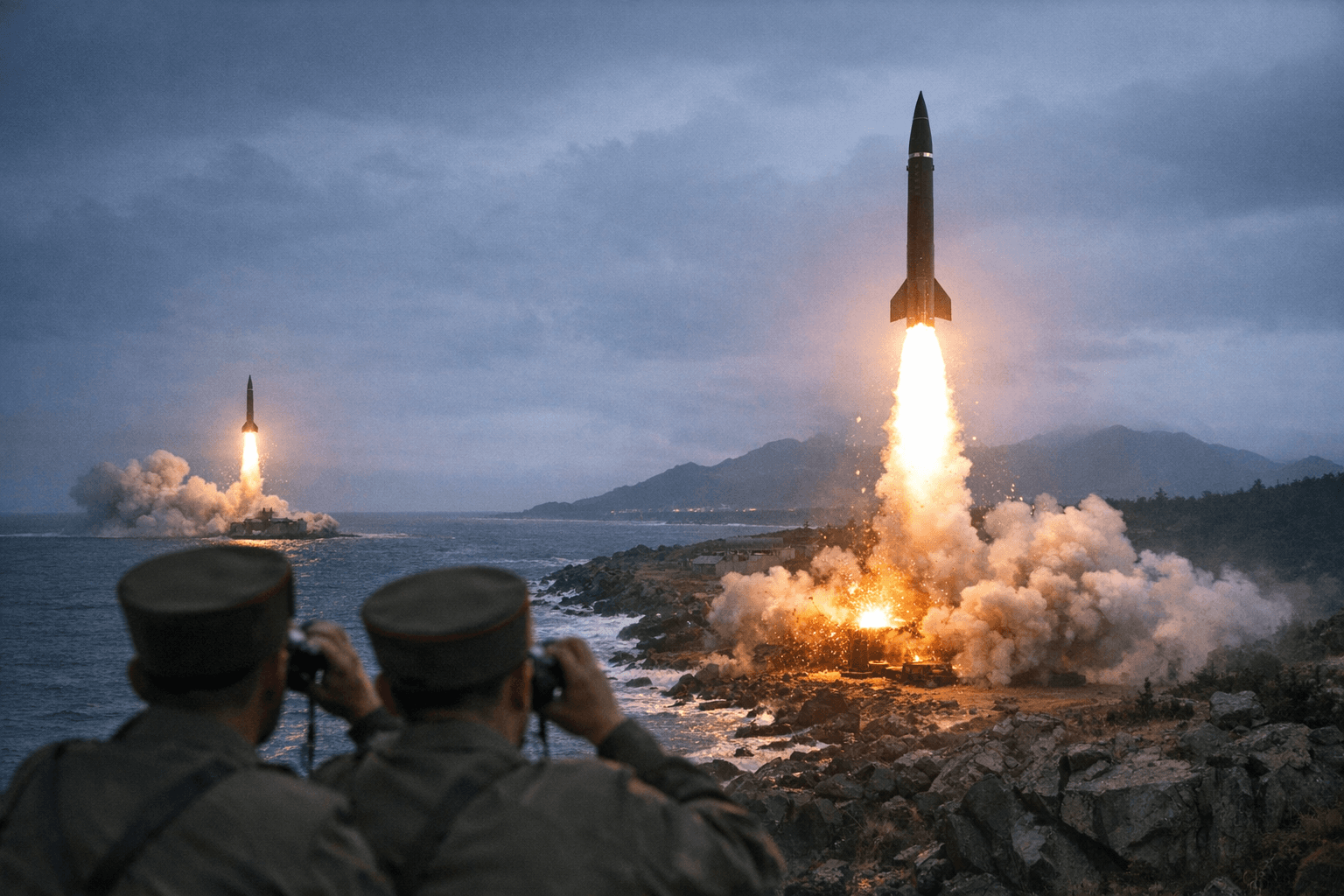
South Korea’s Joint Chiefs of Staff said the military was maintaining a heightened surveillance posture and sharing information closely with the United States and Japan. Japan said it was monitoring the launches, which were believed to have fallen near the Korean Peninsula’s east coast. The cross-border coordination reflected the immediate military concern created by each new test, especially when the launch is paired with a fresh warning about nuclear expansion.
Analysts said the timing suggested more than a simple technical trial. It pointed to Pyongyang seeking to display self-defense capabilities, reinforce deterrence and gain leverage as regional tensions rise around North Korea’s expanding arsenal. Whether Kim Jong Un is signaling confidence in new systems, trying to bargain from a stronger position, or both, the message to Seoul, Washington and Tokyo was clear: North Korea is pressing ahead on parallel nuclear and missile tracks, and regional defense planners will have to account for both at once.
This article was produced by Prism’s automated news system from verified source data, official records, and press releases, then run through automated quality and moderation checks before publishing. The system is built and supervised by the people who set the standards it runs under. Read our full AI policy.
Did this article answer your question?