North Slope Board Member, Student Testify Before Legislature on Maintenance Crisis
North Slope board member Frieda Nageak and student Faith Brower joined a statewide fly-in in Juneau to warn lawmakers that decades of deferred maintenance are endangering rural schools.
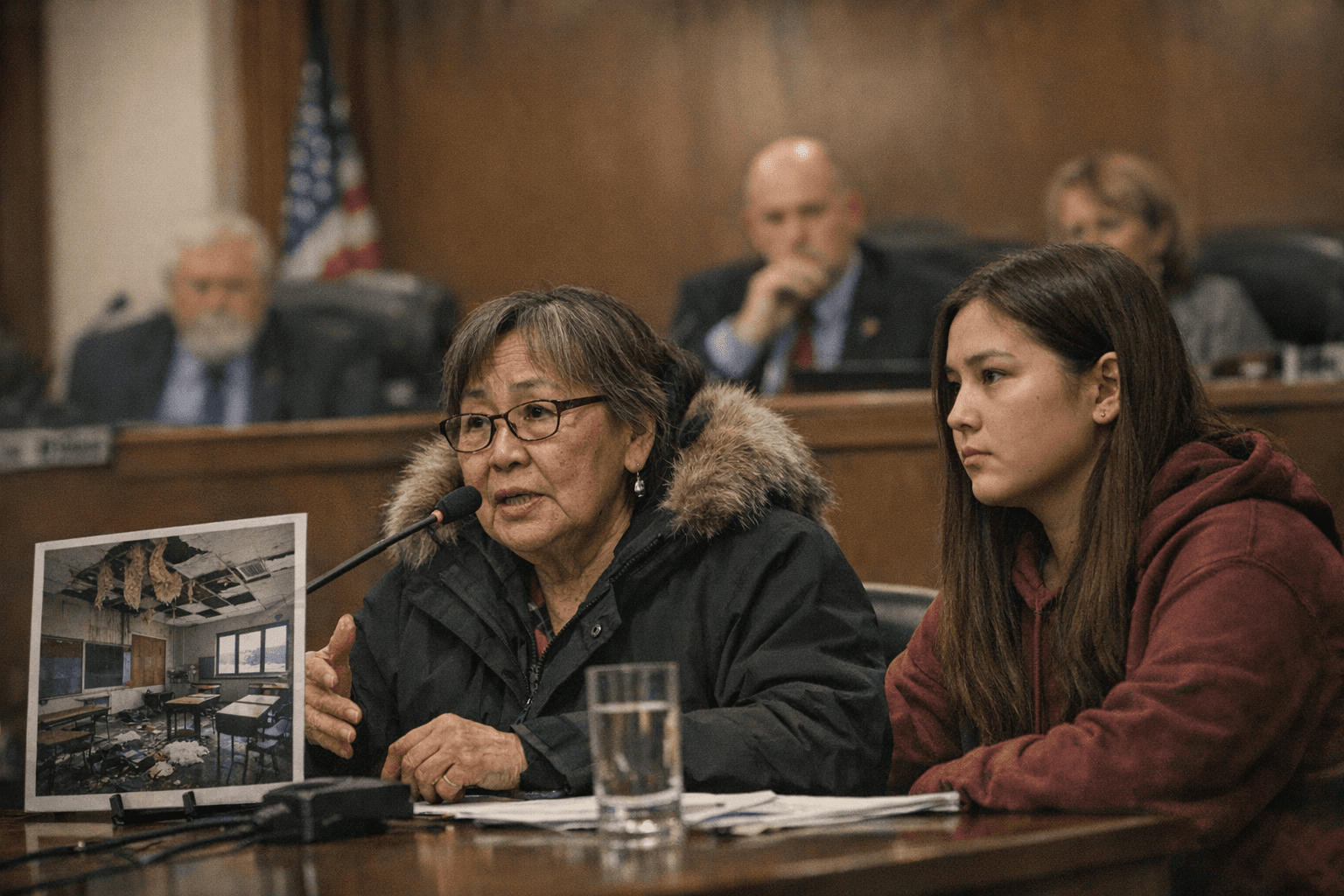
Frieda Nageak, a North Slope Borough School District board member, and student Faith Brower were among students and school board members who traveled to Juneau for the Association of Alaska School Boards’ annual fly-in and testified before a joint session of the House and Senate Education committees that decades of deferred maintenance have created a crisis in Alaska schools.
Speakers painted a picture of failing infrastructure in village schools: leaky roofs that left parts of buildings on the verge of collapse, failing water and sewer systems, old playground equipment and classrooms made smaller by budget-driven closures. The Sleetmute school was offered as a concrete example; House Speaker Bryce Edgmon called that building “the poster child” for what is wrong with how the state pays to build and maintain schools. Testimony emphasized that rural districts are particularly vulnerable because many cannot raise local taxes and rely almost entirely on the annual state budget.
Lawmakers and advocates provided stark dollar figures to quantify the problem. Sen. Bert Stedman reported, “Now this year, we’ve got $401 million on the deferred maintenance list of schools.” Districts estimate they need nearly $800 million to keep buildings safe and operating, while the recent legislative session produced $40 million for school construction and maintenance - roughly 5% of districts’ stated needs. Lon Garrison, executive director of the Association of Alaska School Boards, warned of a breaking point: “I have been in this building every February for 20 years, and for 20 years I have been saying nearly the same exact thing, and we’re at a point now where that conversation is at an inflection point.” He added, “Pretty soon, public education will not work in the state of Alaska,” and urged action: “And we have to do something. We have to be bold.”
The fiscal and political context complicates any quick fix. Oil produced from Alaska’s North Slope dropped in price by more than a third from 2014 to this spring, contributing to a state revenue shortfall and projections from some economists that the budget deficit could exceed $1 billion by next year. Legislators noted the difficulty of allocating scarce dollars among priorities such as transportation and disaster relief while facing the prospect of vetoes from the governor. Sen. Stedman urged collaboration: “We need to have a dialogue with the administration and try to get them to work with us so we can, you know, slow down this deferred maintenance. Because every year doesn’t get addressed, it just gets worse.”
Testimony from communities across Alaska - from the North Slope to the Yukon Flats, Yakutat and Hoonah - stressed operational consequences: stretched budgets, cuts to classes, teachers and activities, school closures and growing risks to student safety and mental health. State senators reacted with a mix of alarm and resolve, calling investigation findings “heartbreaking” and acknowledging that “the responsibility lies squarely on the Legislature.” Senate Majority Leader Cathy Giessel said, “We are working to right the ship!”
For North Slope residents, the fly-in underscores that local schools’ safety and programming hinge on state budget decisions this session. Lawmakers must now reconcile those competing demands during negotiations; communities will be watching whether the administration and Legislature can move beyond crisis management to sustained funding that prevents further closures and protects student safety.
Know something we missed? Have a correction or additional information?
Submit a Tip