NRC Staff Recommends Sweeping Overhaul of Baseline Reactor Oversight and Security Inspections
NRC staff recommends cutting baseline ROP inspection hours by 38% and baseline security inspection hours by about 50%, including Force-on-Force, in SECY papers released Feb. 18, 2026.
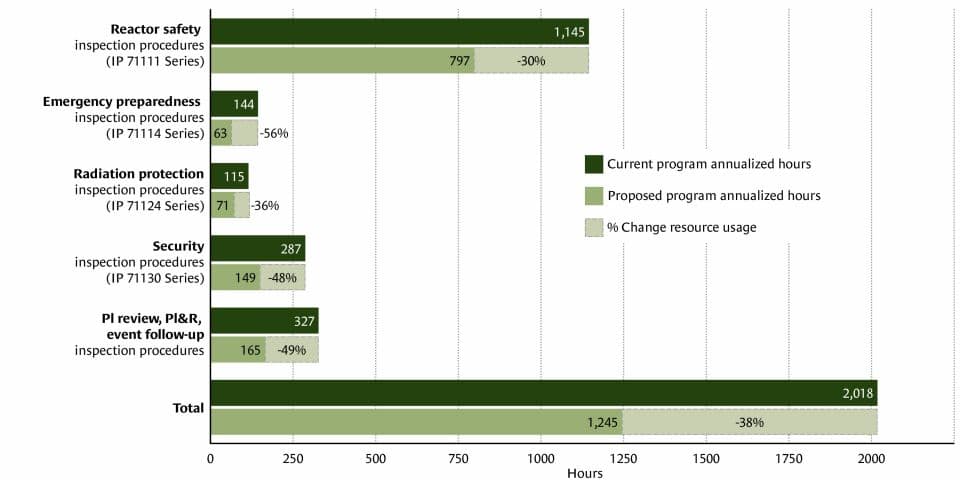
NRC staff delivered a pair of staff recommendation papers that would sharply reduce how the agency inspects U.S. nuclear plants, proposing a 38 percent cut in Reactor Oversight Process baseline inspection hours and about a 50 percent cut in baseline security inspection hours, the latter figure inclusive of Force-on-Force exercises. The recommendations appear in SECY-26-0014 and companion SECY-26-0015, documents the staff released publicly on February 18, 2026 after Executive Director for Operations Michael King submitted recommendations to the Commissioners in early February.
SECY-26-0014 runs 31 pages and frames the proposals as potentially “among the most significant in the ROP’s 25-year-plus history.” The staff paper argues the changes are needed to streamline inspection and assessment of plant performance while remaining responsive to credible risks identified during the process. The SECY text explicitly says the recommendations are “consistent with the NRC's journey to be a more modern, risk-informed, and performance-based safety regulator.”
The overhaul targets specific inspection procedures in reactor safety, emergency preparedness, radiation protection, and the problem identification and resolution portions of the oversight program. NRC staff estimated the ROP baseline revisions could reduce direct inspection hours at U.S. nuclear power plants by 38 percent. On the security side, the staff recommends changes to the baseline security inspection program that would reduce direct inspection hours by about 50 percent compared to current levels, and that figure includes the Force-on-Force inspection program.
The staff recommendations arrive against congressional and executive mandates. The 2024 ADVANCE Act, Pub. L. No. 118-67, Div. B, § 507, required NRC to assess its oversight and inspection programs and identify improvements; Executive Order 14300 and related White House language also directed the agency to revise ROP and reactor security rules, establish high-volume licensing processes for microreactors and modular reactors, and adopt determinate, data-backed thresholds for safety assessments. The SECY papers position staff work as responsive to those statutory and executive directives.

Industry had pushed similar themes. The Nuclear Energy Institute’s July 2025 paper “Accelerating NRC Reform INDUSTRY RECOMMENDATIONS” urged an ROP overhaul, shifting focus to actual safety significance, risk-informing performance indicators and the Significance Determination Program, redesigning the Force-on-Force program, removing prescriptive security requirements, and “right-sizing” cybersecurity standards. NEI proposed immediate actions via policy and exemption authority with full codification by November 2026 through rulemaking, language the SECY documents engage with in assessing implementation options.
Procedural next steps remain with the Commission. An earlier planning paper, SECY-25-0045, had envisioned completing a comprehensive review and preparing a notation vote paper to the Commission by April 2026; SECY-26-0014 and SECY-26-0015 represent the staff’s concrete recommendation product released in mid-February. If the Commission adopts staff proposals, NRC inspection resources would be reallocated across reactor safety and security areas, with specific implementation timing and regulatory changes to be set through the agency’s follow-on rulemaking and policy actions.
Know something we missed? Have a correction or additional information?
Submit a Tip
_730_93825.jpg&w=1920&q=75)