Nvidia's Huang says AI is creating jobs, not destroying them
Jensen Huang said AI is creating "an enormous number of jobs" as warnings grow about entry-level white-collar work. The real test is whether those jobs arrive faster than disruptions.

Jensen Huang used the Milken Institute’s 2026 Global Conference in Los Angeles to make a sweeping case that artificial intelligence is enlarging the labor market rather than hollowing it out. The Nvidia chief said AI is creating "an enormous number of jobs" and called it a major opportunity to "re-industrialize" the United States, putting him squarely against the darker forecasts now driving debate over work, wages and hiring.
Huang’s argument is more than a slogan. It is a testable claim about timing, scale and who benefits first. He has recently pushed back on Anthropic chief executive Dario Amodei’s warning that AI could eliminate 50% of entry-level white-collar jobs in the next one to five years, arguing that dire messages can frighten young people away from careers and worsen shortages in critical fields. In May 2025, Huang sharpened that point by saying workers may "lose your job to somebody who uses AI," a line that frames the competition as a race to adopt the tools rather than a simple handoff from human labor to machines.

The broader labor-market evidence is less absolute than either camp suggests. The International Monetary Fund said in January 2024 that about 40% of global employment is exposed to AI, and about 60% of jobs in advanced economies are exposed. That exposure does not mean immediate replacement, but it does mean many workplaces are vulnerable to major redesign, especially in countries where cognitive work makes up a larger share of employment.

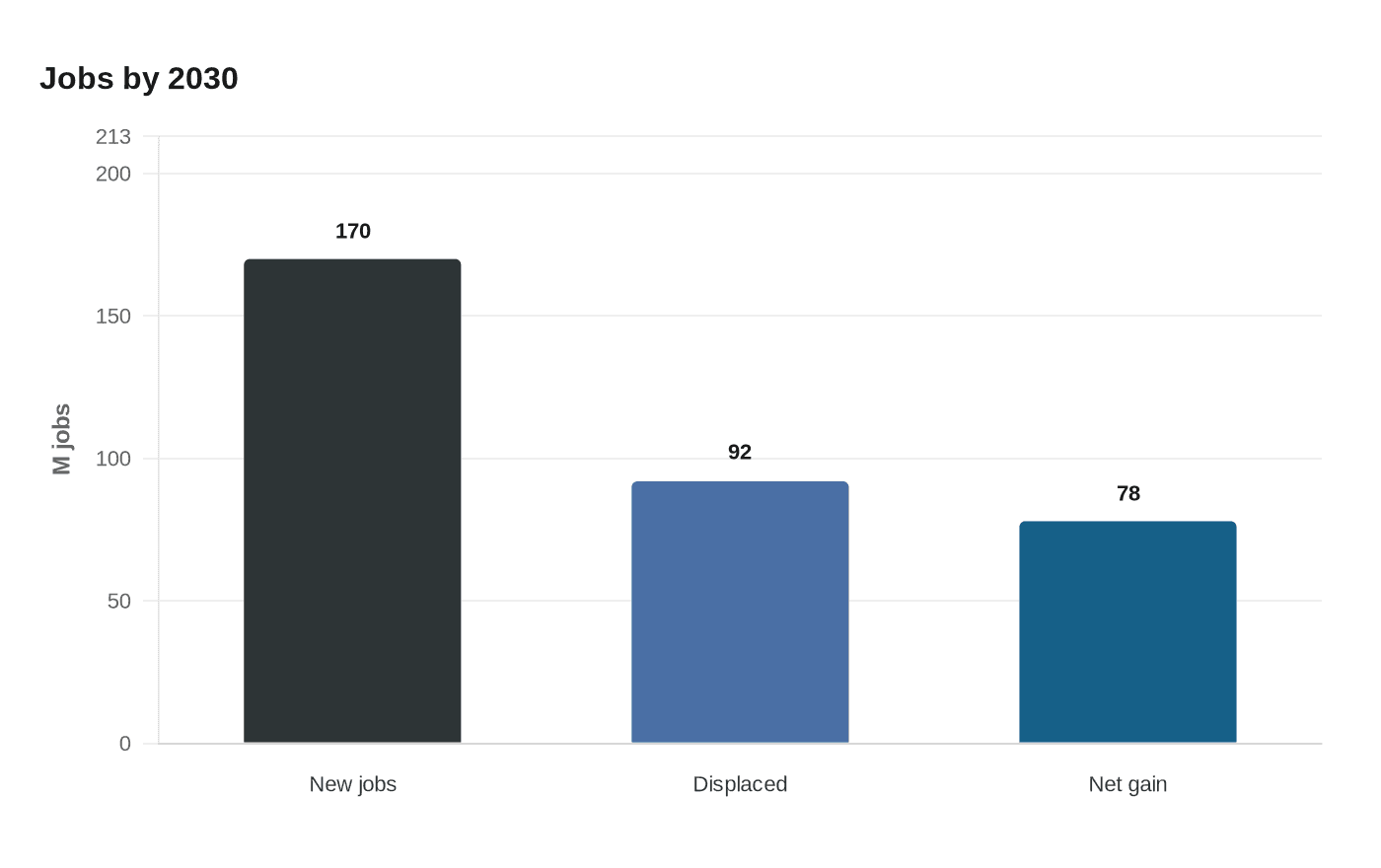
The World Economic Forum’s 2025 Future of Jobs Report projected 170 million new jobs and 92 million displaced by 2030, for a net gain of 78 million jobs. The U.S. Bureau of Labor Statistics said in 2025 that AI is expected to primarily affect occupations whose core tasks can be replicated by generative AI, while jobs in computer, legal, business and financial, and architecture and engineering fields may also be affected. Those are the same categories that have long served as entry points into the middle class, which is why Huang’s optimism is being measured not against abstract productivity gains but against concrete concerns about who gets displaced, who gets retrained and how quickly new demand appears.
That is the political and economic fault line now emerging around AI. Huang is betting that the technology will expand opportunity and strengthen U.S. industry. Labor institutions are warning that the shift will be uneven, and workers will feel the strain before the gains are evenly shared.
This article was produced by Prism’s automated news system from verified source data, official records, and press releases, then run through automated quality and moderation checks before publishing. The system is built and supervised by the people who set the standards it runs under. Read our full AI policy.
Did this article answer your question?


