Offshore wind transmission lines would add $1.68 annually to Humboldt County households
Analysis finds offshore wind transmission would add about $1.68 a year to the average California household, a modest cost that affects Humboldt residents.

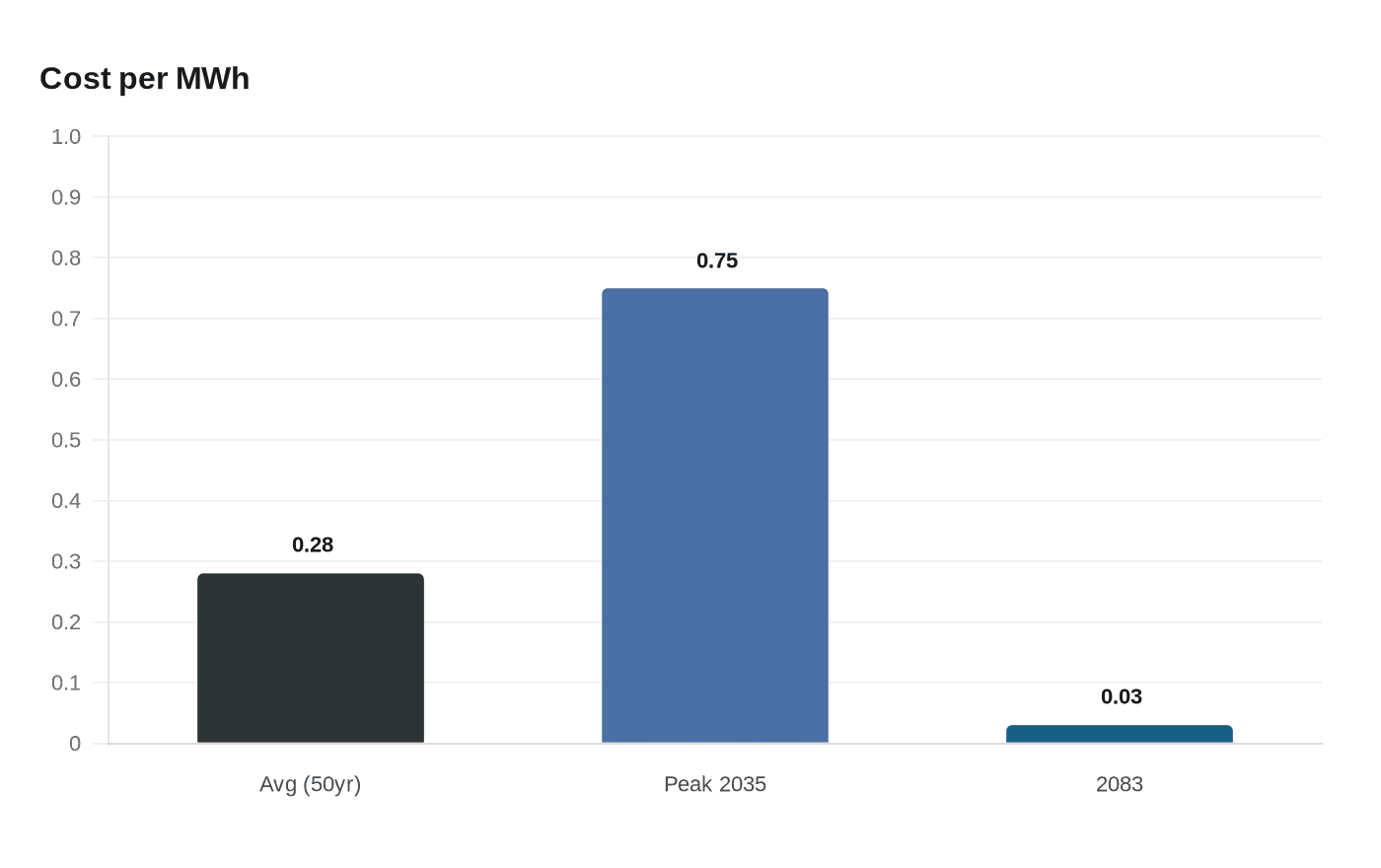
A new analysis of transmission needed to carry offshore wind from the Humboldt Wind Energy Area estimates a modest hit to household bills: about $0.28 per MWh on average, which the report converts to roughly $1.68 per year for the average California household in 2025 dollars. The figure was highlighted in a local analysis and is detailed in a Schatz Center report modeling ratepayer impacts when developer costs are spread across the CAISO-managed grid.
The projects examined are three pieces of infrastructure: a new 500 kV substation at Humboldt Bay and two 500 kV transmission lines, one connecting Humboldt Bay to the Collinsville substation near Pittsburg and a second to the Fern Road substation northeast of Redding. The projects are sponsored by California Grid Holdings LLC, a subsidiary of Viridon Holdings LLC, and are described as approved by the California Independent System Operator. The Schatz Center summarizes the scope as “developing major new infrastructure – including a substation and two 500kV transmission lines – to enable offshore wind power from the Humboldt Wind Energy Area to reach the broader California electric grid.”
Methodology and assumptions matter for the bottom-line number. The Schatz Center report states, “Our findings show that Viridon’s recoverable costs, when spread across all customers on the CAISO-managed grid over the expected 50-year project lifetime, result in an estimated average cost to ratepayers of $0.28/MWh – or approximately $1.68 per year for the average California household (in 2025 dollars).” That calculation uses Viridon’s recoverable cost estimate leveled over a 50-year lifetime and expressed in 2025 dollars.
The analysis also maps a time profile: costs are projected to peak as the projects come online and then decline. “As shown below, ratepayer costs associated with this transmission development are expected to peak in 2035 (when the projects come online) at $0.75/MWh – $4.52/year for the average household – and decline steadily to $0.03/MWh by 2083.” The report also says, “These projects are currently scheduled to come online by the end of 2034,” a slight timing discrepancy within the same analysis that flags a need for schedule clarification.
For Humboldt County residents the headline number is small in dollar terms, but it signals who bears long-term system costs if developer recoveries are socialized across the CAISO grid. Local ratepayers would share in the statewide average; exact impacts on a Eureka or Arcata bill depend on utility allocation, household consumption assumptions and final regulatory decisions.
Next steps for local officials and consumers are clear: obtain the full Schatz Center report for methodology details, request schedule and cost-recovery clarifications from California Grid Holdings LLC and CAISO, and watch for local utility communications. The question for Humboldt is not whether lines will raise bills measurably in the short term, but how project timing and regulatory treatment shape who pays most through the next five decades.
Know something we missed? Have a correction or additional information?
Submit a Tip