Oil prices rise as tensions mount over Strait of Hormuz
Oil climbed as traders weighed a possible Strait of Hormuz disruption, where about one-fifth of global supply flows. A $120 oil shock could lift U.S. gas by as much as $1.25 a gallon.
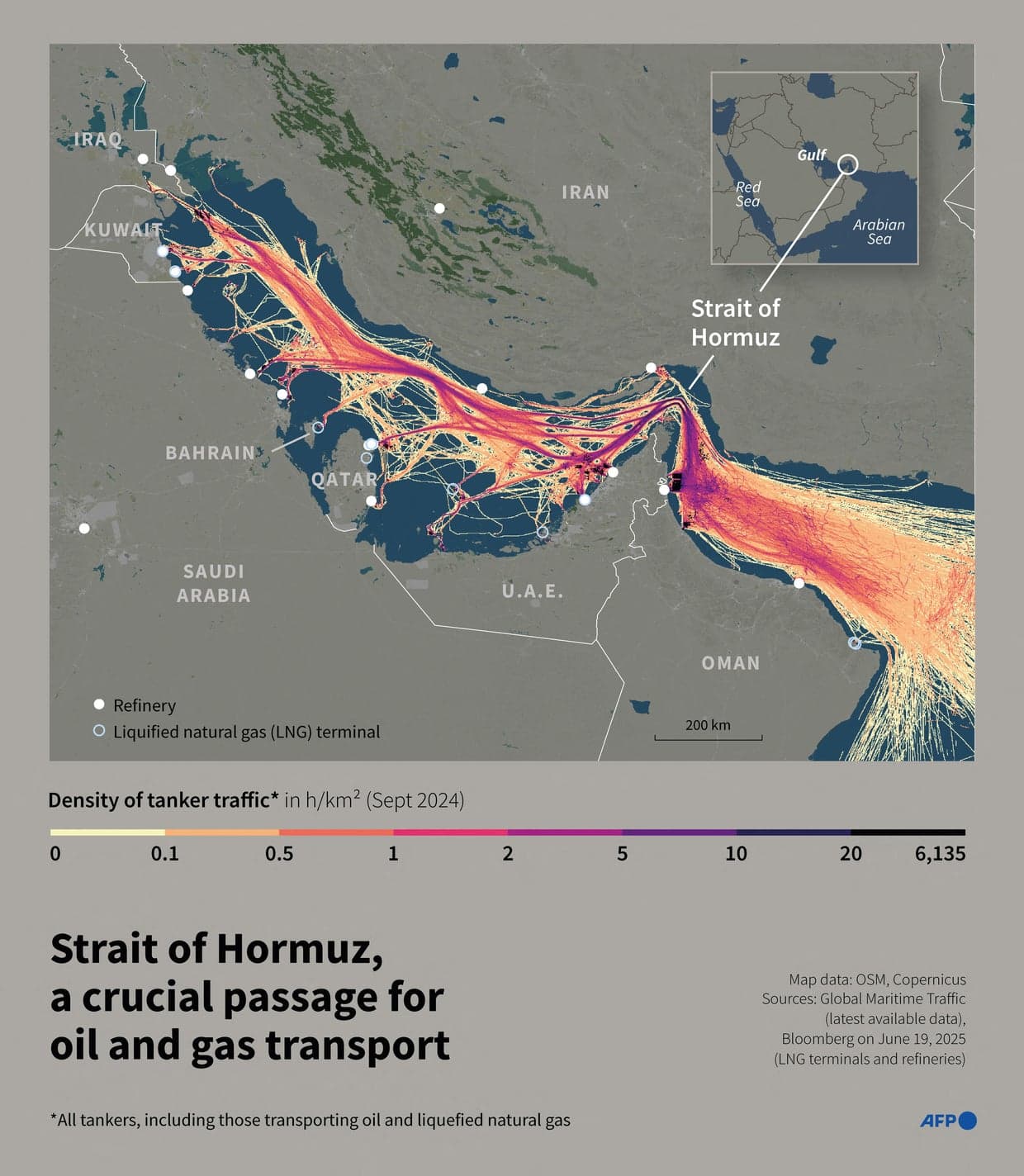
Oil prices edged higher Sunday evening as traders focused on renewed fighting in the Persian Gulf and the risk that traffic through the Strait of Hormuz could slow, with S&P 500 futures little changed after an earlier burst of market stress. The waterway carries about one-fifth of the world’s oil supply, so even a partial interruption would ripple quickly into U.S. gasoline prices, airline fuel costs and inflation expectations.
Benchmark crude had opened about 4% higher in the earlier Sunday session after U.S. strikes on Iranian nuclear facilities, then gave up some of those gains. Last week, oil had already climbed about 3% after Israel’s initial strikes on Iranian targets and Iran’s retaliatory missile attacks. In the earlier market reaction, S&P 500 futures fell about 0.6%, Dow futures dropped roughly 250 points and Nasdaq 100 futures slipped 0.7%.

Shipping companies may reduce traffic before any official shutdown, creating a de facto supply disruption that tightens the market just as drivers and airlines begin to feel it. U.S. Secretary of State Marco Rubio called closing the strait “economic suicide” for Iran and urged China, Iran’s top trading partner, to discourage any move that would interfere with shipping. Iran’s parliament backed closing the passage, but the final decision rests with Iran’s national security council. The U.K. Royal Navy detected electronic interference in the strait.

The International Energy Agency’s June 2026 Oil Market Report forecasts global oil demand will decline by 1.1 million barrels per day in 2026, while global supply is set to fall by 3.9 million barrels per day to 102.4 million barrels per day before rebounding in 2027. OECD government inventories fell to their lowest level since December 1990 as emergency stock releases accelerated. Lipow Oil Associates estimates that if exports through the Strait of Hormuz are affected, oil could quickly reach $100 a barrel, lifting U.S. gasoline by about 75 cents a gallon. In a worst case, $120 oil could push gas prices up as much as $1.25 a gallon, a move that would reach household budgets within days because retail fuel usually trails crude by several days.
This article was produced by Prism’s automated news system from verified source data, official records, and press releases, then run through automated quality and moderation checks before publishing. The system is built and supervised by the people who set the standards it runs under. Read our full AI policy.
Did this article answer your question?

