Oil Prices Spike, Stocks Fall Amid Iran War and Hormuz Strait Tensions
The Dow plunged 1,100 points before settling down 784 on Thursday as U.S. crude surged 8.5% amid Iran's near-shutdown of the Strait of Hormuz.

Anthony Matesic was working the floor at the New York Stock Exchange on Thursday, March 5, when the numbers turned ugly fast. The Dow Jones Industrial Average briefly cratered more than 1,100 points before settling with a loss of 784 points, or 1.6%. Brent crude jumped 15% to around $83 per barrel by March 5. The Middle East crisis has severely disrupted oil exports through the Strait of Hormuz since the U.S. and Israel launched strikes against Iran on Feb. 28.
Benchmark U.S. crude shot up 8.5% on Thursday to settle at $81.01 per barrel, while Brent crude, the international standard, climbed 4.9% to $85.41, each near its highest price since 2024. The S&P 500 fell 0.6%, erasing what had been a small gain for the year so far, and the Nasdaq composite slipped 0.3%. The Russell 2000 index of smaller stocks fell a market-leading 1.9%.
Iran's closure of the Strait of Hormuz has disrupted roughly 20% of global oil supplies. Tanker traffic dropped by approximately 70%, with over 150 ships anchoring outside the strait to avoid risks. Financial markets have been tracking every development: sharp increases in oil are raising fears that a prolonged surge could grind down the global economy, exhaust households' ability to spend and push interest rates higher.
Airlines absorbed some of the worst losses on Thursday. American Airlines lost 5.4%, United Airlines fell 5% and Delta Air Lines sank 3.9%. Higher fuel bills are only part of the pain; the war has left hundreds of thousands of passengers stranded across the Middle East. Smaller companies also took heavy hits, which tends to happen when worries grow about economic strength and rising interest rates.
The yield on the 10-year Treasury rose to 4.13% from 4.09% late Wednesday and from just 3.97% before the war with Iran began. The Federal Reserve had signaled plans to resume rate cuts later this year to boost the job market and economy, but because of the war and higher oil prices, traders pushed their forecasts for the first cut further into the summer. The Fed now faces an uncomfortable bind: keep rates high to contain inflation, or cut them to support an economy already feeling the strain.
Goldman Sachs sharply raised its oil price forecasts, expecting Brent to average $110 in March and April, up from a previous forecast of $98. In the United Kingdom, month-ahead gas prices rose 3.1% to 155p a therm, nearly double their levels before the Iran conflict began.
The geopolitical backdrop grew more volatile over the weekend when Trump issued an ultimatum. Trump wrote on Truth Social that if Iran doesn't "FULLY OPEN, WITHOUT THREAT, the Strait of Hormuz, within 48 HOURS," the United States would "hit and obliterate their various POWER PLANTS, STARTING WITH THE BIGGEST ONE FIRST." Iran answered the threat with attacks on Israel and Gulf states over the weekend, and threatened to respond with attacks on energy infrastructure and by laying sea mines across the "entire Persian Gulf."
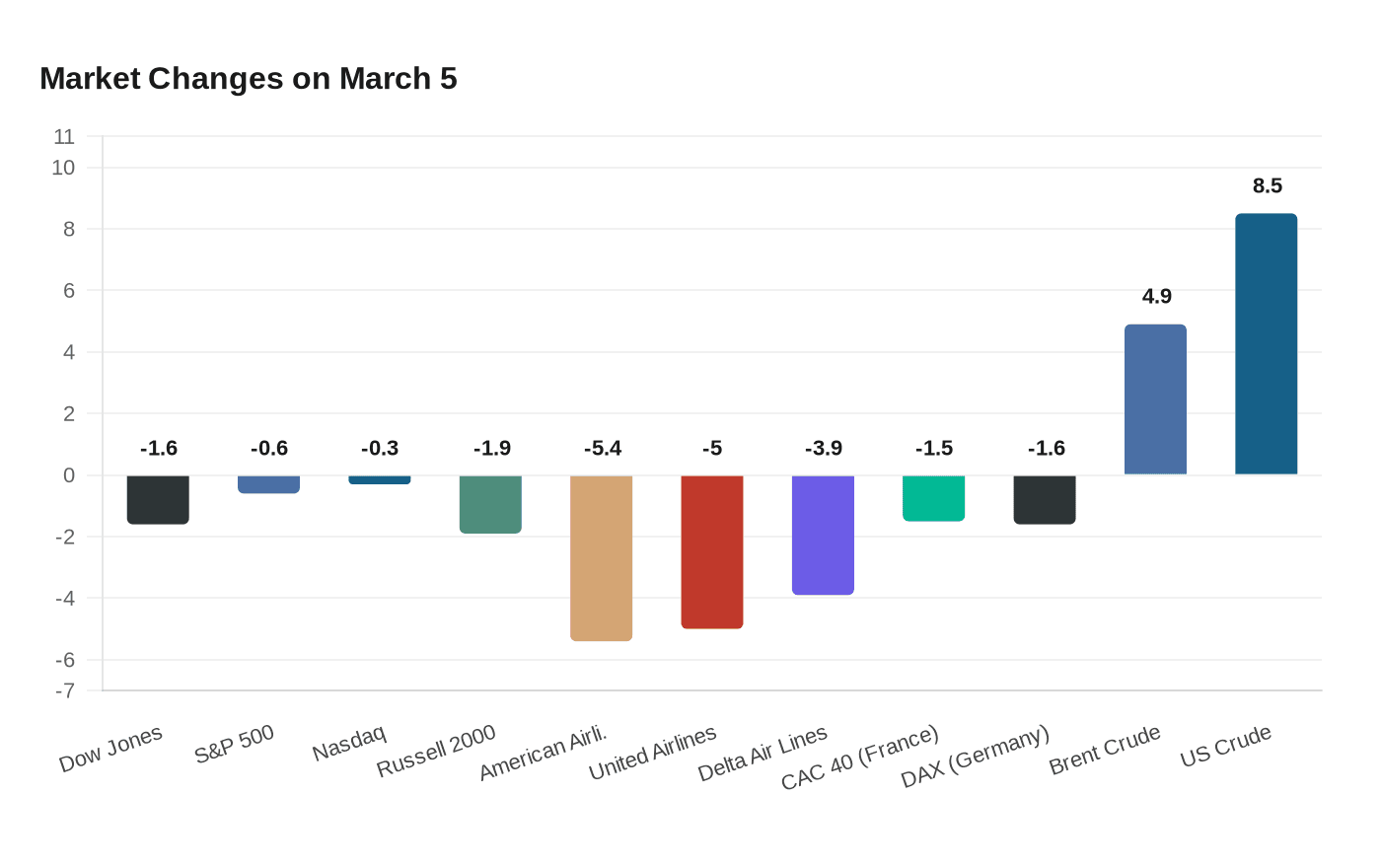
Global markets absorbed the escalation with sharp declines. France's CAC 40 fell 1.5% and Germany's DAX lost 1.6% as oil prices accelerated. In Asia, South Korea's Kospi soared 9.6% to recover much of its 12.1% plunge from the prior session, which had been its worst single-day drop ever.
Despite the turbulence, the S&P 500 was down only 0.7% for the week through Thursday, as gains in Big Tech stocks and oil producers helped blunt broader losses. Scott Wren, senior global market strategist at Wells Fargo Investment Institute, said "the more likely outcome is an increase in market risk aversion that likely lasts only a short time until investors can see a winding down of hostilities." His colleague Paul Christopher, head of global investment strategy at the same firm, added that rapidly mounting escalations could signal "both sides are facing growing constraints that may prevent a long conflict."
Goldman Sachs analysts warned that if Hormuz flows remain at 5% of normal levels through April 10, prices are likely to trend higher, and should those flows remain at 5% for 10 weeks, daily Brent prices could exceed their 2008 record level. The central question hanging over every trading desk is the same one Iran and Washington have yet to answer: how long the strait stays closed.
This article was produced by Prism’s automated news system from verified source data, official records, and press releases, then run through automated quality and moderation checks before publishing. The system is built and supervised by the people who set the standards it runs under. Read our full AI policy.
Did this article answer your question?

