Oil spikes past $110 as Middle East war shutters exports
Tradingeconomics and exchanges reported WTI and Brent jumping above $110 amid Strait of Hormuz disruptions, raising gasoline costs and rattling stock futures.

Tradingeconomics reported that WTI crude oil futures "soared as much as 31% on Monday, before easing back to trade 25% higher around $113 per barrel," as renewed Middle East hostilities and shipping interruptions sent a shock through energy markets. The move pushed electronic Brent and WTI prints through the $110 mark in Sunday evening and early Monday trading, with a Tradingeconomics CFD showing crude at $115.78 on March 9, 2026, up 27.37% from the prior day.
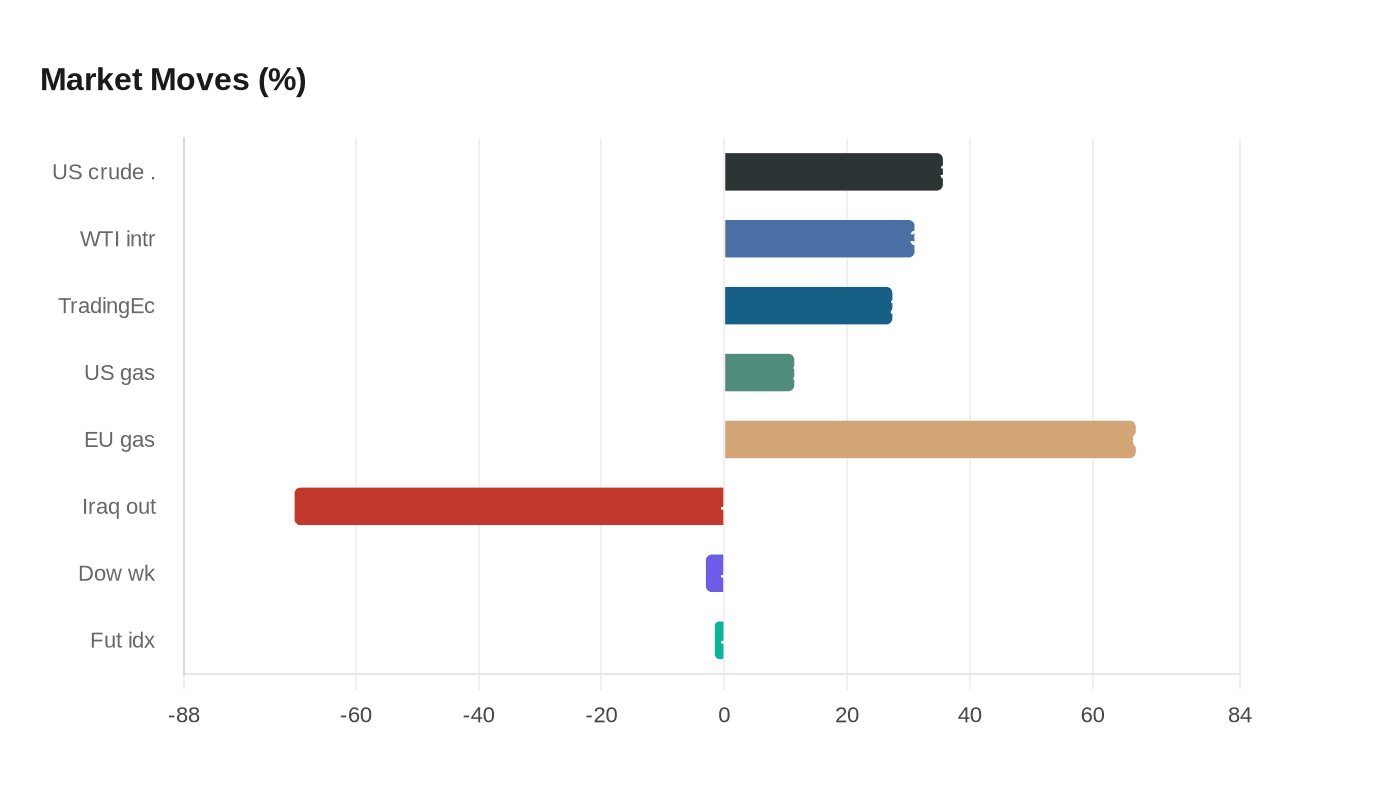
The spike built on an extraordinary weekly advance. Investors reported that "U.S. crude oil futures spiked 35.6% to $90.90 a barrel, a record weekly gain going back to 1983. It's the highest settlement since September 2023," a settlement level that market participants said set the stage for the subsequent intraday eruptions. The New York Times noted that Brent "briefly topped $110 a barrel soon after markets opened," and that futures on the S&P 500, Nasdaq Composite and Dow Jones all fell roughly 1.5 percent on Sunday evening as traders priced in a tightening oil market.
The price moves tied directly to concrete supply disruptions. Tradingeconomics cited industry sources saying that "in Iraq, output from its three main southern oilfields has dropped by 70% to 1.3 million bpd from 4.3 million bpd prior to the conflict." The same account said Kuwait, "OPEC’s fifth-largest producer, also began cutting production on Saturday and has declared force majeure," and that LNG output reductions from Qatar had further tightened global flows. The New York Times reported the Strait of Hormuz, a key shipping lane on Iran’s southern coast, "has been all but closed for more than a week, preventing fuel produced in the region from reaching overseas markets," and noted that "one-fifth of the world’s oil and substantial amounts of natural gas normally move through the strait each day."

Political dynamics intensified market reaction. 1News described the surge as following "Israel and the US attacked Iran on March 1," and Gaspriceguy reported a high-impact leadership claim: "Following the death of longtime Supreme Leader Ayatollah Ali Khamenei, Iran’s powerful Assembly of Experts moved quickly to appoint his son, Mojtaba Khamenei, as the country’s new supreme leader," describing Mojtaba as "widely viewed as a hardline figure with strong ties to Iran’s Revolutionary Guard." Those reports underscore how military escalation and contested political transitions have injected a geopolitical premium into prices.
Knock-on market effects were broad. Investors said U.S. natural gas futures "swelled 11.4%, but European natural gas prices skyrocketed 67%," and that the Dow Jones "slumped 3% in last week's stock market trading, its worst week in 11 months." Gaspriceguy warned wholesalers and refiners, faced with Sunday evening crude moves, may implement "rare 'intra-day' price increases at fuel terminals starting Monday morning," potentially adding another "20–40 cents" to retail gasoline in the next cycle and amplifying price-cycling behavior in states such as Michigan, Indiana, Ohio and Texas.
Tradingeconomics framed the episode in historical terms: the intraday move was "the largest one-day gain since April 2020" and it pushed prices to "the highest price level since June 2022." Its models projected crude averaging $106.28 by the end of the quarter and $118.75 in 12 months, while its dataset also noted a reported all-time high of 410.45 in December 2025. The immediate economic picture is clear: tighter Middle East supplies are forcing a re-pricing of risk across commodities and equities, and consumers can expect higher pump prices and renewed inflationary pressure that will weigh on real spending and financial market stability.
This article was produced by Prism’s automated news system from verified source data, official records, and press releases, then run through automated quality and moderation checks before publishing. The system is built and supervised by the people who set the standards it runs under. Read our full AI policy.
Did this article answer your question?

