Oil Surges Past $100 as Iran War Cripples Middle East Energy Supply
Crude oil topped $100 a barrel as the Iran war enters its second week, with strikes on oil facilities and a near-shutdown of Strait of Hormuz tanker traffic.
Crude oil prices surged past $100 a barrel Monday as the widening Iran war hammered energy infrastructure across the Middle East, with strikes on oil facilities in Tehran, Bahrain and Beirut sending markets into their most volatile session in years.
After trading resumed on the Chicago Mercantile Exchange, Brent crude was at $107.97 a barrel, up 16.5% from its Friday close of $92.69, while West Texas Intermediate rose 16.9% to about $106.22. The intraday swings were far more extreme: WTI surged 31.4% to a peak of $119.48 and Brent climbed as much as 29% to $119.50 before leveling off. The gains extended a punishing prior week in which U.S. crude had already jumped roughly 36% and Brent had risen 28%.
Brent crude had not crossed the $100 threshold since July 2022, when it briefly hit $104 a barrel.
The price shock reflects a near-total disruption of the world's most critical oil artery. Roughly 15 million barrels of crude, about 20% of global supply, normally transit the Strait of Hormuz every day, according to Rystad Energy. The threat of Iranian missile and drone attacks has all but stopped tanker traffic through the strait, squeezing exports from Saudi Arabia, Kuwait, Iraq, Qatar, Bahrain, the United Arab Emirates and Iran itself.
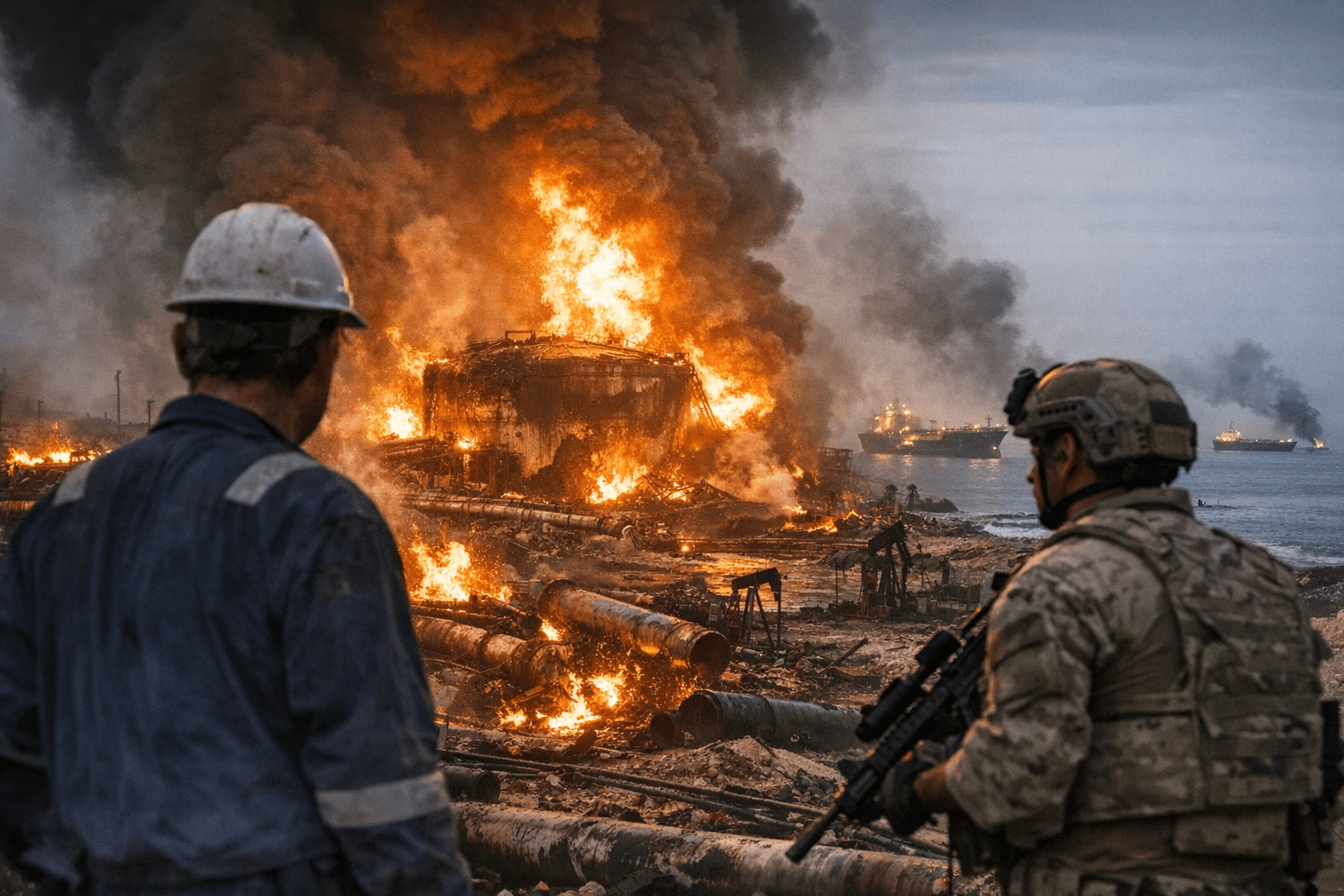
The damage is now physical as well as logistical. Iran struck Bahrain's Al Ma'ameer oil facility Monday, causing a fire and material damage. Bahrain's state-owned Bapco Energies subsequently declared force majeure, a legal step that allows a company to suspend contractual obligations under extraordinary circumstances. Kuwait Petroleum Corporation and QatarEnergy had made similar declarations the preceding week. Iraq, Kuwait and the UAE have cut oil production outright as storage tanks fill with crude that cannot be exported.
A thick plume of smoke rose Sunday from an oil storage facility in Tehran hit by a U.S.-Israeli strike late Saturday, according to an Associated Press photograph taken March 8. Israeli forces also launched airstrikes on Beirut's southern suburbs Monday, with one strike hitting a building belonging to al-Qard al-Hassan, a Hezbollah-linked financial institution sanctioned by Washington. The Lebanese Health Ministry reports 394 people have been killed since fighting between Israel and Hezbollah escalated last week.
Iran exports roughly 1.6 million barrels a day, mostly to China. A sustained disruption to those flows will force buyers to compete for alternative supplies, adding further upward pressure to already strained markets.
The energy shock is radiating through broader financial markets. U.S. stock index futures fell late Sunday, with S&P 500 futures down 1.6%, Dow futures down 1.8% and Nasdaq futures down 1.5%. Natural gas rose 4.6% to about $3.33 per 1,000 cubic feet, extending an 11% gain from the prior week.
President Trump, asked about the price surge, called it "a very small price to pay," according to the Times of India.
The United States and other governments have pledged to release strategic petroleum reserves to dampen the rally, but prices climbed regardless. With the Strait of Hormuz effectively closed to commercial tanker traffic and major Gulf producers declaring force majeure across the region, the market is pricing in the possibility that supply disruptions could deepen before any diplomatic resolution takes hold.
This article was produced by Prism’s automated news system from verified source data, official records, and press releases, then run through automated quality and moderation checks before publishing. The system is built and supervised by the people who set the standards it runs under. Read our full AI policy.
Did this article answer your question?


