Orion's New Space Toilet Aims to Handle Deep Space Waste
Hours after Artemis II's April 1 launch, NASA disclosed a controller glitch in Orion's new toilet, a system engineers spent a decade building to keep four astronauts alive for 10 days in deep space.

NASA astronauts Commander Reid Wiseman, Pilot Victor Glover, Mission Specialist Christina Koch, and CSA astronaut Jeremy Hansen launched at 6:35 p.m. EDT on Wednesday, April 1, 2026, becoming the first humans to travel toward the moon in more than 50 years. Within hours, the spacecraft named Integrity had a problem: its toilet would not start.
During a news briefing after the launch, Amit Kshatriya, NASA's associate administrator, said that mission controllers were tracking a couple of minor issues, including one with the onboard toilet. "We had a controller issue with the toilet when they spun it up, so we got to work through that," he said. "That's going to take a maybe a few hours of troubleshoot."
The disclosure drew knowing laughs, but for the crew of Artemis II, waste management is not a punchline. It is a life support item. The orbit adjustments were designed to put the astronauts in a highly elliptical 24-hour-long orbit, giving them time to check out the Orion capsule, making sure the ship's communications, navigation, propulsion, and life support systems were working properly before heading to the moon. Wiseman laid out the stakes plainly before the mission. "That one 24-hour orbit gives us time to check out all of Orion's environmental control, life support systems," Wiseman said. "Can it scrub our carbon dioxide? Can it keep us alive? Can we drink water? Can we go to the bathroom? All those basic human functions. We've got to go get those things tested before we press out to the moon."
The Universal Waste Management System, or UWMS, represents more than a decade of engineering work. Space infrastructure company Collins Aerospace first entered into a contract with NASA to develop the project in 2015. The system was created to solve longstanding potty problems faced by astronauts, offering amenities that include handles to help them stay steady in microgravity, a system that can handle both urine and feces simultaneously, urine-collection devices that work for both male and female astronauts, and a door for privacy in a cramped crew capsule. 3D-printed from titanium, its lightweight, standardized design means it can easily fit in many different types of spacecraft, including the ISS, the Artemis missions' Orion capsule, and potential future vehicles that have yet to be built. The Orion version is 61% smaller than the toilet used on shuttle missions.
Getting there was not smooth. An Artemis II demonstration on the ISS, meant to mimic the Orion mission in length and crew size, was started in January 2023 but stopped after three days due to a failed dose pump. A second attempt in 2024 ran into its own trouble: the dual fan separator failed to spin during startup, with on-orbit data showing a "locked rotor" fault traced to issues with the controller circuits. The Orion toilet was delivered in December 2019 and installed in the Artemis II vehicle in March 2021. Updated commode seats and fecal bags, refined based on ISS crew feedback, were manufactured and delivered for installation prior to launch.
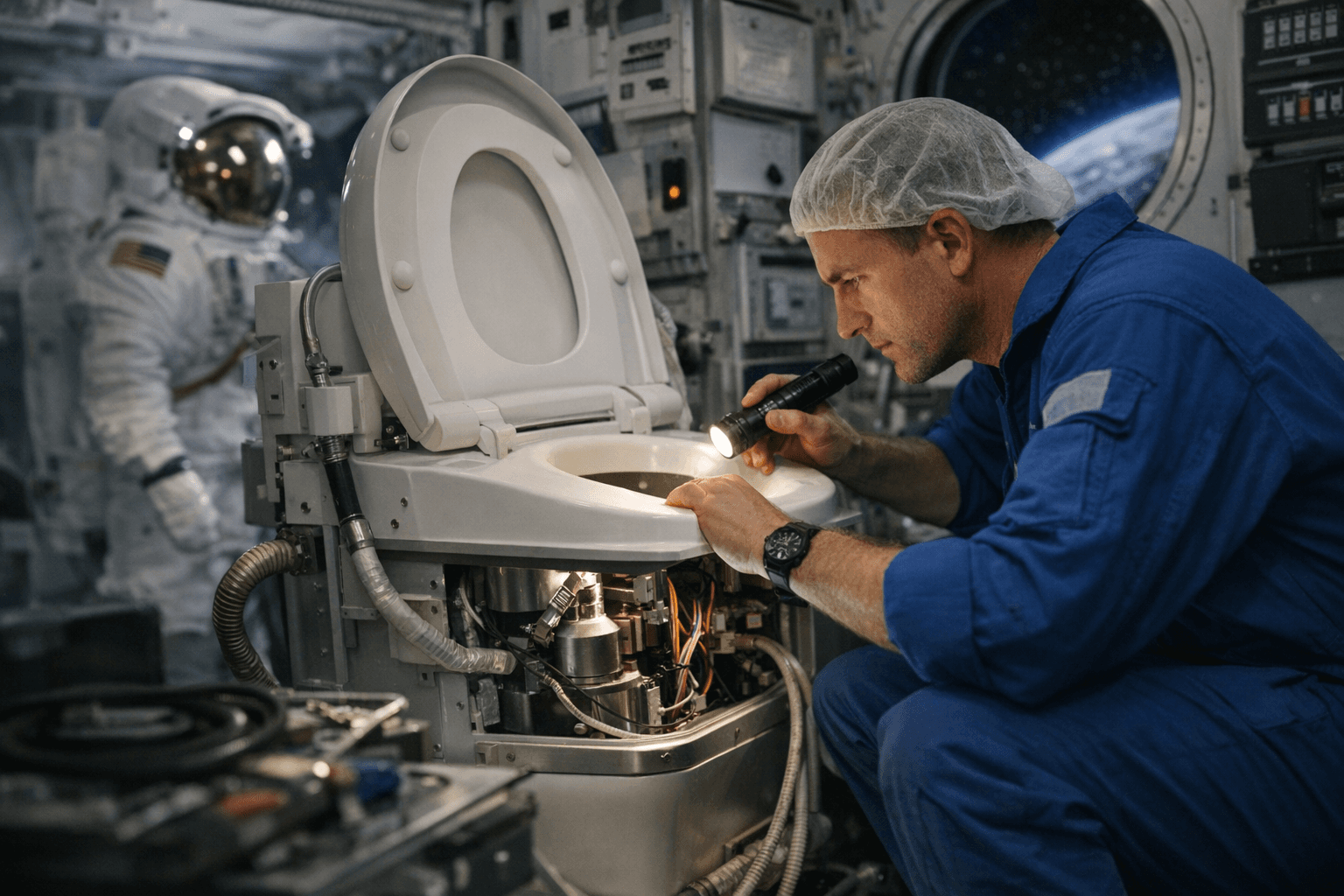
If the UWMS cannot be resolved in flight, the crew has fallback options: backup urine collection bags, with solid waste still disposable from the poop chute. But for a 10-day mission carrying four people beyond Earth orbit with no resupply option, those backups are a last resort, not a plan.
Jeremy Hansen, the Canadian mission specialist, called the crew "pretty fortunate" to have a toilet with a door on the spacecraft. He described it as "the one place that we can go during the mission where we can actually feel like we're alone for a moment."
For UWMS project manager Melissa McKinley, the mission itself is the ultimate test. "I am very excited for the crew to use this," McKinley said. "We'll know so much more when this mission comes back.... It's really going to drive [waste management] on future Artemis missions and the lunar campaign, as well as the Mars campaign to come." NASA has made clear that Artemis II is a test mission, and every system onboard, from propulsion to plumbing, is collecting data that will shape whether humans can survive the far longer journeys ahead.
This article was produced by Prism’s automated news system from verified source data, official records, and press releases, then run through automated quality and moderation checks before publishing. The system is built and supervised by the people who set the standards it runs under. Read our full AI policy.
Did this article answer your question?