Pakistan Offers to Mediate Between United States and Iran Amid Rising Tensions
Pakistan's army chief called Trump while PM Sharif rang Iran's president, as Islamabad positioned itself as the host for US-Iran peace talks that could happen this week.

Pakistan's army chief Asim Munir spoke with US President Donald Trump on Sunday, while Prime Minister Shehbaz Sharif held a telephone call with Iranian President Masoud Pezeshkian on Monday, as Islamabad moved to insert itself as the key intermediary in a war now entering its fourth week.
Pakistan is joining a growing list of countries acting as go-betweens for the United States and Iran, four sources told NBC News, with two of those sources saying an in-person meeting could be held in the coming days in Islamabad. A diplomatic source said Pakistan is in conversations with both the U.S. and Iran and is "well poised to play an active role" in discussions to end the war, which has killed more than 2,000 people and displaced millions.
Pakistani Prime Minister Shehbaz Sharif wrote on X that Pakistan "stands ready and honoured to be the host to facilitate meaningful and conclusive talks for a comprehensive settlement of the ongoing conflict." A Gulf official said Pakistan had been passing messages between the two countries for the past two days.
The diplomatic push drew immediate attention to Munir's personal ties in Washington. Qamar Cheema, executive director of the Islamabad-based Sanober Institute, said U.S. envoy Steve Witkoff "has a direct connection" to Field Marshal Munir, adding: "They have a good working relation." Trump has also spoken warmly about the Pakistani field marshal, calling him a "great general" and "a great guy" in February.
According to Axios, two possible formats are under discussion for a meeting in Islamabad. One involves Iranian Foreign Minister Abbas Araghchi, U.S. envoy Steve Witkoff and Trump's son-in-law Jared Kushner. Another envisions U.S. Vice President JD Vance meeting Iran's parliament speaker, Mohammad Bagher Ghalibaf, who has dismissed Trump's claims of talks as an attempt to "escape the quagmire in which the US and Israel are trapped." These details come from an unidentified Israeli official and remain unconfirmed by Washington or Tehran.
Trump announced that he was delaying his threat to "obliterate" Iran's power plants after "very good and productive" conversations with Tehran to end the war. Iran's response was categorical. Iran's foreign ministry spokesperson Esmaeil Baqaei said Tehran had received messages from the United States through "friendly states" requesting negotiations but insisted appropriate responses were given in line with the country's fundamental positions. Iran's parliament speaker, Mohammad Bagher Qalibaf, dismissed reports of direct negotiations as "fake news," accusing the United States and Israel of attempting to influence financial and oil markets.
The White House did not confirm whether Pakistan was acting as an intermediary with Iran. "These are sensitive diplomatic discussions and the U.S. will not negotiate through the press," press secretary Karoline Leavitt said.
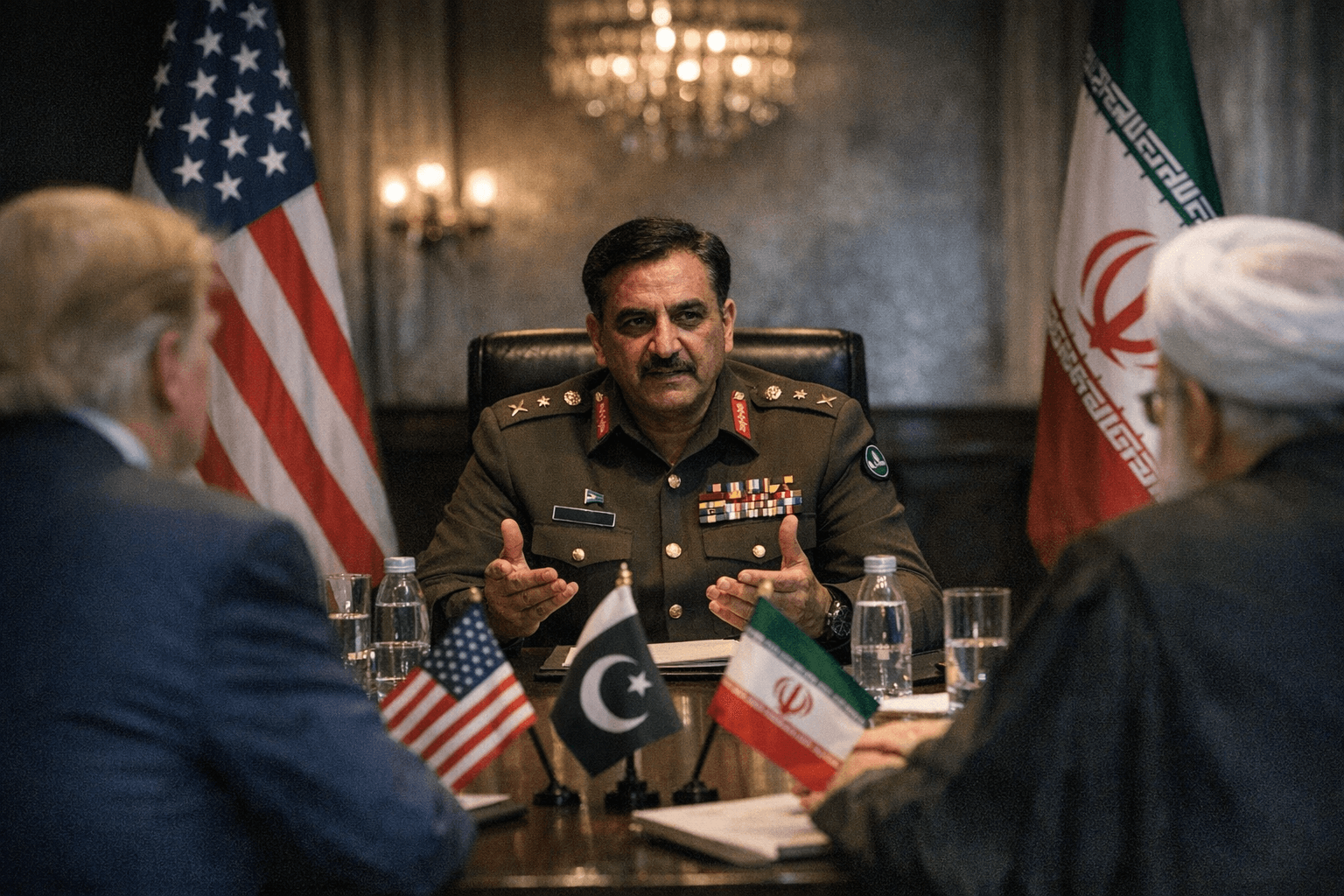
Pakistan's credentials as a go-between rest on a specific and unusual combination of relationships. It is the only Muslim-majority country with nuclear weapons and does not host U.S. military bases. It maintains longstanding ties with Saudi Arabia, dating back to 1947, reinforced by a strategic defence pact signed in September 2025. As far back as March 3, Foreign Minister Dar told Pakistan's parliament that Islamabad was "ready to facilitate dialogue between Washington and Tehran." In the same address, Dar revealed that Pakistan had pushed back against Washington's demand for zero uranium enrichment, instead proposing a monitored framework. "It was agreed that there should be surveillance of two to three countries, and Iran was happy with that," he said.
There is also an institutional link rarely mentioned in public: the latest war on Iran began on February 28 when the U.S. and Israel launched coordinated strikes that killed Supreme Leader Ali Khamenei and many other senior officials, just a day after Oman's foreign minister had declared a breakthrough "within reach." Since then, Pakistan has been among the few governments with uninterrupted channels to both capitals.
Pakistan has been working to facilitate negotiations between Iran and the U.S. since Pakistani Foreign Minister Ishaq Dar visited Saudi Arabia alongside other regional counterparts last week, where he quietly told Arab counterparts Islamabad was mediating, without providing details.
The energy stakes underpinning Pakistan's urgency are severe. The war has killed more than 2,000 people and displaced millions as it enters its fourth week. The head of the International Energy Agency has warned that the disruption already exceeds the combined oil crises of 1973 and 1979. For a country of 260 million people that imports almost all of its crude oil and liquefied natural gas from Gulf nations, the closure of the Strait of Hormuz, which carries roughly one-fifth of the world's oil supply, has translated into acute domestic shortages.
Countries including Pakistan, Oman, Turkey, and Egypt are reportedly acting as intermediaries, quietly facilitating communication in an effort to prevent further escalation. Whether Islamabad can convert that crowded field of mediators into a singular hosting role may depend on whether Trump and Iran's leadership see strategic value in giving Pakistan that visibility, and whether Munir's personal rapport with both sides proves more durable than the diplomacy itself.
Sources:
Know something we missed? Have a correction or additional information?
Submit a Tip