Paraplegic Engineer Becomes First Wheelchair User to Cross Kármán Line
Michaela “Michi” Benthaus, a German aerospace and mechatronics engineer who has used a wheelchair since a 2018 accident, flew on Blue Origin’s New Shepard on Dec. 20, 2025 and became the first person who uses a wheelchair to cross the internationally recognized Kármán line. The roughly 10 minute suborbital flight demonstrated that commercial space tourism can be adapted for people with disabilities, raising practical and policy questions about broader accessibility for future missions.
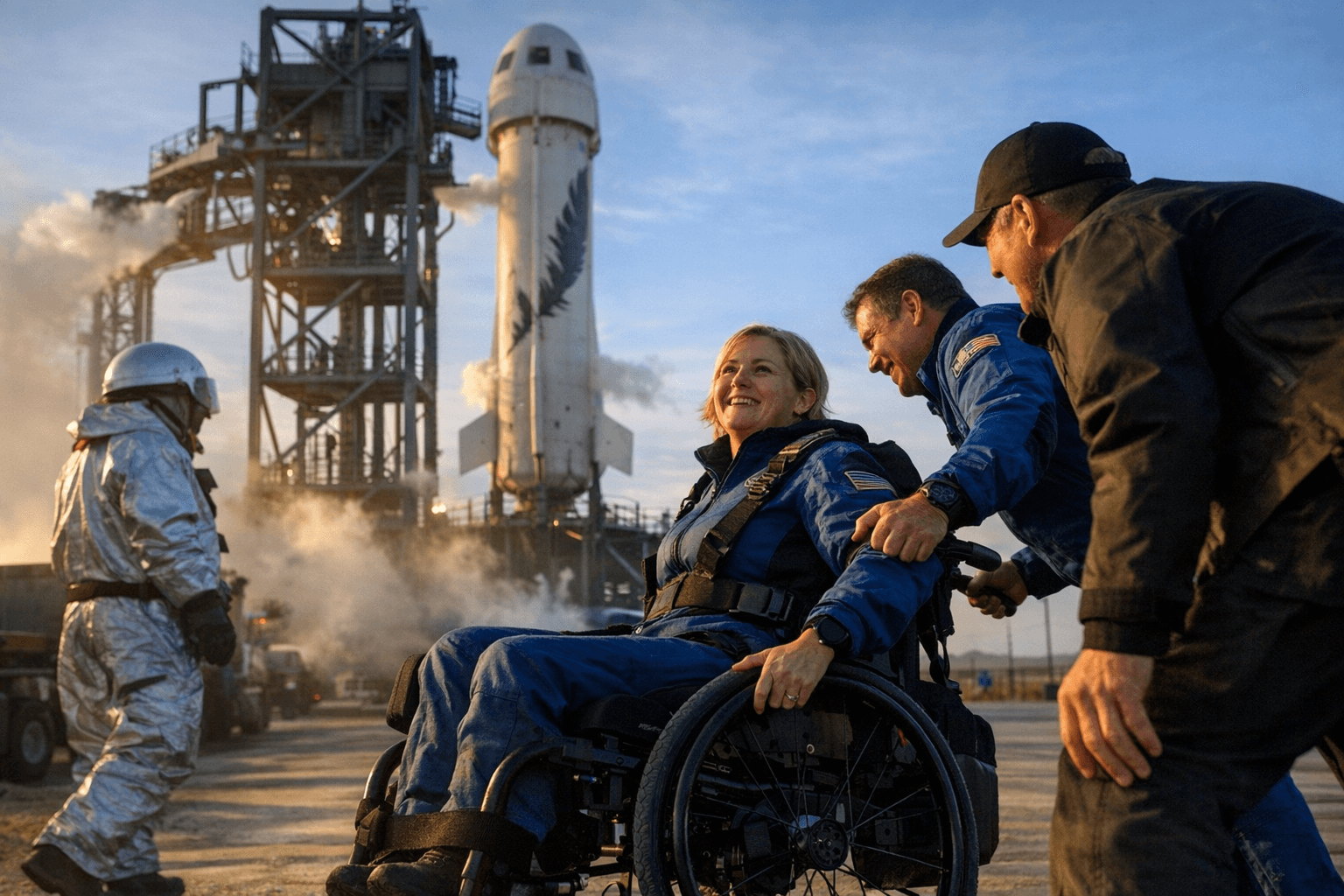
Michaela “Michi” Benthaus rode into space on Dec. 20, 2025 aboard Blue Origin’s New Shepard, becoming the first person who uses a wheelchair to cross the Kármán line. The German aerospace and mechatronics engineer, who was paralyzed in a 2018 mountain biking accident and has used a wheelchair since, joined five other passengers for a roughly 10 minute suborbital mission that reached about 105 kilometres above Earth and delivered slightly more than three minutes of microgravity.
Launched from West Texas and recovered near Van Horn, Texas, the New Shepard flight followed the familiar profile of contemporary suborbital missions. The booster separated and returned for a vertical landing while the capsule coasted to its peak altitude, allowing passengers to unstrap and float in cabin weightlessness. Benthaus, who left her wheelchair behind inside the capsule, spent several minutes experiencing free fall and looking back at Earth from above the Kármán line.
In comments made ahead of the flight Benthaus reflected on how improbable the opportunity felt, saying she “never really thought that going on a spaceflight would be a real option for me because even as like a super healthy person, it’s like so competitive, right?” She emphasized the novelty and symbolic nature of the mission when she added, “There is like no history of people with disabilities flying to space.”
The flight was privately organized and sponsored in part through the efforts of Hans Koenigsmann, a retired SpaceX executive who is also German born and who was among the passengers. Reports indicate Koenigsmann helped arrange Benthaus’s trip in cooperation with Blue Origin. Ticket prices for the flight were not disclosed.
News coverage noted that only minor adjustments reportedly were required to accommodate Benthaus inside the New Shepard capsule, a point that has been highlighted as evidence that suborbital vehicles can be adapted to include more diverse participants. Blue Origin supplied still images and video frames showing Benthaus in a blue flight suit near the capsule hatch and after landing, underscoring the public visibility of the milestone.
Beyond the personal triumph, the mission sits within a broader moment of gradual inclusion in human spaceflight. Earlier in 2025 a European space agency cleared a reserve astronaut with an amputation for potential future service on the International Space Station, signaling institutional shifts toward accommodating different bodies in orbit. Benthaus’s flight pushes that conversation beyond astronaut selection and into the commercial spaceflight sector, where private flights are increasingly the proving ground for new norms and designs.
Practical questions remain. Commercial suborbital capsules are small and procedures differ widely across providers. If the touted need for only minor modifications is borne out, designers, regulators and operators will face decisions about certified accommodations, health screening, and training protocols that ensure safety without unduly excluding people with disabilities.
For Benthaus, the flight was intended to be more than a personal milestone. She has said she hopes the mission will make space more accessible and inspire policy and design work that opens the view from orbit to a wider range of people. As private human spaceflight matures, this flight will be measured both for its symbolic first and for whether it sparks concrete changes in how the industry builds for all bodies.
This article was produced by Prism’s automated news system from verified source data, official records, and press releases, then run through automated quality and moderation checks before publishing. The system is built and supervised by the people who set the standards it runs under. Read our full AI policy.
Did this article answer your question?


