Persian Gulf Oil Disruptions Are Worse Than Prices Suggest
Brent crude above $100 masks a far deeper shock: stranded tankers, collapsed war-risk insurance, and refinery mismatches that mean gasoline, diesel, and jet fuel feel the crisis in very different ways.

The Price You See Is Not the Price You're Paying
When Brent crude crossed $100 per barrel for the first time since 2022 after the outbreak of the US-Iran war on February 28, 2026, the number dominated financial headlines. But the benchmark price of crude oil, however eye-catching, is one of the least complete ways to measure what is actually happening to global energy supply. The disruption flowing from the closure of the Strait of Hormuz is broader, stranger, and in many ways more severe than any single headline figure can capture. The International Energy Agency has already characterized the crisis as "the largest supply disruption in the history of the global oil market." Understanding why requires looking past the spot price to the mechanisms that are actually strangling supply.
How Insurance Closed the Strait Before the Military Did
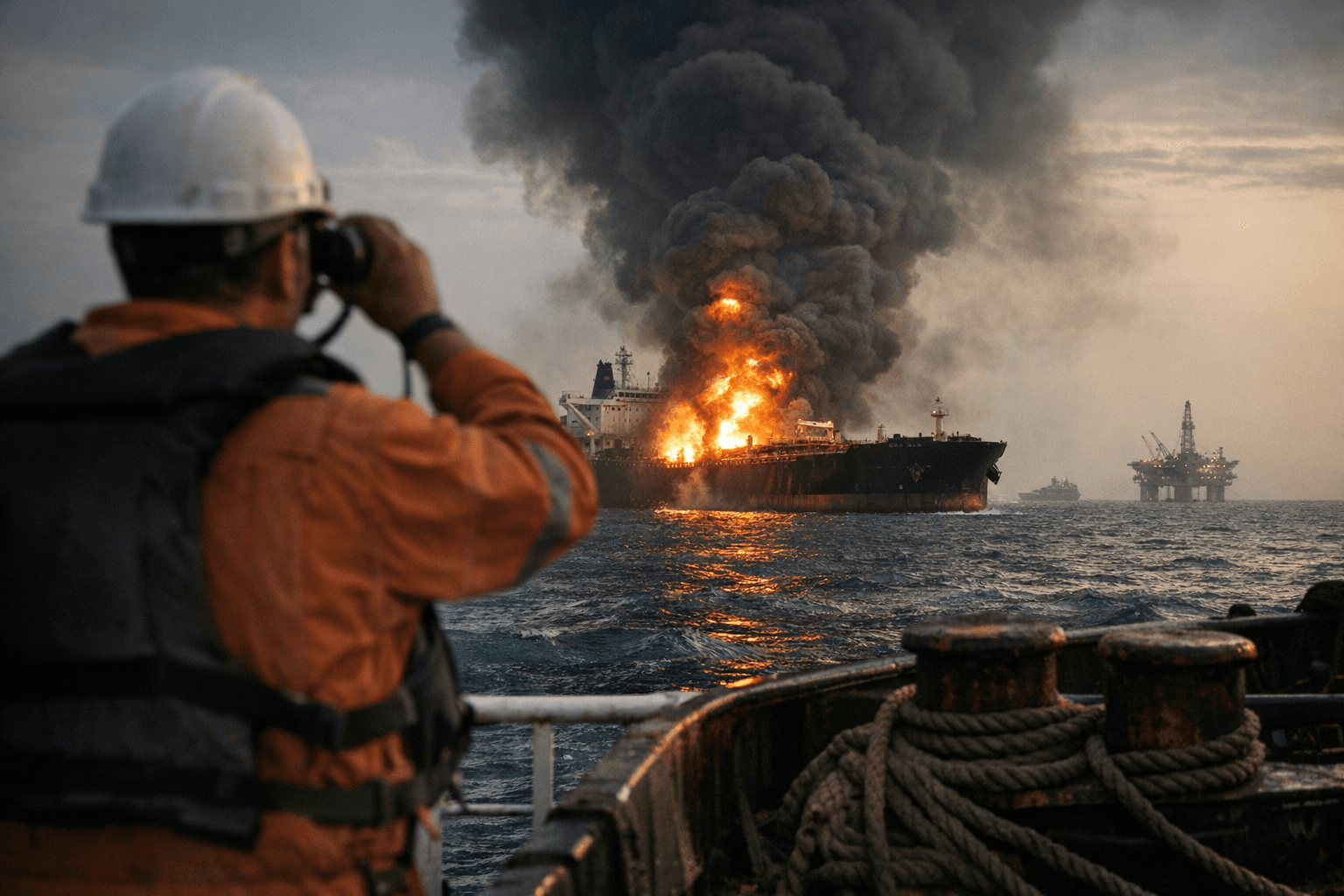
The most important early driver of the Strait's closure was not gunfire. The conflict prompted a closure of the Strait of Hormuz, through which most oil produced in the Persian Gulf is exported, and initially this closure was mainly driven by the need to adjust insurance contracts for oil tankers. That distinction matters enormously for how the disruption spreads. Tanker traffic depends not just on whether ships can technically pass through Hormuz, but on whether operators can obtain war-risk coverage, whether charterers can absorb higher premiums, and whether crews are willing to enter an active conflict zone.
The US-Iran conflict pushed the Strait of Hormuz to a de facto closure through insurance withdrawal, putting at risk roughly 20% of global oil supply alongside critical volumes of jet fuel, LPG, and LNG serving Asian and European markets. Major container shipping companies, including Maersk, CMA CGM, and Hapag-Lloyd, suspended transits through the strait and related routes such as the Red Sea. Houthi-controlled Yemen announced on February 28 that it would resume attacks on Israel and commercial ships in the Red Sea, forcing Suez Canal traffic to be rerouted around Africa's Cape of Good Hope, adding weeks to transit times and increasing shipping costs.
The result is a war-risk premium baked into every barrel that moves, even when it moves at all. "The closure of the Strait of Hormuz added roughly $40 per barrel as a geopolitical risk premium above what market fundamentals would normally dictate," one analyst told Al Jazeera. That $40 does not show up neatly in benchmark quotes; it shows up in freight spreads, insurance loadings, and the price differential between crudes that can actually be delivered and those sitting idle at anchor.
Quantifying the Hidden Choke Points
The raw numbers behind the disruption are staggering. The US Energy Information Administration estimates that about 20 million barrels per day of crude oil and petroleum products moved through the Strait in 2024, equal to roughly one-fifth of global petroleum liquids consumption and more than one-quarter of global seaborne oil trade. More than 150 tankers were stranded outside the waterway when the crisis broke. As of March 8, production at the three main oil fields in southern Iraq had dropped by 70% since the start of the war, from 4.3 million barrels per day to just 1.3 million. As of March 12, the Gulf Arab states had cut their production by at least 10 million barrels per day.
On March 13, Saudi Arabia reduced its oil production by 20%, from 10 million barrels per day to 8 million, after the shutdown of two of Saudi Aramco's offshore fields, including Safaniya. QatarEnergy had already stopped gas production on March 2 and declared force majeure on gas contracts on March 4. Kuwait Petroleum Corporation followed on March 7. The production curtailments were not voluntary; as soon as local oil storage fills up, oil producers have no choice but to shut in their oil wells if the oil cannot be stored or exported.
The Refinery Mismatch Problem
Headline prices assume that substitute barrels are interchangeable. They are not. The missing oil is mostly medium and heavy grades, which some Asian refineries depend on and cannot easily switch to lighter grades. This grade mismatch turns a shipping disruption into a refining crisis. California refineries have historically imported a significant portion of their crude oil from Iraq and other Middle Eastern sources that transit the Strait of Hormuz, and these facilities are configured to process heavier, higher-sulfur crude grades typical of those imports. Heavier crude from Canada faces logistical constraints for West Coast delivery, limited pipeline access via routes like Trans Mountain, and requires different processing infrastructure that many California refineries are not fully equipped to handle efficiently or at scale in the short term.
The bypass routes that producers themselves possess face similar constraints. Saudi Arabia's East-West Pipeline, with a capacity of 7 million barrels per day, and the UAE's Fujairah pipeline offer partial alternatives, but terminal infrastructure at Jeddah limits throughput. These routes could sustain a portion of displaced volume but would not offset a full Strait closure.
Gasoline, Diesel, and Jet Fuel: Three Different Crises
Not all fuel types are suffering equally, and the divergence matters for which consumers and industries feel the shock first. Jet fuel disruption will follow with a slight lag but is likely to be more persistent. Kuwait is a central hub in regional jet supply, and any sustained disruption to Strait transit will translate directly into European aviation supply tightening. Qatar's Ras Laffan export terminal, struck by Iranian drones, compounded the problem: LNG markets are especially vulnerable because Qatari exports depend on Hormuz and most of those cargoes serve Asian buyers, making the conflict not only a Middle East oil shock but also a wider Asian gas and power-security problem.
Diesel faces a different kind of exposure. Refined products such as diesel, gasoline, and jet fuel are all exposed because transport disruption affects both feedstock access and refinery margins. Industrial users and freight carriers, which run almost exclusively on diesel, are particularly sensitive to supply squeezes that don't show up fully in crude benchmarks because the refinery margin blows out before the pump price catches up.
Gasoline is relatively better insulated, as global supply is more distributed and the arbitrage network more flexible. But that insulation has limits at the retail level. In the second week of March, California's gasoline prices exceeded $5 per gallon due to the conflict with Iran. The refinery mismatch is the direct reason: even with more globally distributed gasoline supply, the specific coastal refineries that serve California motorists cannot easily switch their crude diet.
Why Strategic Stock Releases Can't Fix It
Governments reached for the emergency toolkit quickly. The International Energy Agency on March 11 announced a coordinated release of 400 million barrels from member nations' emergency reserves, the largest such deployment in the agency's 52-year history. The United States committed to releasing 172 million barrels from its Strategic Petroleum Reserve over 120 days. The numbers sound large; measured against the actual disruption, they are not. Macquarie analysts estimated that 400 million barrels amounts to roughly 16 days of normal Gulf transit volume.
The structural constraints of the SPR make the math worse. The SPR's maximum drawdown capacity is 4.4 million barrels per day, and oil requires about 13 days to reach US markets after a presidential release order, meaning even the world's largest emergency stockpile cannot flood the market with crude immediately. Meanwhile, EIA estimates world consumption of petroleum and other liquids will average 105.17 million barrels per day in 2026, meaning 400 million barrels would theoretically cover just four days of global consumption.
"The release may soften the shock and calm nerves temporarily," one analyst told Al Jazeera, "but it will remain limited as long as the fundamental problem — the freedom of supply and tanker movement through Hormuz — remains unresolved."
The Shadow Economy of Non-Transparent Deals
Complicating price discovery further is a growing layer of opaque, bilateral arrangements. Iran established its own shipping channel north of Larak Island, separate from the main channel south of the island. One ship paid $2 million to use Iran's channel. A Pakistani tanker crossed with Iranian permission on March 16. These deals don't register in the exchange-traded crude price; they represent a private market for access whose cost structure is invisible to most participants.
The conflict is also materially improving Russia's competitive position in crude oil markets. With Middle East barrels facing logistical disruption, both India and China face strong incentives to deepen reliance on Russian supply. Russian crude flowing into those markets at a discount further muddies the relationship between reported benchmark prices and what large importers are actually paying.
The Economic Damage Beyond the Pump
The Federal Reserve Bank of Dallas modeled the macro consequences explicitly: a one-quarter closure of the Strait would raise average West Texas Intermediate prices to $98 per barrel and lower global GDP growth by an annualized 2.9 percentage points in the second quarter of 2026. A disruption lasting three quarters could reduce fourth-quarter global GDP growth by 1.3 percentage points.
Airspace closures have widened the shock beyond seaborne energy. When missile exchanges disrupt Gulf air corridors as maritime risk clogs shipping lanes, the costs spread into air freight, tourism, business travel, and trade timing. The Persian Gulf is not merely an oil pipeline to the world; it is a logistics bridge. The Persian Gulf is also a major hub for global fertilizer production and exports, accounting for roughly 30% to 35% of global urea exports and around 20% to 30% of ammonia exports, with up to 30% of internationally traded fertilizers normally transiting the Strait of Hormuz. Global fertilizer prices could average 15% to 20% higher during the first half of 2026 if the crisis continues, a cost that feeds directly into food prices with a lag of several growing seasons.
The Strait of Hormuz has never been fully closed before in its modern role as the artery of global energy trade. Every past crisis, from the 1973 Yom Kippur War to the 1979 Iranian Revolution, involved either the anticipation of disruption or a partial supply shock. What is unfolding now is something the market has never had to actually price: a genuine, sustained blockage of the world's single most critical energy chokepoint, with a cost structure that benchmark crude prices, by design, were never built to measure.
This article was produced by Prism’s automated news system from verified source data, official records, and press releases, then run through automated quality and moderation checks before publishing. The system is built and supervised by the people who set the standards it runs under. Read our full AI policy.
Did this article answer your question?