Philadelphia’s soft pretzel tradition endures at Center City bakery
Philadelphia’s pretzel culture still runs on street-corner grit, and one East Passyunk bakery shows why a cheap staple remains civic pride.
A city built around a pretzel
A soft pretzel still says something unmistakable about Philadelphia. The Encyclopedia of Greater Philadelphia puts it plainly, calling the city’s pretzels “as crepes are to Paris,” and that comparison captures more than nostalgia. In Philadelphia, the pretzel is a daily object, a civic symbol, and a reminder that the city’s identity has long been built as much on ordinary food as on grand monuments.

That matters because the pretzel here is not treated like a boutique indulgence. It is a figure-eight snack with a chewy bite, sold on street corners, eaten on the run, and carried into the workday like part of the city’s routine. Philadelphians eat them for breakfast, after lunch, or from food carts across Center City, and some homesick former residents even have them shipped overnight. In a city that prizes authenticity, the pretzel remains one of the clearest expressions of local taste.
From immigrant roots to street-corner commerce
The Philadelphia pretzel story reaches back to the Pennsylvania Dutch immigrants who settled in the region in the 1700s. The broader history of the pretzel extends much farther into Europe, with the Encyclopedia tracing early depictions to the 1100s and even pointing to a legend of French monks in 610 A.D. That long lineage gives the snack an unusual kind of weight: it is both humble and ancient, familiar and historical.
Philadelphia’s own pretzel culture became distinct not just because of the dough, but because of how the food moved through the city. The Encyclopedia says the first street vendor of soft pretzels in Philadelphia was Daniel Christopher Kleiss, around 1820. By then, the city had already begun restricting street vending, with rules in place by 1789. That detail matters. Soft pretzels were never only about appetite. They were part of a larger civic conversation about who gets to use public space, how food reaches neighborhoods, and what kind of informal economy a city will tolerate.
That tension still echoes in the modern pretzel trade. The pretzel endures because it is cheap, portable, and deeply local. It belongs to the street as much as to the bakery, and that connection to public life is part of what makes it more than comfort food.
Why Center City Soft Pretzel Co. still draws a crowd
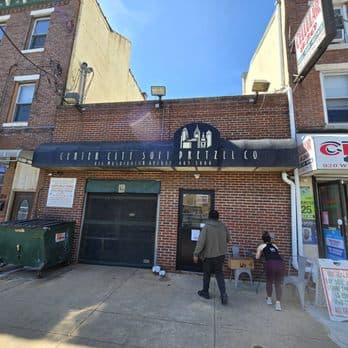
Center City Soft Pretzel Co. sits at 816 Washington Avenue, in Philadelphia’s Italian Market and East Passyunk area, not technically in Center City at all. That location says a lot about the city’s food geography: the name may sound downtown, but the bakery’s roots are in a neighborhood where local commerce still carries real cultural authority. Visit Philadelphia places it among the city’s top pretzel destinations, and for good reason. The bakery says it has been in business for more than 40 years, after Tony Tonelli founded it in 1981.
Today, Tonelli’s daughter, Erika, runs the company. The family continuity matters because Philadelphia’s food identity is often preserved not by large brands, but by businesses that keep passing techniques, expectations, and loyalties from one generation to the next. Center City Soft Pretzel Co. says it is the only all-natural soft pretzel bakery in the tri-state area, using just flour, yeast, and water. It also says its pretzels are nut-free, dairy-free, and kosher certified, a combination that helps explain why the bakery can serve such a broad slice of the city without turning the pretzel into something fussy or over-engineered.
The scale is part of the appeal. The company churns out tens of thousands of pretzels a week, proof that an old-fashioned staple can still operate at serious volume. In an era when food trends often reward novelty, that kind of output shows that consistency still has a market, especially when the product is tied so tightly to place.
A fire, a closure, and a return
The bakery’s recent history also shows how fragile small food institutions can be. Visit Philadelphia says Center City Soft Pretzel Co. reopened after an 18-month closure following a devastating fire. Philadelphia Magazine described the same recovery after the shutdown as an 18-month struggle. The fact that the bakery came back matters beyond one storefront. In a food culture increasingly shaped by consolidation, rising costs, and shifting consumer habits, a family-run shop returning after a fire is a statement about persistence as much as survival.
Its menu reflects the same balance of tradition and adaptation. Visit Philadelphia says the bakery offers classic figure-eight pretzels, braids, and nuggets. Those shapes preserve the basic identity of the Philadelphia pretzel while allowing the shop to serve different uses and appetites. The figure-eight remains the emblem, but the braids and nuggets show how a legacy food can stay relevant without surrendering what makes it recognizable.
What the pretzel still means in Philadelphia
The soft pretzel endures in Philadelphia because it sits at the intersection of memory, commerce, and civic ritual. It is inexpensive enough to remain everyday food, visible enough to signal neighborhood life, and distinctive enough to travel as a symbol of the city itself. That is why the pretzel still matters in a place where food carries social meaning far beyond flavor.
Center City Soft Pretzel Co. makes that case in practical terms. It is a family business rooted in an old immigrant tradition, operating in a neighborhood that still gives local food real gravity, and producing a product that Philadelphia continues to recognize as its own. Even after a fire, even amid changing tastes, the city’s pretzel culture survives because it never stopped being useful, portable, and public. In Philadelphia, that is exactly what tradition looks like.
This article was produced by Prism’s automated news system from verified source data, official records, and press releases, then run through automated quality and moderation checks before publishing. The system is built and supervised by the people who set the standards it runs under. Read our full AI policy.
Did this article answer your question?

