Philippine, US and Japan aircraft reach Bashi Channel for first time
Trilateral air patrols reached the Bashi Channel during the 15th MMCA, the AFP said; ships remained inside Philippine waters, and China criticized the drills.

For the first time, Philippine, U.S. and Japanese aircraft patrolled as far north as the Bashi Channel during the 15th Multilateral Maritime Cooperative Activity, the Armed Forces of the Philippines said, marking an operational expansion that drew immediate diplomatic pushback from China.
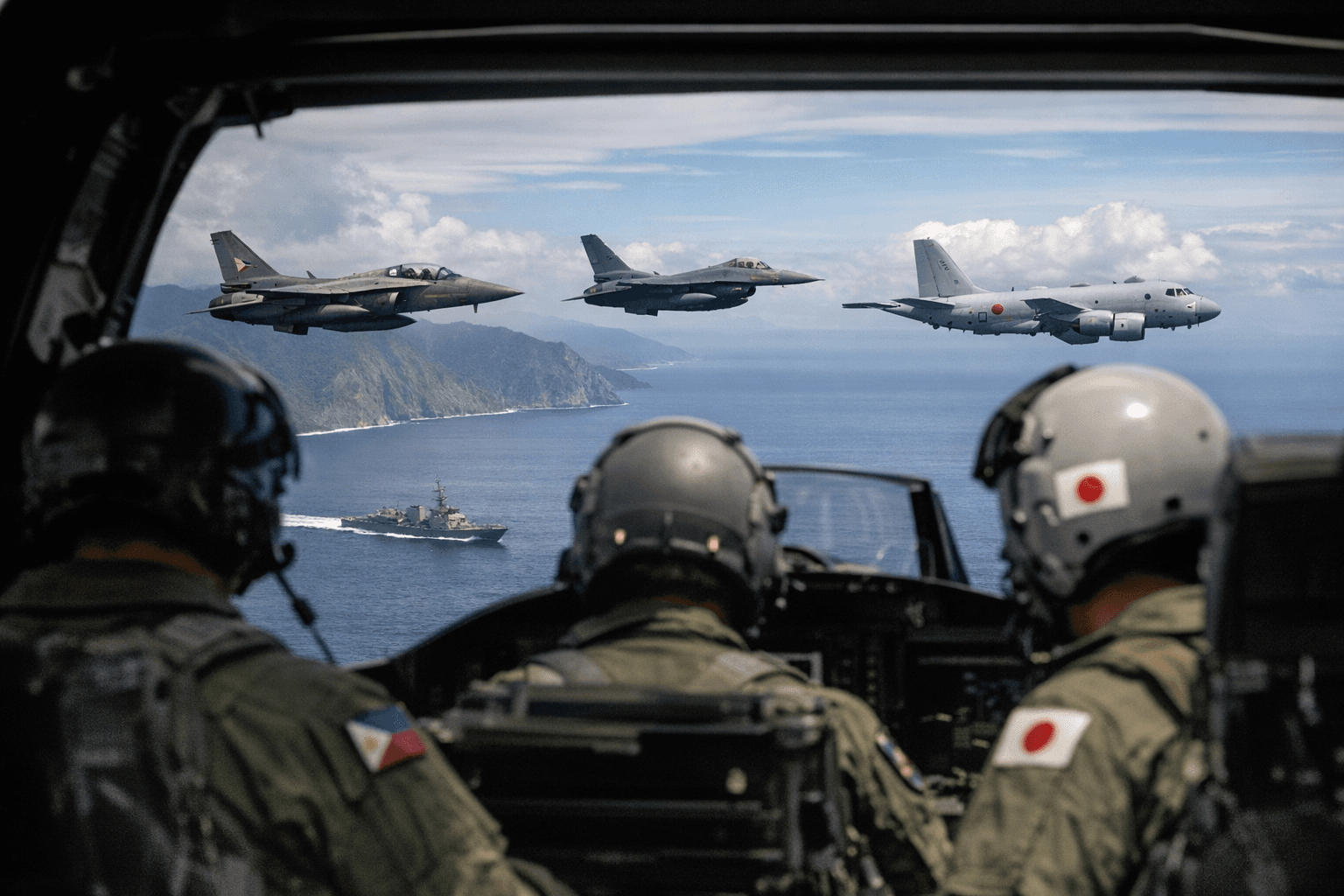
The AFP said air operations “were conducted within airspace over Philippine territory and its territorial sea, north of Luzon,” and that the at-sea phase occurred in a designated operational box near Mavulis Island and west of Basco, Batanes. An AFP handout photo dated Feb. 26, released Feb. 27, shows a Philippine FA-50 flying alongside a Japan Maritime Self‑Defense Force P‑3 Orion. The AFP also said participating vessels remained inside Philippine waters and did not enter the Bashi Channel.
Philippine, U.S. and Japanese assets listed by military releases included the Philippine Navy frigate BRP Antonio Luna (FF‑151) with an embarked AW‑159 helicopter, Philippine Coast Guard vessel BRP Gabriela Silang (OPV‑8301), Philippine Air Force FA‑50 fighters plus A‑29 Super Tucanos, a C‑208B utility plane and a W‑3A Sokol helicopter. U.S. contributions included the guided‑missile destroyer USS Dewey (DDG‑105) and a P‑8A Poseidon maritime patrol aircraft, with an MH‑60R Seahawk embarked on the Dewey. Japan deployed P‑3 Orion maritime patrol aircraft.
Exercise activities reported by the AFP and military briefings ranged from communications checks and maritime domain awareness drills to replenishment at sea, division tactics, officer‑of‑the‑watch maneuvers, fly‑bys, anti‑submarine warfare training and photo exercises. The BRP Antonio Luna conducted a live‑fire gunnery exercise followed by hotwash sessions to capture lessons for future operations. The AFP characterized the training as demonstrating the partners’ “ability to operate seamlessly in complex maritime environments, reflecting the deepening maritime cooperation among them,” and described participation as a “whole‑of‑nation approach to safeguarding the country’s maritime domain.”
Strategically, the Bashi Channel sits between the Philippines’ northern islands and Taiwan and is a maritime gateway between the Luzon Strait and the broader South China Sea. Its narrower geography, roughly 100 kilometers between the two coastlines, makes it a sensitive corridor for submarines, surface vessels and patrol aircraft. Trilateral patrols that push air coverage into the channel change patrol geometry without, according to AFP statements, bringing allied surface ships into contested waters.
China’s Southern Theater Command criticized the exercises. Spokesperson Zhai Shichen said, “The Philippines co‑opted countries outside the region to organize the so‑called joint patrols, disrupting peace and stability in the region,” and said China conducted a “routine patrol” in the South China Sea at the same time.
The exercise underscores policy tradeoffs facing Manila and its partners. For the Philippine government, demonstrable interoperability with U.S. and Japanese forces can bolster deterrence and justify investments in aircraft, patrol vessels and maritime domain awareness. At the same time, expanding joint operations near Taiwan heightens diplomatic friction with Beijing and will likely shape debate in the Philippine Congress over defense budgets, basing access and the balance between external partnerships and neighborhood diplomacy.
Military officials have left open some scheduling details about the broader 15th MMCA; AFP imagery and briefings place the northern at‑sea and air phase in the last days of February, with the AFP providing the principal public account of operational boundaries. Regional policymakers and oversight bodies will now face choices about transparency, force posture and how far to extend routine trilateral activity in the narrow maritime approaches north of Luzon.
This article was produced by Prism’s automated news system from verified source data, official records, and press releases, then run through automated quality and moderation checks before publishing. The system is built and supervised by the people who set the standards it runs under. Read our full AI policy.
Did this article answer your question?