Philippines, US launch Balikatan drills near Taiwan, test readiness
Philippine and U.S. forces opened Balikatan near Taiwan with maritime strike drills, testing whether the alliance can move fast in a real crisis.
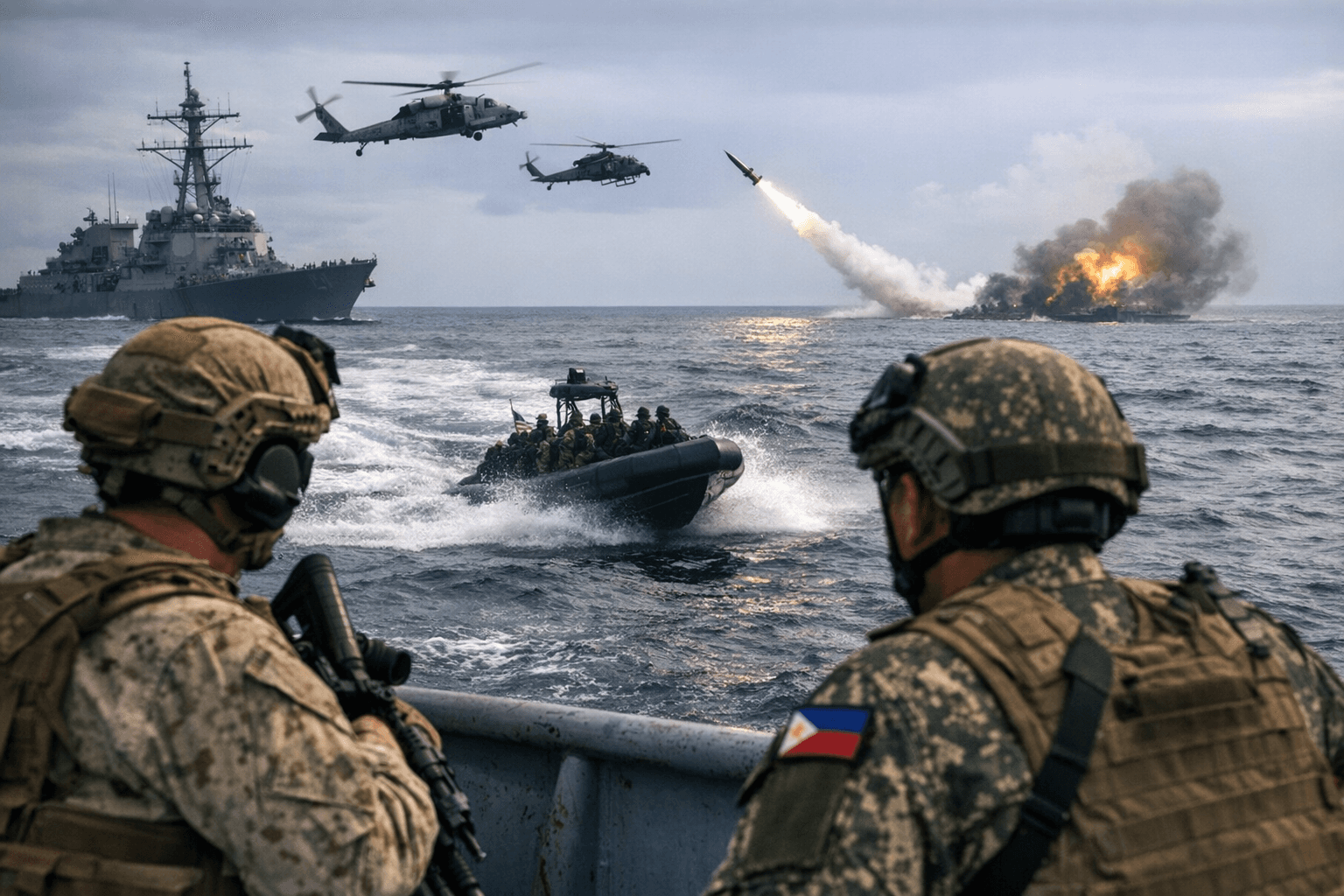
A remote Philippine island near Taiwan became the stage for the opening of Balikatan, as Philippine and U.S. forces began drills designed to test how the alliance would perform under real-world conditions. The exercise, the 41st iteration of Balikatan, ran from April 20 through May 8 and carried added weight as it coincided with the 75th anniversary of the U.S.-Philippine Mutual Defense Treaty.
More than 17,000 personnel from the Philippines, the United States, Australia, Japan, Canada, France and New Zealand took part, while another 17 nations joined as international observers. U.S. Indo-Pacific Command said the exercise stretched across air, land, sea, space and cyber domains, with capstone events centered on maritime security, coastal defense, combined and joint fires, and ship-to-shore offloads. The geography was deliberate: drills near Taiwan and across the Philippine archipelago signaled that Balikatan was not a symbolic display, but a rehearsal for contingencies that could unfold in the contested waters of the Indo-Pacific.
Before the main exercise began, U.S. and Philippine forces practiced maritime prepositioning force offload operations at Port of Cagayan de Oro, then moved supplies across Luzon. That logistics drill underscored the practical side of readiness, showing how quickly personnel and equipment could be unloaded, distributed and put into position. Philippine Army Maj. Gen. Francisco F. Lorenzo Jr. said the exercise gave the Armed Forces of the Philippines a chance to accelerate modernization and sharpen its role as a vanguard of regional peace.
The multinational footprint was larger than in previous years. Australia said around 400 members of the Australian Defence Force were involved, including land forces, medical teams, tactical air assets and the Anzac-class frigate HMAS Toowoomba. Canberra also said Czechia, Lithuania, the Netherlands, Poland and the United Kingdom were participating as observers. U.S. Marine Corps Lt. Gen. Christian Wortman described the alliance as a cornerstone of peace and stability in the Indo-Pacific for 75 years.
Balikatan’s scale has expanded quickly. In 2025, the exercise involved more than 14,000 Filipino, U.S., Australian and Japanese personnel, and included NMESIS deployments to Batan Island in the Luzon Strait, live-fire drills and humanitarian projects that reached more than 75,000 Filipinos. This year’s version built on that template with a broader set of domains and more allies at the table, reinforcing the message that the alliance is preparing for more than routine training. In the weeks before Balikatan, the two navies also carried out a Maritime Cooperative Activity in the Philippine Exclusive Economic Zone, with USS Blue Ridge participating for the first time and the U.S. Navy calling it the fourth MCA of 2026.
This article was produced by Prism’s automated news system from verified source data, official records, and press releases, then run through automated quality and moderation checks before publishing. The system is built and supervised by the people who set the standards it runs under. Read our full AI policy.
Did this article answer your question?


