Photographer Documented New York, Soviet Siberia and the Adirondacks With Keen Eye
Nathan Farb photographed countercultural New York, smuggled portraits out of Soviet Siberia, and defined the Adirondacks visually across six decades of extraordinary range.
A Life Spent Bearing Witness
Nathan Farb, the photographer whose 8x10 view camera transformed three vastly different worlds into enduring visual records, died on March 26, 2026, at 85. Born January 18, 1941, he was a renowned photographer and multimedia artist, and his career traced an arc unlike almost any other in American documentary photography: from the gritty bohemia of New York's Lower East Side to a Cold War intelligence operation disguised as a cultural exchange, to the cathedral-like wilderness of the Adirondack Mountains. Each chapter was defined not just by where Farb pointed his lens, but by what he was willing to risk to get there.
The Lower East Side and the Summer of Love
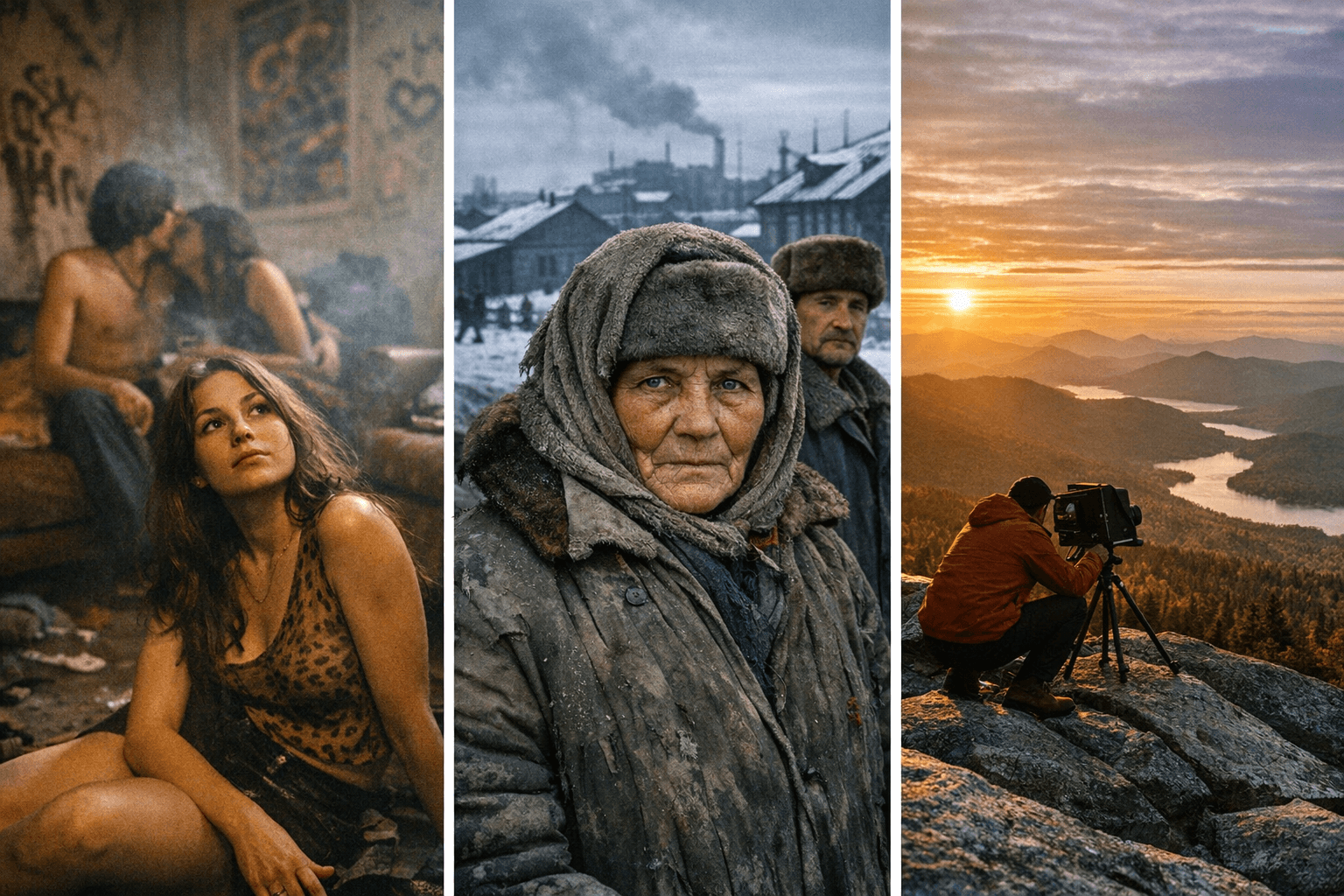
Searching for both his past and future, Farb bought his first camera and started shooting on the streets of New York City's Lower East Side in 1966. The impulse was personal as much as artistic. He arrived on the Lower East Side in the mid-1960s searching for adventure and his Jewish roots, and he lamented being "too late for the Beats and too early for the hippies," but the timing turned out to be exactly right. The year after he discovered photography, he stumbled upon the East Village's "Summer of Love," a scene propelled by rock music, drugs, sexual abandon, and anti-Vietnam War sentiment.
Those photographs were made for an unpublished book titled "Summer of Love," and some were used in a New York Times photo blog in 2017. Farb's photos from that era burst onto the international stage in 1967 with the murders of Groovy Hutchins and Linda Fitzpatrick, which drew national media attention to the East Village counterculture scene Farb had been quietly documenting. The work was later presented as "The Other Summer of Love" in the Times' photography blog "Lens." Where San Francisco's Haight-Ashbury drew the marquee coverage, Farb's Lower East Side photographs preserved a grittier, more turbulent counterpart to the flower-power mythology.
His methods were already characteristically audacious. He was bodacious in going for the images he wanted, using a Life magazine luggage tag as a "press pass" to gain access to events, and once getting thrown off the stage at a Janis Joplin concert. In 1971, his political multimedia work "Lockport," created in collaboration with Judith Treesberg, was shown at The Public Theater to critical acclaim and a cult following. That performance piece led Rutgers University to invite him to create a photography and multimedia program in the experimental Art and Music Department at Livingston College, where he taught until 1979.
Into the Soviet Union: The Russians
The most operatically daring chapter of Farb's career came in 1977. He was part of an international cultural exchange that brought him to the USSR, and in Novosibirsk, Siberia, he photographed local visitors to the American exhibit. The project had been arranged by the United States Information Agency, whose remit was to promote American interests at the height of the Cold War. For Farb, it was a unique chance to see inside the Soviet Union, not Moscow, which was closely watched, but the provincial interior he considered the "real Russia."
He carried a 4-by-5-inch Polaroid camera and an additional Polaroid 195 for his role in the Photography USA exhibition. From his studio in Novosibirsk, crowds would gather to watch him at work. He photographed portraits of ordinary townspeople with 8x10 black-and-white Polaroid film, giving subjects their prints on the spot. But he kept the negatives for himself, aware that Soviet authorities would confiscate them if discovered. His book "The Russians" depicts the "classless Soviet society" that was, as he put it, dying to be just like the United States, and was famous in some circles, having been published in six countries and magazines around the world.
The work became the book "The Russians," published first in Germany and then in the United States, France, Italy, and Holland. The photographs were the first candid, unmediated portraits of provincial Soviet citizens that most Western audiences had ever seen. MoMA owned and displayed his image of the Party Chiefs for approximately ten years. One subject, a gangly student photographed in classic 1970s style, was Boris Klyachko, who reconnected with Farb in 2016, 39 years after his portrait was taken; in the intervening decades, the Soviet Union had crumbled and collapsed, and Klyachko had immigrated. The photographs had outlasted the system they documented.
Farb returned to Siberia in 2018, and his trips to Siberia in 1977 and 2018 were documented in the film "Nathan Farb and the Cold War."
The Adirondacks: A Life's Work in Landscape
If the Soviet chapter established Farb as a documentary provocateur, his decades-long engagement with the Adirondacks revealed an entirely different artistic register. His iconic 8x10 view camera work of the Adirondack region, where he grew up, was published in three books by Rizzoli. He first became captivated with the Adirondacks as a child growing up in Lake Placid, New York, and that childhood intimacy never left him. He eventually settled in Jay, New York, not far from Lake Placid, and worked from a studio there for the last two decades of his life.
The Adirondack body of work was built on physical commitment: his intimate knowledge of the region led him deep into the woods to photograph rarely visited vistas. The method required lugging large-format equipment through difficult terrain, but the results were unmistakable. His two volumes of Adirondack photographs, "The Adirondacks" (Rizzoli, 1985) and "100 Views of the Adirondacks" (Rizzoli, 1989), established Farb as the preeminent photographer of the region. "The Adirondacks" became the best-selling book of Adirondack photographs ever published, and his gigantic prints are well known and highly sought after, adorning museums, public spaces, and private collections.
In the 1980s and 1990s, Farb's large-format panoramas and abstract close-ups defined wilderness and the Adirondack Park after the Winter Olympics, when the public was just gaining consciousness of the vast region north of Albany. A 2004 Rizzoli book, "Adirondack Wilderness," was produced in collaboration with The Nature Conservancy. His photographic essays on nature and the environment appeared in Life, The New York Times Magazine, Audubon, and Adirondack Life.
Method, Ethics, and Influence
What united Farb's work across such disparate geographies was his insistence on access and his willingness to adapt his tools to circumstance. The Polaroid back on his view camera in Novosibirsk was both a social instrument, offering subjects an instant print as a kind of exchange, and a technical ruse that allowed him to retain negatives that would otherwise have been seized. In the Adirondacks, the same 8x10 format became a vehicle for a different kind of truth: the slow, deliberate exposure required by large-format film forced a patience that matched the unhurried rhythms of the wilderness.
One critic noted that Farb's photographs "achieve effects of great sharpness, clarity, depth and richness of color and texture," making "a focal point of some minute, exquisite object, transient with the season or the time of day." His work in the Soviet Union operated under a different ethic: the photographs of ordinary Siberians were, as he described them, "real; without propaganda, without politics," a candid humanism that cut through Cold War ideology on both sides.
Beyond his own practice, Farb influenced a generation of photographers through his teaching at Rutgers and Parsons, and through his books that shaped how the Adirondacks were perceived by the public and policymakers during a critical period for the park's conservation. He was an early adopter of the original Sony Portapak and continued exploring new technologies throughout his life, from video to large-scale multimedia pieces. The range, in retrospect, was not restlessness but a consistent search: for access to moments that official narratives preferred to leave undocumented.
This article was produced by Prism’s automated news system from verified source data, official records, and press releases, then run through automated quality and moderation checks before publishing. The system is built and supervised by the people who set the standards it runs under. Read our full AI policy.
Did this article answer your question?