Poll finds fading U.S. exceptionalism ahead of America 250
Only about one-quarter of adults said the U.S. stands above all others, with younger Americans far more likely to question the country’s exceptionalism.

Fewer Americans now see the United States as standing apart from the rest of the world, a sign of softening national exceptionalism just as the country approaches its 250th birthday. In an AP-NORC America 250 poll, only about one-quarter of adults said the U.S. stands above all other countries, while 44% called it one of the greatest countries but not the greatest and about 3 in 10 said other countries are better.
The divide was especially sharp by age. Among adults under 30, 44% said there are better countries than the U.S., compared with 22% of adults ages 60 and older. That generational gap points to more than a simple mood shift. It suggests a younger cohort that is less inclined to treat American identity as self-evidently superior, and more willing to question whether the country still lives up to its own mythology.
The poll also found a quieter but important erosion in how Americans define democracy itself. About two-thirds now say a democratically elected government is extremely or very important to the nation’s identity, down from 80% in 2021. That is still a broad majority, but the drop shows weaker intensity behind a core civic ideal at a moment when election-season rhetoric and local civic flashpoints are already testing public trust in institutions.
Those tensions were visible in the response of Derricka Wall, 24, of Chickasaw, Alabama, who said the problem is not democracy itself but the politicians placed in office. Her view fits the broader pattern in the poll: many Americans still support democratic government in principle, yet are increasingly frustrated by dysfunction, polarization and the sense that guardrails are fraying.
The survey also showed how unsettled the basics of national identity have become. Americans remained divided over whether diversity is an essential part of being American, reinforcing the idea that the country is arguing not just over policy, but over membership and meaning. The same poll found that only a third of Americans say the American Dream still holds true today, while half said it once held true but does not anymore and 15% said it has never been true.
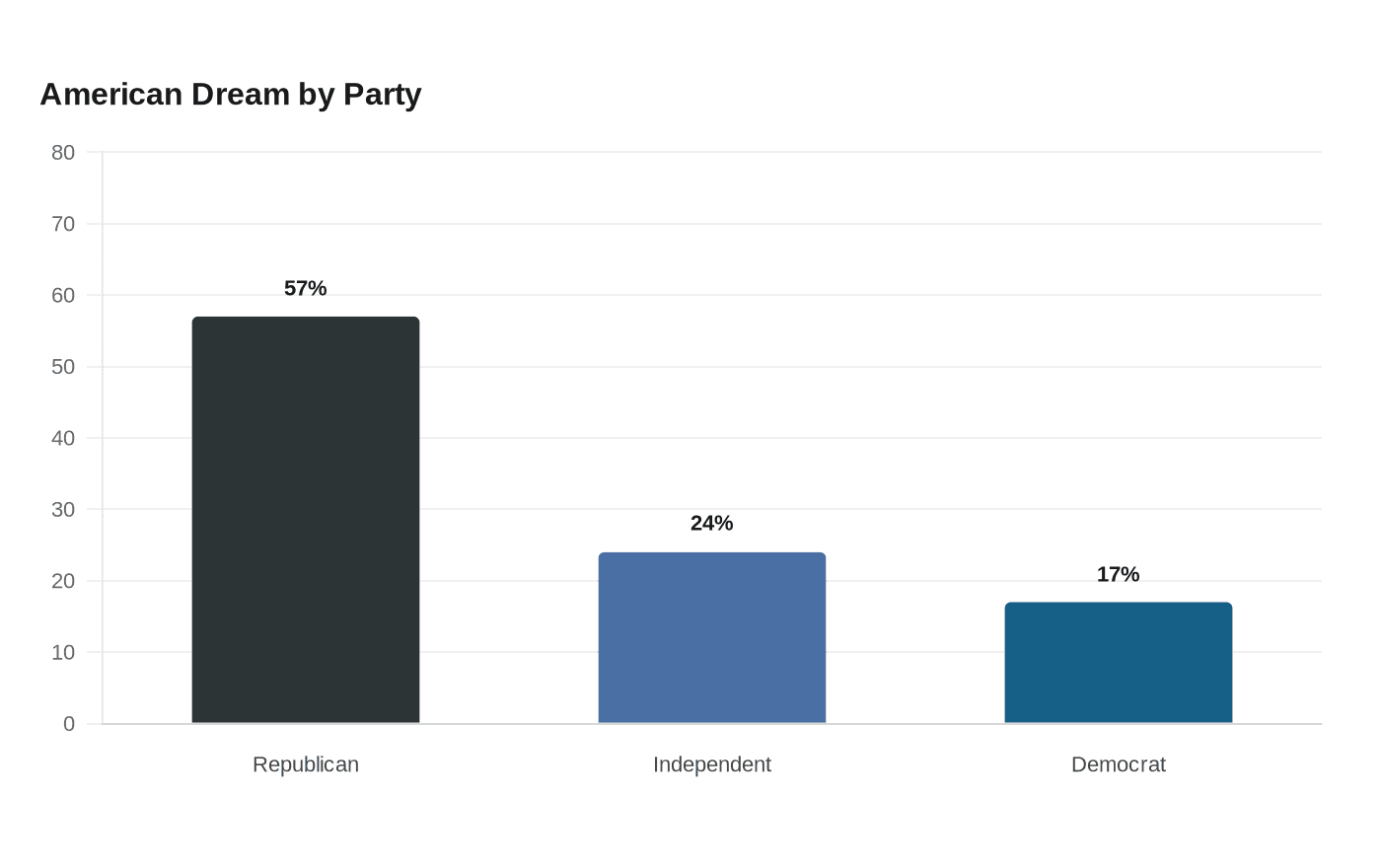
That skepticism cut along familiar lines. Republicans were far more likely than independents and Democrats to say the American Dream still holds true, 57% compared with 24% and 17%. Older adults were also more likely to hold onto the idea than younger adults, with 46% of those 60 and older saying it still applies, compared with 22% of adults ages 18 to 29. White adults were more likely than Black adults to say the dream currently holds true, 40% to 19%.
The AP-NORC poll was conducted April 16-20, 2026, among 2,596 adults in the AmeriSpeak probability-based panel and has a margin of sampling error of plus or minus 2.6 percentage points. With July 4, 2026 set to mark the 250th anniversary of the founding of the United States, the results suggest an anniversary year shadowed by a more fragile sense of civic cohesion than the country’s founding celebrations might imply.
This article was produced by Prism’s automated news system from verified source data, official records, and press releases, then run through automated quality and moderation checks before publishing. The system is built and supervised by the people who set the standards it runs under. Read our full AI policy.
Know something we missed? Have a correction or additional information?
Submit a Tip