Poll: Two-Thirds of Americans Want Faster End to U.S. Military Action in Iran
Two-thirds of Americans want a faster end to U.S. military action in Iran even if it means falling short of all stated goals, with concern over troop safety and financial costs climbing sharply.

A Reuters/Ipsos poll released March 31 found that 66% of Americans want the United States to end its military involvement in Iran quickly, even if that means abandoning some of the Trump administration's stated objectives. Only 27% said the U.S. should press on until all goals are achieved, regardless of how long it takes. Six percent declined to answer.
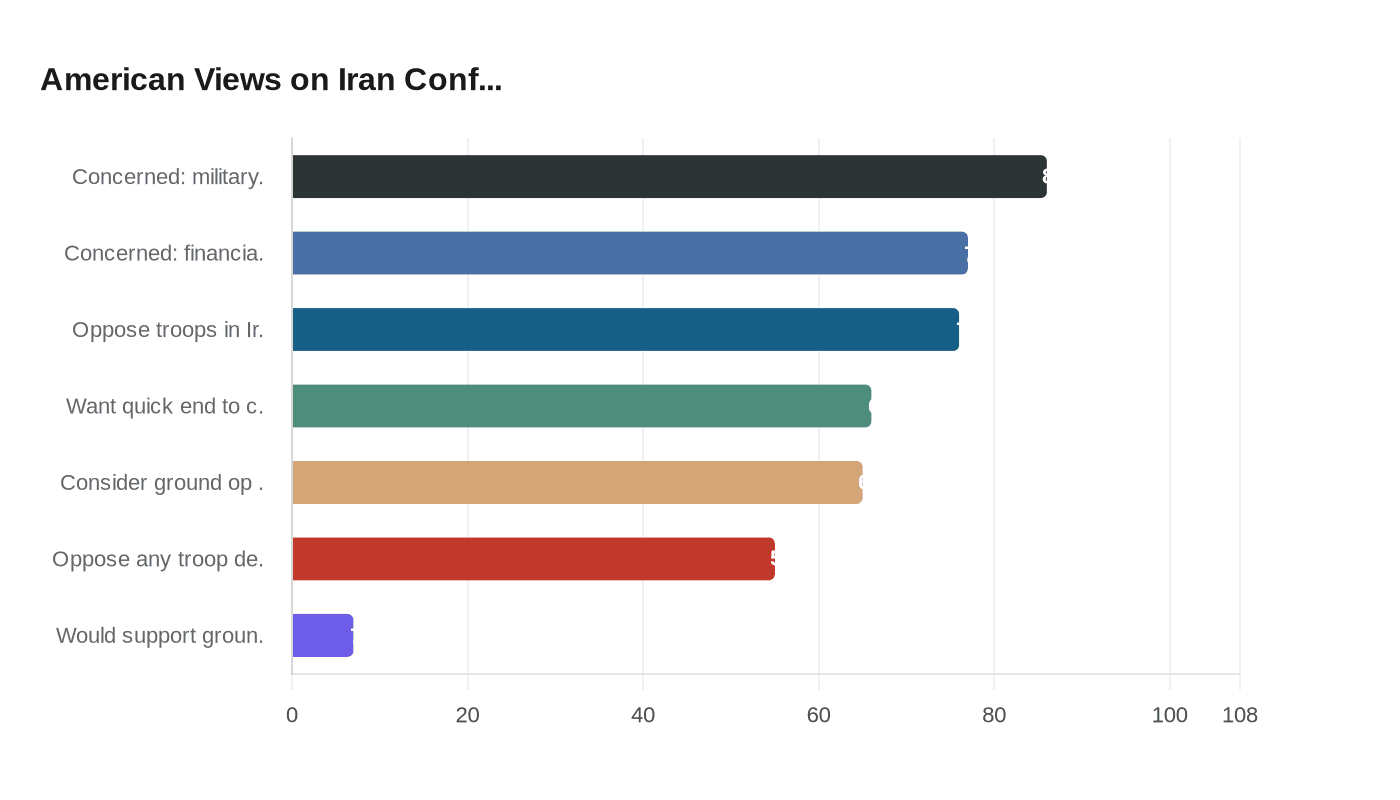
The survey, conducted among 1,021 U.S. adults from March 27 to 29, captured sentiment at a moment when Operation Epic Fury had already stretched past the administration's initial six-week estimate. Eighty-six percent of respondents said they were very or somewhat concerned about the risk to American military personnel, while 77% cited worry over financial costs. That financial-concern figure climbed eight points in roughly two weeks of Ipsos tracking, a signal that the war's economic toll is registering with the public faster than its strategic rationale.
Ground troop deployment remained deeply unpopular, with 76% of Americans saying they would oppose sending U.S. troops into Iran. A related Ipsos survey from mid-March found that while 65% of Americans consider a large-scale ground operation likely, just 7% would actually support it, and a majority of Americans, at 55%, said they would not support the U.S. deploying any troops inside Iran at all.
The partisan divide within those headline numbers matters as much as the numbers themselves. Among Republicans who voted for Trump, 40% supported ending the conflict quickly even if it did not achieve U.S. goals, while 57% supported longer involvement. That internal split is politically significant: with midterm elections approaching, a Republican bloc of four-in-ten demanding an exit ramp undermines any White House argument that the base is uniformly behind a prolonged campaign.
Congressional action has not followed the disapproval. Despite month-over-month polling showing opposition consistently outpacing support, lawmakers have not moved to constrain the operation through authorization votes or appropriations riders, leaving the White House with broad operational latitude even as public patience narrows.
Trump's overall approval rating slumped to 36% this week, the lowest since he took office, with the Iran conflict tracking alongside economic grievances as a primary drag. The Reuters/Ipsos poll found just 29% of Americans approve of how Trump is handling the economy overall, the lowest rating he has had on the issue over both of his terms as president.
By nearly two-to-one, more Americans said the military action against Iran will make the U.S. less safe in the long run, at 40%, than said it will make the country safer, at 22%. That pessimism about outcomes, combined with rising cost sensitivity and the 40% of Republicans expressing exit preferences, creates the kind of cross-partisan pressure that historically forces White Houses to recalibrate: accelerate a diplomatic track, redefine success narrowly enough to claim it, or absorb the political attrition of a war the public no longer believes in.
This article was produced by Prism’s automated news system from verified source data, official records, and press releases, then run through automated quality and moderation checks before publishing. The system is built and supervised by the people who set the standards it runs under. Read our full AI policy.
Did this article answer your question?

