Pollock and Brancusi works shatter records in Newhouse sale
A Pollock hit $181.2 million and a Brancusi reached $107.6 million, pushing S.I. Newhouse’s collection into the $100 million club.
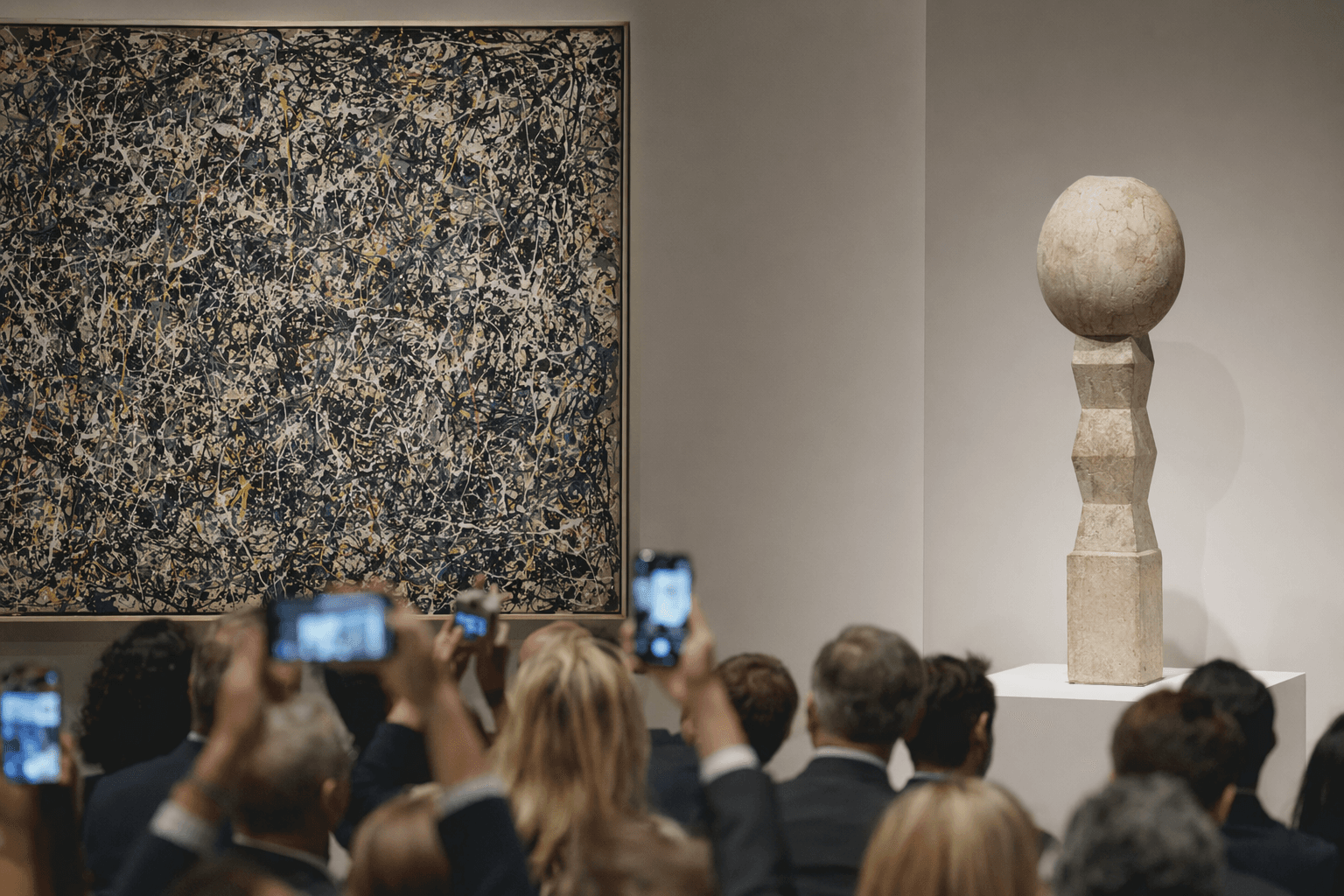
Two works from S.I. Newhouse’s collection cleared the $100 million threshold in New York, turning Christie’s evening sale into a blunt display of how little ceiling remains at the top of the art market. Jackson Pollock’s Number 7A, 1948, sold for $181.2 million with fees, while Constantin Brancusi’s Danaide, 1913, brought $107.6 million, both from the 16-lot Masterpieces: The Private Collection of S.I. Newhouse auction.
The Pollock was the night’s biggest surprise in scale as well as price. The oil-and-enamel-on-canvas work, measuring 35 by 131 1/2 inches, carried a hammer price of $157 million and set a new auction record for Pollock, topping the $61.16 million paid for Number 17, 1951, at Sotheby’s in 2021. Its result pushed a major Abstract Expressionist further into the rarefied category where trophies function less like discretionary luxuries than like global blue-chip assets, prized for scarcity, provenance and the certainty that no comparable supply can be created again.
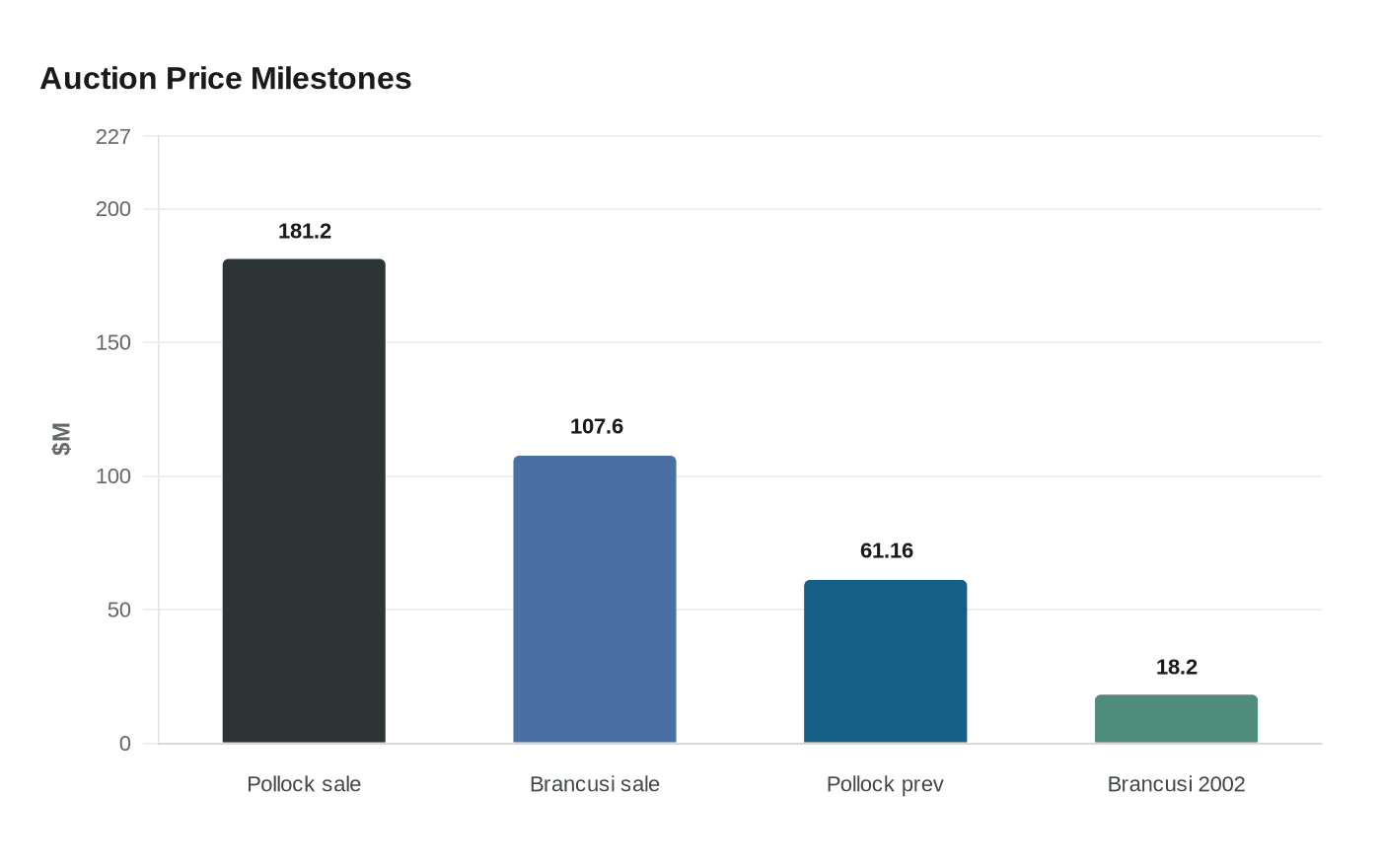
Brancusi’s Danaide told a similar story with a different century and medium. The bronze head, finished with a brown patina and gold leaf, was the first work in Brancusi’s Danaide series and is linked to his recurring portrait of Margit Pogany. Christie’s had estimated it in the region of $100 million, and the final $107.6 million with fees gave Brancusi a new auction record. The sale also marked a dramatic gain on the $18.2 million Newhouse paid for it at Christie’s in 2002, which had itself been a record for sculpture at the time.
For Christie’s, the pairing of Pollock and Brancusi was the center of a sale expected to total about $450 million and promoted as a rare glimpse into the most personal chapter of Newhouse’s collecting life. Christie’s even used Nicole Kidman in a campaign for the Brancusi, a sign of how aggressively the house framed the lot as a cultural event as much as a financial one. Newhouse, the longtime Condé Nast chairman and one of the most prominent collectors of postwar and modern art, died in 2017 at 89.
The results underscored a defining feature of the ultra-wealthy market: when trophy works with museum-grade names and unimpeachable provenance come up, capital still chases them hard. Even amid broader auction uncertainty, the Newhouse sale showed that the $100 million club remains a place where wealth concentration, cultural prestige and long-term asset appreciation intersect with remarkable force.
Know something we missed? Have a correction or additional information?
Submit a Tip