Pompeii Wall Damage May Reveal Ancient Rapid-Fire Weapon in Action
Small, square impact clusters on Pompeii's northern walls may be the first physical evidence of the polybolos, an ancient chain-fed repeating dart weapon.
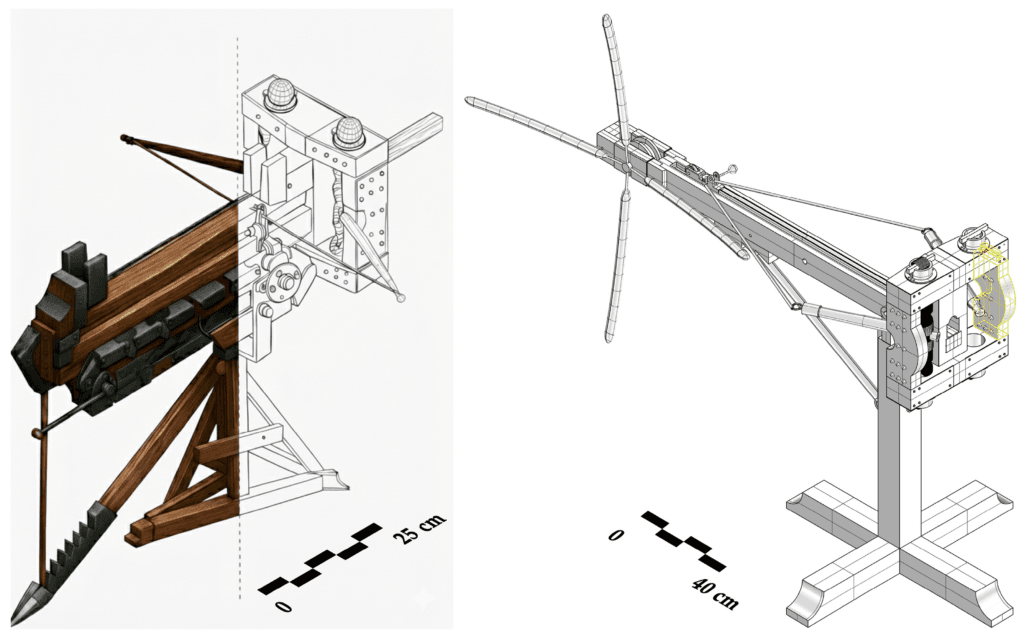
Clusters of small, square-shaped impact scars carved into the northern fortified walls of Pompeii have become the center of a striking new archaeological argument: that a mechanically reloaded, dart-firing weapon known as the polybolos was used against the city more than 2,000 years ago.
A team of archaeologists and engineers published findings this week using high-resolution 3-D scanning and morphometric analysis to distinguish the marks from those left by conventional ballistae or stone-throwing catapults. Their conclusion points to the polybolos, a torsion-driven, chain- or mechanism-fed artillery device that ancient sources describe as capable of firing bolts in rapid succession without manual reloading between shots.
The geometry of the scars drove the team's interpretation. Rather than the broad, circular craters associated with heavy stone projectiles, the Pompeii marks appear in fan-shaped, narrowly concentrated clusters consistent with multiple metal-tipped darts arriving in quick sequence from a fixed point of aim. The researchers mapped these dispersion patterns digitally and compared them against engineering reconstructions of firing sequences that a repeating mechanism would produce.
Their theoretical anchor came from Philo of Byzantium's Belopoeica, one of antiquity's most detailed technical treatises on artillery. Philo's description of the polybolos, long treated by scholars as an intriguing but unverifiable account of Hellenistic mechanical ingenuity, provided the team with a reference framework for what the weapon's output should look like on a stone surface.
No physical polybolos machine has been recovered at Pompeii. The researchers acknowledge that their argument rests entirely on pattern-matching between the observed scars, their geometric and statistical signatures, and the reconstructed physics of a repeating mechanism. That caveat has drawn measured skepticism from other specialists. Impact marks on ancient masonry can result from weathering, subsequent construction damage, or atypical projectiles fired by standard ballista configurations, and critics argue those alternative explanations must be more rigorously excluded before the polybolos interpretation can be considered settled.
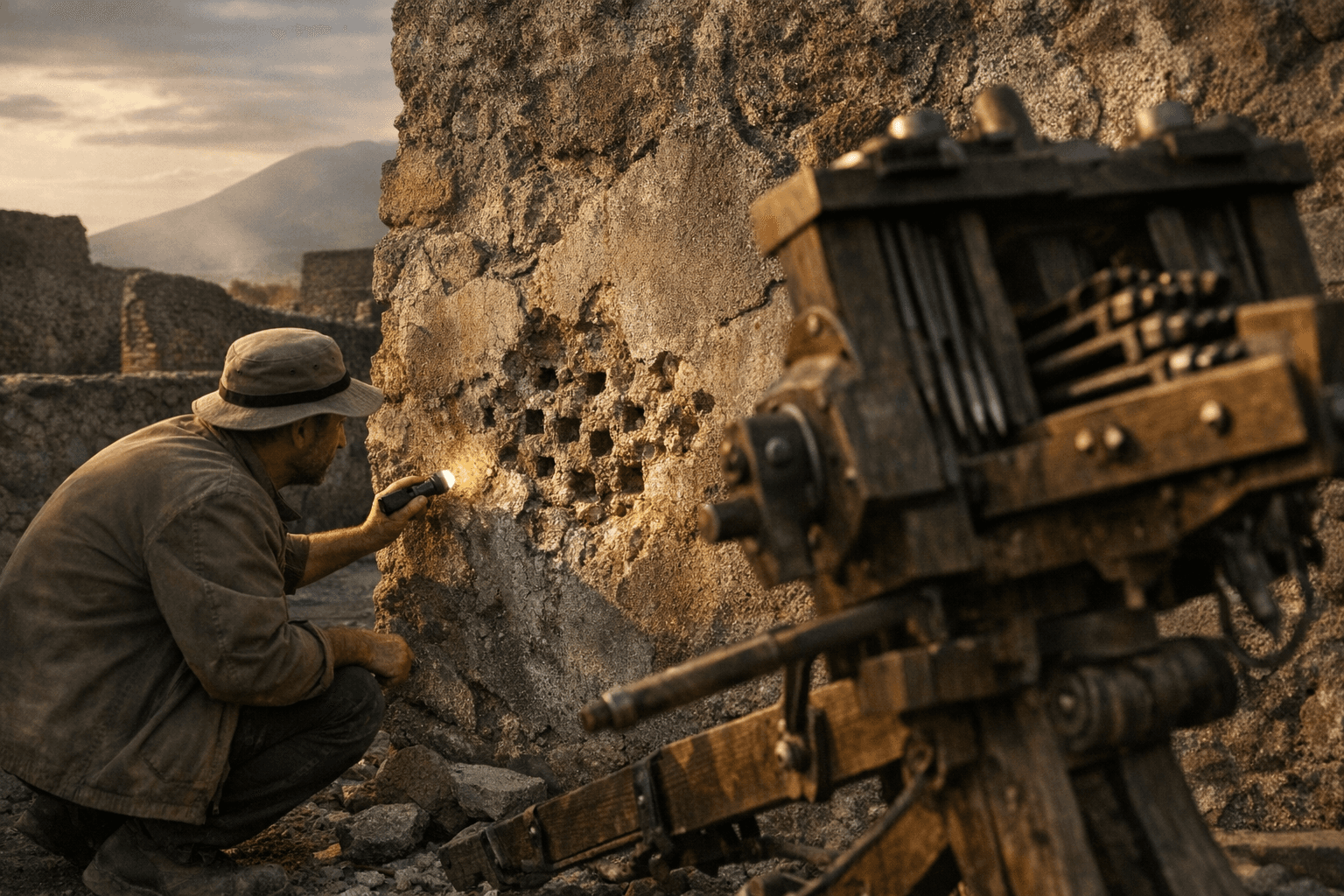
The stakes of getting it right are considerable. If the pattern holds under further scrutiny, it would represent the first direct archaeological evidence that the polybolos moved beyond the drawing boards and technical manuals of Hellenistic engineers and into active use during military operations in the Roman world. That would require historians to revise prevailing assumptions about the sophistication of siege technology in this period, particularly the engineering tradition centered on Rhodes that produced many of antiquity's most ambitious mechanical designs.
The study also demonstrates what modern analytical tools can extract from sites that have been studied for centuries. Pompeii's walls have been examined by generations of archaeologists; 3-D scanning and computational morphometrics are now surfacing patterns that visual inspection alone could not resolve.
Peer review and independent replication will determine whether the polybolos interpretation survives contact with the broader scholarly community. The debate is already likely to generate targeted excavation campaigns, experimental reconstructions of working polybolos mechanisms, and more precise modeling of projectile dispersion. Each of those efforts could either sharpen the case or reveal that the marks at Pompeii have a more mundane explanation. Either outcome would advance the science of how ancient sieges were actually fought.
This article was produced by Prism’s automated news system from verified source data, official records, and press releases, then run through automated quality and moderation checks before publishing. The system is built and supervised by the people who set the standards it runs under. Read our full AI policy.
Did this article answer your question?


