Pope Leo XIV and Trump clash, echoing centuries of papal confrontations
Pope Leo XIV’s refusal to spar with Trump is reviving an old papal script: moral authority confronting power, with American Catholics caught in the middle.
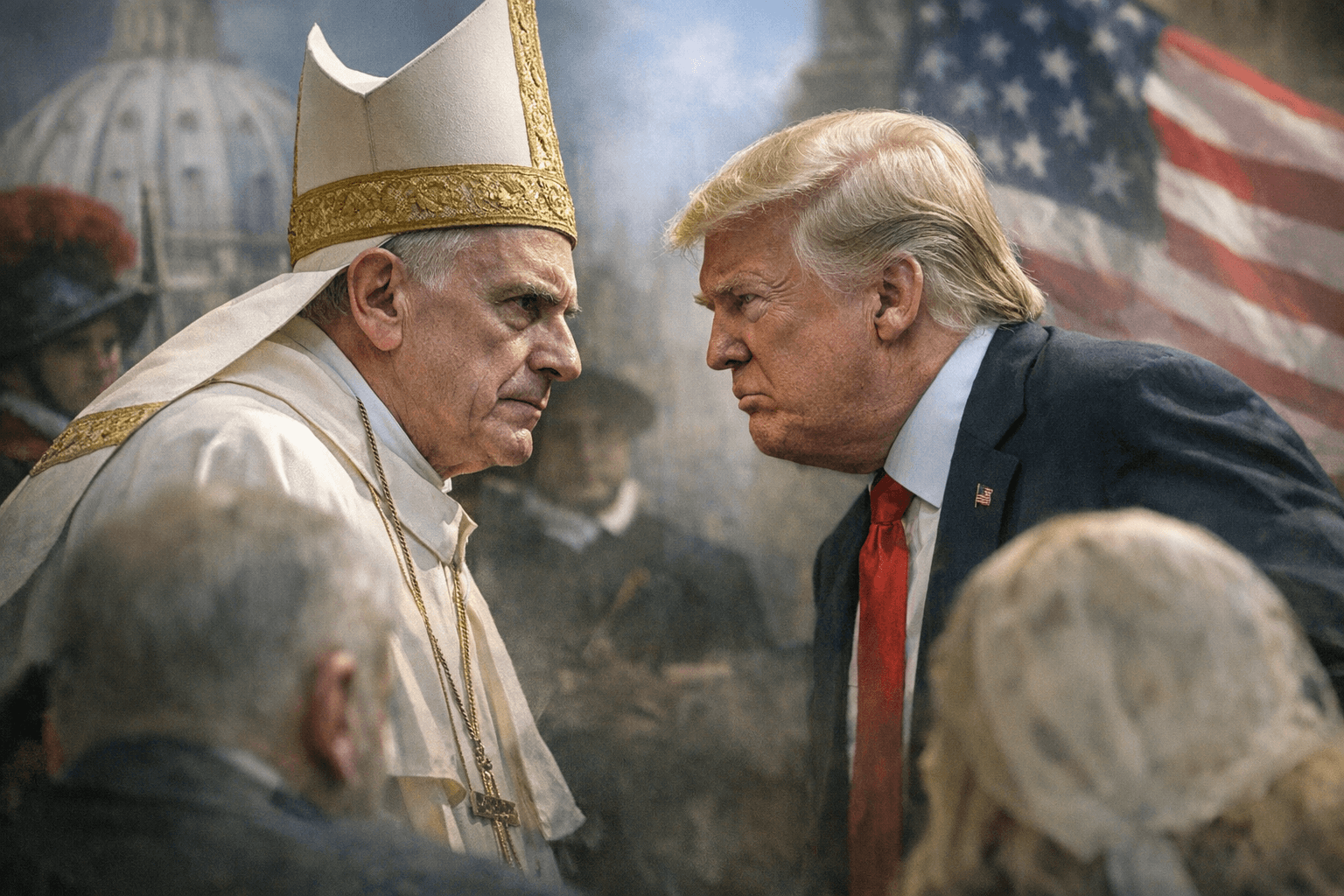
A clash that is bigger than a personal feud
Pope Leo XIV is answering Donald J. Trump the way the Vatican often answers raw political force: by refusing the bait and returning to peace. That posture has turned a sharp personal exchange into something larger, because Leo is not just another critic of a president. He is the first American pope, and his clash with Trump lands inside American Catholic life, where parishioners, pastors, and voters are already split.
The immediate argument has been unusually public. The U.S. Conference of Catholic Bishops said Archbishop Paul S. Coakley was “disheartened” by Trump’s disparaging words about the Holy Father, and stressed that the pope is “not his rival” and “is the Vicar of Christ.” Leo, meanwhile, said aboard the papal flight to Algeria that debating Trump was “not in my interest at all” and that he would keep preaching peace. The Vatican reinforced that message throughout his apostolic journey to Algeria, Cameroon, Angola, and Equatorial Guinea, where his remarks were framed around peace rather than escalation.
Why the old papal playbook still matters
This clash feels modern because it is being fought through social media, press briefings, and television coverage, but the structure is ancient. Popes have long collided with powerful rulers when they claim a moral authority higher than state power. In that sense, the Trump-Leo dispute belongs to the same story line as earlier papal confrontations with kings, emperors, and commanders who wanted the church to stay in its lane.
Pope Leo I is the most famous touchstone. He is traditionally remembered for meeting Attila the Hun in 452, after Attila had advanced into Italy and threatened Rome. He is also linked to persuading the Vandal king Genseric not to massacre Rome’s inhabitants during the sack of 455. The memory of that confrontation still lives in Rome, including a marble relief, *Meeting of Attila and Pope Leo*, by Alessandro Algardi, which dates to 1646 to 1653 and hangs in St. Peter’s Basilica. The message is not subtle: papal authority has often been imagined as a restraint on violence, not a partner to it.
That historical pattern is why the present feud resonates beyond personality politics. The Vatican’s own framing, that “the future belongs to men and women of peace,” places Leo XIV in a long line of pontiffs who have tried to translate spiritual authority into a warning against coercion. The language is moral, but its implications are political, because it challenges the idea that national strength alone defines legitimacy.
What is genuinely new in the Leo XIV era
The modern dispute is not a replay of ancient Rome. It is happening in an era of mass media, party polarization, and a global Catholic Church that is also deeply American in its reach. Leo XIV’s nationality changes the optics in a way previous popes never had to manage. When an American pope presses back against an American president, the argument is not just Vatican versus Washington. It becomes a fight over who speaks for American Catholics and what kind of Catholic public life they want.
That is why the feud has landed so sharply in churches. The New York Times reported on April 19, 2026, that pastors and parishioners at Catholic churches connected to both Leo and the Trump administration were speaking out about the dispute. ABC News reported that some Catholic Trump supporters were unhappy with Trump’s attacks on the first American pope, and political observers suggested the clash could cost Republicans support among Catholic Americans. That matters because Catholic voters have recently been important to Republican gains, making this more than a symbolic spat.
The current conflict is also different because it is being mediated through a pope who is deliberately refusing to escalate. Leo XIV has kept returning the argument to peace, even as Trump’s rhetoric has drawn stronger reactions from church leaders. That restraint gives the Vatican room to claim the higher ground, but it also exposes how much contemporary political conflict depends on spectacle. In earlier centuries, a pope could confront a ruler in person. Now he confronts an ecosystem of clips, posts, and instant partisan reactions.
Catholics are feeling the split in real time
The feud is not unfolding only in Washington or Rome. It is being felt in parishes, where Catholics who admire Leo’s emphasis on peace are sitting beside Catholics who see Trump as their political champion. That divide gives the conflict a social edge, because churches are often one of the last places where people with opposite political loyalties still share the same pews.
That tension also helps explain why the bishops’ response was so direct. Coakley’s statement did more than defend the pope’s dignity. It reminded Catholics that the office itself carries a spiritual claim that cannot be reduced to campaign politics. Calling Leo the Vicar of Christ was a way of saying that the pope’s authority is not up for partisan negotiation, even when American elections tempt politicians to treat religion as another pressure point.
There is also a broader public-health and community dimension to that stance. When leaders speak repeatedly about peace, they are speaking to the conditions that shape family life, migration, trauma, and the stability of communities already strained by division. Leo XIV’s insistence on peace, especially during his trip through Algeria, Cameroon, Angola, and Equatorial Guinea, places human dignity ahead of political theater. That is why the dispute feels so charged: it is not simply about words, but about what kind of social order those words invite.
The enduring lesson of papal conflict
From Attila to Genseric to Trump, the recurring pattern is the same: when the Vatican asserts moral authority, powerful rulers often hear a threat. The details change, from invading armies to social media attacks, but the underlying question does not. Who gets to define legitimacy when politics turns hard-edged and nationalist?
What is new now is not the idea of papal confrontation. It is the setting. A pope from the United States is speaking in a global moral register at a moment when American Catholic voters are politically consequential, internal church divisions are visible, and public life rewards outrage over restraint. Leo XIV’s decision not to fight Trump on Trump’s terms makes the clash look less like a personality contest and more like a test of whether peace can still command authority in a polarized age.
This article was produced by Prism’s automated news system from verified source data, official records, and press releases, then run through automated quality and moderation checks before publishing. The system is built and supervised by the people who set the standards it runs under. Read our full AI policy.
Did this article answer your question?

