Pope Leo XIV in Equatorial Guinea denounces inequality, urges social solidarity
In Malabo, Pope Leo XIV tied Equatorial Guinea’s oil wealth to poverty, urging leaders to reject exclusion and put the common good ahead of power and profit.
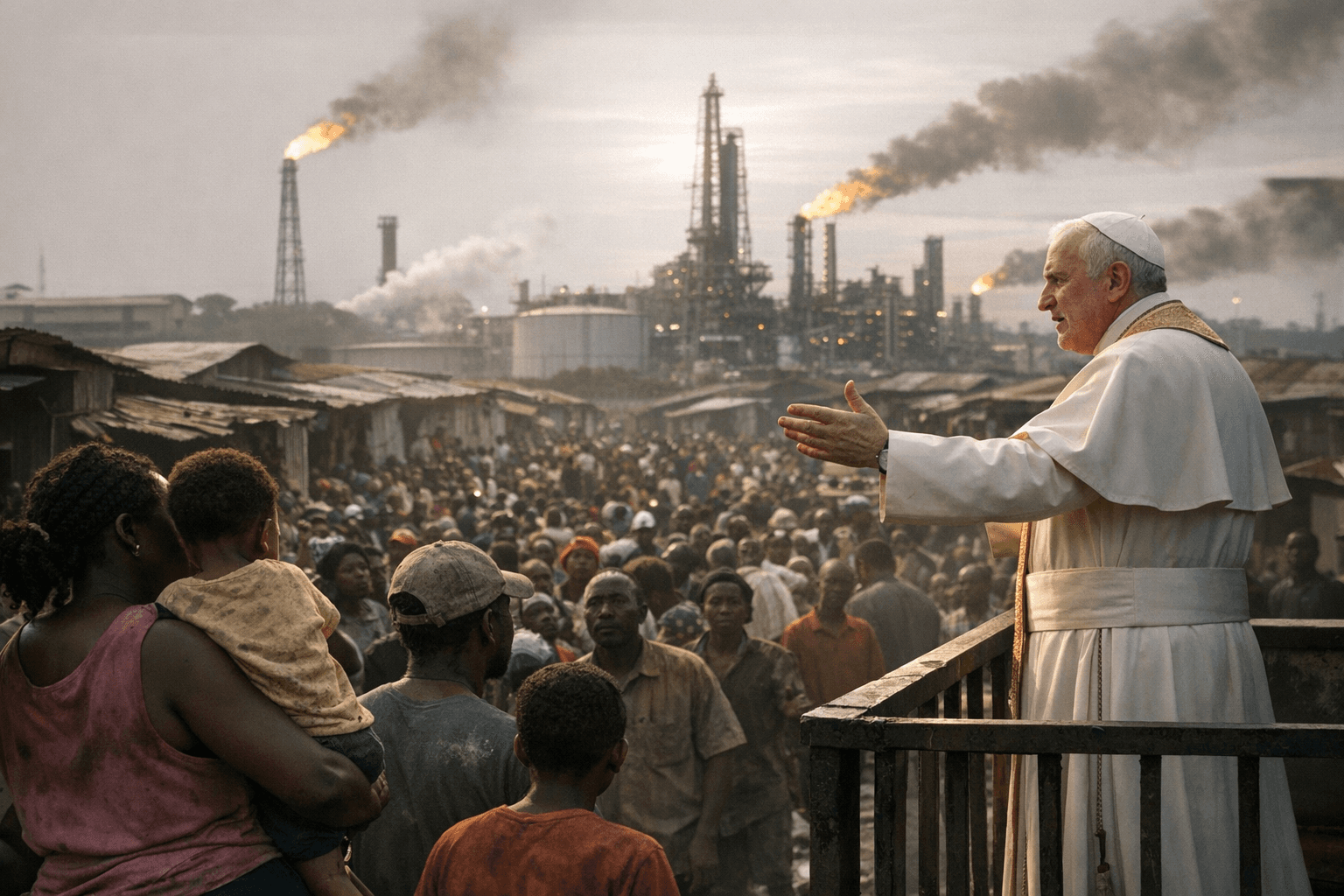
Pope Leo XIV used his final stop in Equatorial Guinea to press one of the sharpest themes of his Africa tour: a church that speaks credibly about human dignity must confront inequality, not soften it. Speaking in Malabo before authorities, civil society figures and diplomats, he urged the country to reject exclusion and orient development toward the common good rather than power and profit.
The message landed in a country where oil wealth has long coexisted with poverty and political concentration of power. Leo’s four-nation journey through Algeria, Cameroon, Angola and Equatorial Guinea stretched across 10 days, and this was the first papal visit to Equatorial Guinea since John Paul II traveled there in 1982. The pope’s remarks made clear that he was treating the gap between riches and hardship as a public problem, not a private shortcoming of the poor.
That emphasis was reinforced by the broader economic record. The World Bank says declining oil revenues, combined with years of weak diversification, have driven a prolonged recession in Equatorial Guinea, reversed economic gains and jeopardized social progress. Its 2025 Country Economic Memorandum says the country needs stronger institutions, better fiscal management, greater human capital and a sound business environment if growth is to become more inclusive.
Leo’s stop also carried a political edge. Recent reporting said he visited prisoners and addressed prison conditions during the Equatorial Guinea leg, adding another layer to a trip that was already sensitive in one of Africa’s most tightly controlled states. He also condemned the “colonization” of Africa’s mineral resources, casting the continent’s extractive wealth as a test of whether governments serve broad public needs or narrow elites.
That frame matters in Equatorial Guinea, where the state’s legitimacy is closely tied to its ability to manage patronage, control dissent and distribute the gains from petroleum. Leo’s language suggested that the Church sees the issue as structural, not symbolic: if wealth is concentrated and institutions remain weak, social solidarity becomes harder to sustain and claims about human dignity ring hollow.
The trip had already taken on added geopolitical resonance after President Donald Trump criticized Leo over the pope’s anti-war stance on the Iran conflict. By the time Leo reached Malabo, the trip’s closing note was unmistakable: peace requires justice, justice requires limits on power, and natural wealth only strengthens a country when it reaches beyond a small circle at the top.
This article was produced by Prism’s automated news system from verified source data, official records, and press releases, then run through automated quality and moderation checks before publishing. The system is built and supervised by the people who set the standards it runs under. Read our full AI policy.
Did this article answer your question?