Pope Leo XIV Rebukes War Leaders at Palm Sunday Mass, Rejecting Divine Justification
Pope Leo XIV invoked Isaiah's 'hands full of blood' at Palm Sunday Mass, confronting U.S. officials who used Christian language to justify the Iran war.
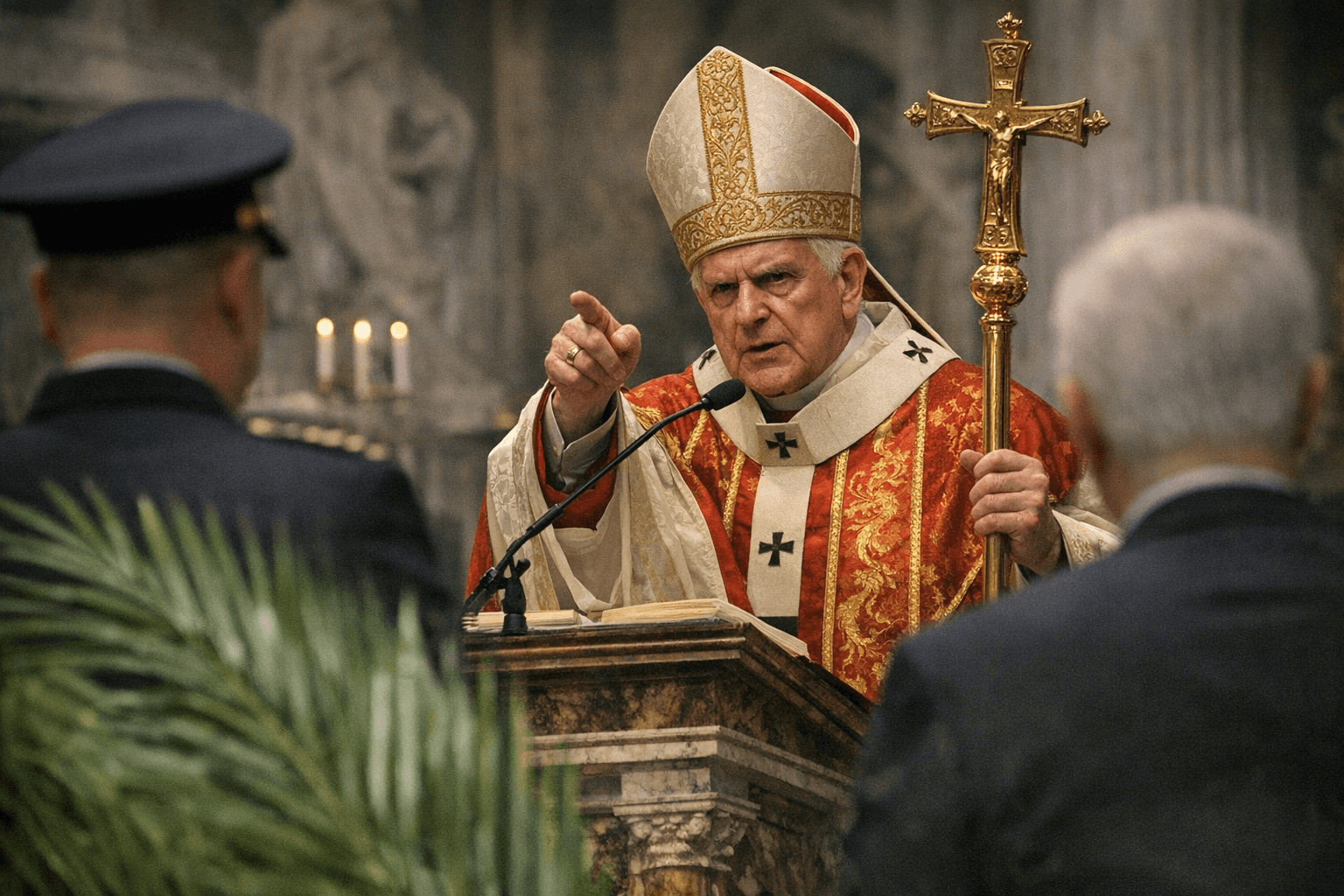
Three days before Palm Sunday, Defense Secretary Pete Hegseth stood at a Pentagon prayer service and asked God to sanction "overwhelming violence" against enemies who deserved "no mercy," carrying a Bible stamped with "Deus Vult," the medieval Crusader battle cry. On Sunday morning, in St. Peter's Square, Pope Leo XIV answered.
Addressing tens of thousands of worshippers as the U.S.-Israeli war on Iran entered its second month, the Chicago-born pontiff declared that God does not answer the prayers of those who wage war. "Brothers and sisters, this is our God: Jesus, King of Peace, who rejects war, whom no one can use to justify war," Leo said. "He does not listen to the prayers of those who wage war, but rejects them."
To make the rebuke unmistakable, Leo invoked the prophet Isaiah directly: "Even though you make many prayers, I will not listen: your hands are full of blood."
Though Leo named no individual in his homily, the application to Washington was widely interpreted as direct. U.S. officials have repeatedly invoked Christian faith to frame the Iran campaign as a divine mandate. After the joint U.S.-Israeli strikes launched on February 28, multiple military commanders reportedly told troops the operation was "God's divine plan." The Military Religious Freedom Foundation reported receiving more than 200 calls from active-duty service members across 50 military installations in the aftermath of the initial attack.
Leo also addressed the humanitarian toll of Holy Week itself. Jerusalem police on Sunday prevented the Catholic Church's top leadership from entering the Church of the Holy Sepulchre, the site where Christians believe Jesus was crucified. The Latin Patriarchate described it as the first time in centuries church leaders had been blocked from celebrating Palm Sunday there. In a special blessing at the end of Mass, Leo prayed for Christians in the Middle East "suffering the consequences of an atrocious conflict. In many cases, they cannot live fully the rites of these holy days."
Sunday's homily was the sharpest salvo yet in what has become a sustained, public confrontation between the Holy See and the Trump administration. Leo had already called for a ceasefire at least five separate times since the strikes began. When asked about ceasefire prospects, Trump said the White House was "not looking to do that."
The Vatican's top diplomat sharpened the theological stakes further. Cardinal Pietro Parolin, the Holy See's Secretary of State, was asked directly at an academic conference at the Vatican Apostolic Library whether the Iran campaign satisfies the conditions of Catholic just war doctrine. "No," he said, "it does not seem to meet the conditions."
The statement marked a formal moral judgment from the highest-ranking Vatican official below the pope himself, arriving as American Catholics, who represent one of the largest and most electorally contested religious blocs in the United States, absorb a sustained conflict between their church's leadership and their government. This is Pope Leo XIV's first Holy Week as pontiff. What began as a call for dialogue on March 1 has hardened, homily by homily, into an explicit theological challenge to the war's Christian framing.
This article was produced by Prism’s automated news system from verified source data, official records, and press releases, then run through automated quality and moderation checks before publishing. The system is built and supervised by the people who set the standards it runs under. Read our full AI policy.
Did this article answer your question?

