Practical Guide Maps Five Supplier Types for Sourcing Amethyst Components
Prism News frames a practical map of five supplier types for amethyst components—know the exact bead sizes, mine sources, and which sellers openly disclose natural versus synthetic stones.

Prism News set the frame: makers and small jewelers need a practical map to source February’s signature stone, amethyst. The guide maps five supplier types and points to established component houses such as Fire Mountain Gems & Beads; from there, a pragmatic sourcing strategy divides into clear vendor roles, component forms, and provenance questions you should ask before you buy.
Maker-focused component houses (example: Fire Mountain Gems and Beads) Fire Mountain is the archetype of a long-standing component house: the site carries category-level stock for February birthstones — “Faceted Stones,” “Crystals,” and “Pendants” — and markets directly to makers with copy like “Beading Soothes the Soul.” The company profile includes the claim “Friendly service since 1973” and a concrete business address: “Fire Mountain Gems and Beads, Inc. - One Fire Mountain Way, Grants Pass, OR USA 97526-2373.” That longevity suggests broad catalog depth and SKU continuity, but also comes with supplier-level disclosures: a Proposition 65–style warning reads, “This product can expose you to chemicals including Toluene, which is known to the State of California to cause birth defects or other reproductive harm. For more information go to p65warnings.ca.gov.xn--ivg Practical takeaway: these houses are convenient for a wide range of finished components (pendants, faceted centers) and for experienced makers — Fire Mountain explicitly states “Products sold by Fire Mountain Gems and Beads® are intended for experienced jewelry-makers and designer-artists; children 14 years of age or younger should use these products with adult direction.”
Online bead specialists (example: Tejas Beads) For granular bead-level sourcing, Tejas Beads’s site lists the exact sizes and shapes makers want: rondelles 2x4mm, faceted rounds in 6mm, 8mm and 10mm, microfaceted rondelles at 4mm and 4.5mm, freeform nuggets in 8mm and 10mm, and graduated sticks from 12mm to 20mm. Their marketing promises: “Tejas Beads is your trusted source for natural gemstone beads, pearls, and jewelry-making supplies. Expect great customer service, top quality stones, and prompt shipping from our USA based shop.” Use these retailers when you need repeatable bead counts, matched colors for bracelets, or clearance SKUs such as “Chevron Amethyst · Smooth · Round · 6mm, 8mm, 10mm \CLEARANCE\.” Practical takeaway: treat bead specialists as inventory-focused partners — verify origin details for each SKU (natural versus treated or synthetic) even if the site lists the stone name.
Mine-direct, lapidary, and origin-focused suppliers Sourcing rough or single-origin crystals shifts the conversation from SKU sizes to geology and provenance. The Gemological Institute of America lays out where amethyst comes from and why it matters: Russia dominated until the 19th century, then Brazil (notably Rio Grande do Sul) surged into global supply; today, Africa and South America — especially Zambia’s Kariba mine and Bolivia’s Anahí mine — are important producers. GIA’s field notes describe Brazil’s rough as often lighter in color and forming in giant crystal-lined geodes, whereas Kariba in Zambia produces “superb quality with richly saturated colors,” and Bolivia’s Anahí displays large amethyst and ametrine crystals. The U.S. Four Peaks mine, “just 46 miles (74 km) outside of Phoenix, Arizona,” yields “very fine dark purple and purplish red amethyst crystals,” though working conditions there are remote and rugged. Practical takeaway: for color-intense center stones, ask sellers about mine origin — “Zambia, Kariba” or “Four Peaks” are meaningful provenance markers that typically affect both aesthetic and price.
Wholesale rough suppliers, estate sources, and auction channels If your project calls for historic material or unusually large crystals, auction and estate channels can be fertile. Gemrockauctions reminds us that amethyst was part of European jewel history for centuries; jewelers sold birthstone jewelry from the 1500s, and Tiffany’s 1870 “Gregorian Birthstone Poems” helped formalize the modern list. The piece reproduces the old poem exactly: “The February-born shall find / Sincerity and peace of mind, / Freedom from passion and from care, / If they an amethyst will wear.” Museum and royal examples — an amethyst intaglio dated about 360 AD held at the British Museum, Luxembourg’s Nassau Amethysts, the Duchess of Cornwall’s heart-shaped amethyst and pearl necklace originally gifted in 1923, Norway’s amethyst parure and the Flora Danica tiara — underline amethyst’s cultural cachet and explain why estate material appears at auction. Practical takeaway: auctions supply provenance-rich stones, but require careful due diligence on restorations, mounts, and any treatments.
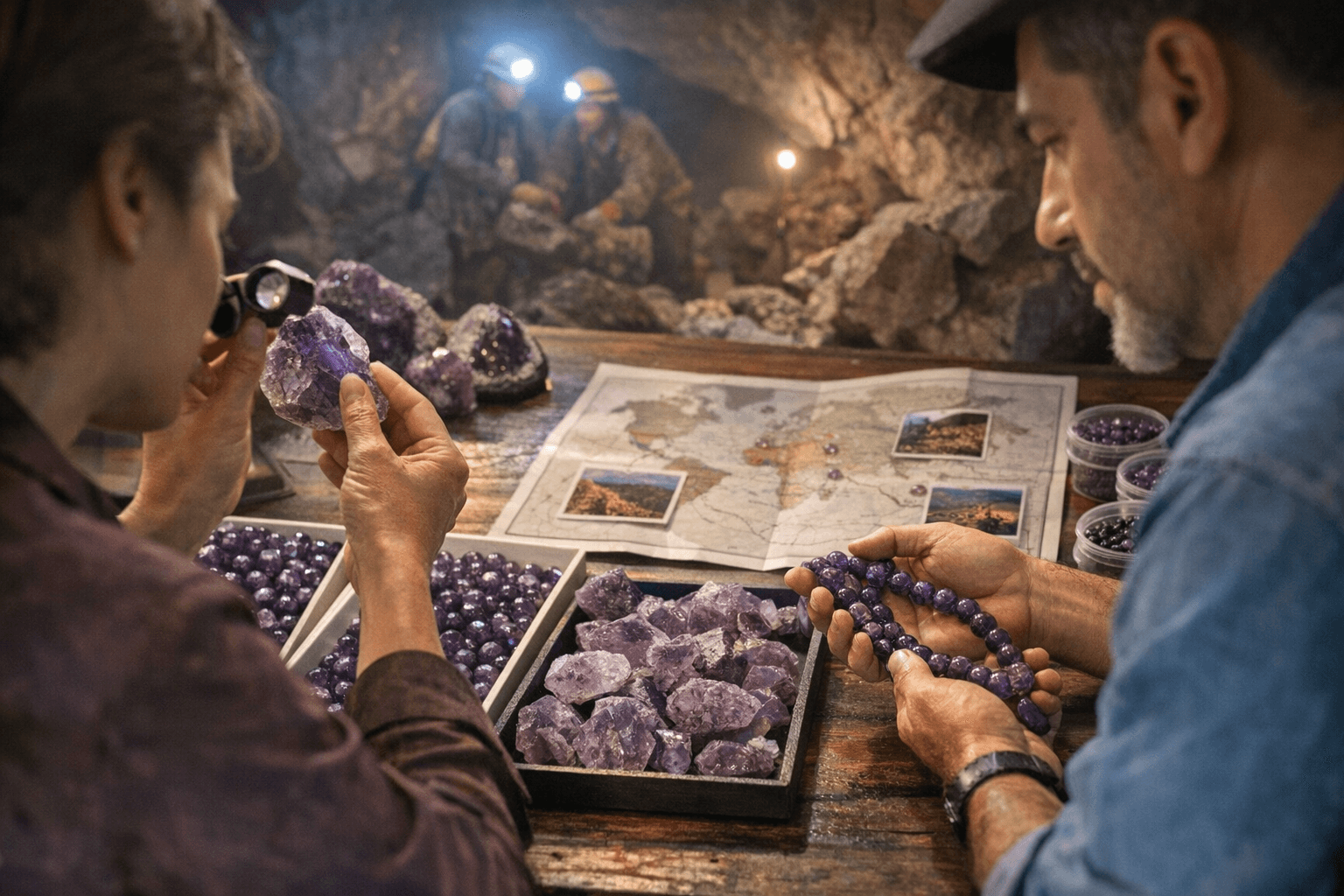
Lab-created, synthetic, and treated amethyst: disclosure and testing Synthetic amethyst isn’t new. As GIA explains, “As you shop for the February birthstone, you’ll also encounter lab-created amethyst. Having the same chemical and physical properties as its natural counterpart, synthetic amethyst has been known since the 1970s. In some cases, it is very difficult to distinguish natural from synthetic amethyst without access to advanced gemological testing. The GIA Laboratory can tell the difference, but many in the jewelry industry do not request testing because of the cost and time required to determine the origin of what is a comparatively inexpensive gem. Still, merchants are required to tell you if a gem is natural or synthetic.” Practical takeaway: if origin matters to you, insist on explicit disclosure and, for higher-value pieces, a lab report. For lower-cost bead strands, demand a written declaration of natural versus synthetic and be prepared that independent testing will add cost and lead time.
- small accent rondelles 2x4mm and microfaceted rondelles 4–4.5mm for delicate bracelets and chain work;
- faceted rounds 6mm–10mm for classical settings and cluster pieces;
- freeform nuggets 8–10mm and graduated sticks 12–20mm for bohemian necklaces and convertible designs;
- chevron and lavender amethyst variants for tonal range.
What to buy for what purpose: component forms and sizes to keep on hand
Makers designing February collections should stock a core set of amethyst components. From Tejas’s inventory lines and Fire Mountain’s category shelving, the essentials are:
Practical takeaway: match form to design intention — faceted rounds read formal, freeform nuggets read artisanal — and record SKU/lot numbers for color consistency across production runs.
Due diligence, safety and the conversation you should have with suppliers Ask every seller three concrete questions: (1) Is this natural, treated, or synthetic? (2) Where was the rough mined (country, or specific mine if known)? (3) Can you document any required safety warnings or material-content hazards? Use Fire Mountain’s example of transparent site copy and warnings — including the Toluene notice — as the standard of care you should expect. When a supplier leans heavily on marketing phrases like “trusted source” or “top quality stones,” treat that as a claim to verify; ask for references, sample photos, and, for high-value items, lab testing.
Conclusion A meaningful amethyst purchase starts with knowing which supplier type suits your need: the component house for catalog breadth, the bead specialist for repeatable sizes, mine-direct sellers for provenance, auction houses for history-laden pieces, and lab-grown dealers when budget and uniformity matter. Keep the GIA’s testing reality and disclosure requirement in mind, track SKU and lot information from retailers such as Tejas Beads, and expect clear safety and product notices like those found on Fire Mountain’s site. Sourcing amethyst well is not just about color; it’s about provenance, disclosure, and the concrete details — sizes, mine names, and written assertions — that let you build beauty without compromise.
Know something we missed? Have a correction or additional information?
Submit a Tip